Cáo Studio · คู่มือถ่ายรูปที่เวียดนาม · Proposal & Anniversary Photoshoot Vietnam — Hanoi, Saigon, Hoi An
Proposal at Japanese Covered Bridge Hoi An — Photoshoot Guide 2026
ทีม Cáo Studio · ฮานอย · 2026-10-03
A proposal at the Japanese Covered Bridge is a decision: you're asking the person you love in front of Hoi An's single most photographed structure. The bridge itself is small, red, arched, and packed by mid-morning. Light, timing, and a director who knows the space make the difference between a blurry phone snapshot and frames you both return to.
Why the Japanese Covered Bridge Works for Proposals
The bridge's architecture does half the work: red lacquer, wooden beams, a narrow curve over the water, and lanterns that hang unlit by day. It's intimate — you can't fit more than six people on the span — which means no crowd photobombs and no room for posed stiffness. The water reflects light. The red paintwork anchors color. An ao dai's silk drapes naturally against the bridge's angle. The bridge is also the first thing tourists photograph in Hoi An; your proposal happens in the frame people recognize, which means the moment feels both personal and symbolically set. Cáo Studio chooses the Japanese Bridge for proposals because it requires no styling tricks — the landmark is the frame, and the two of you fill it.
What Time of Day Catches the Right Light?
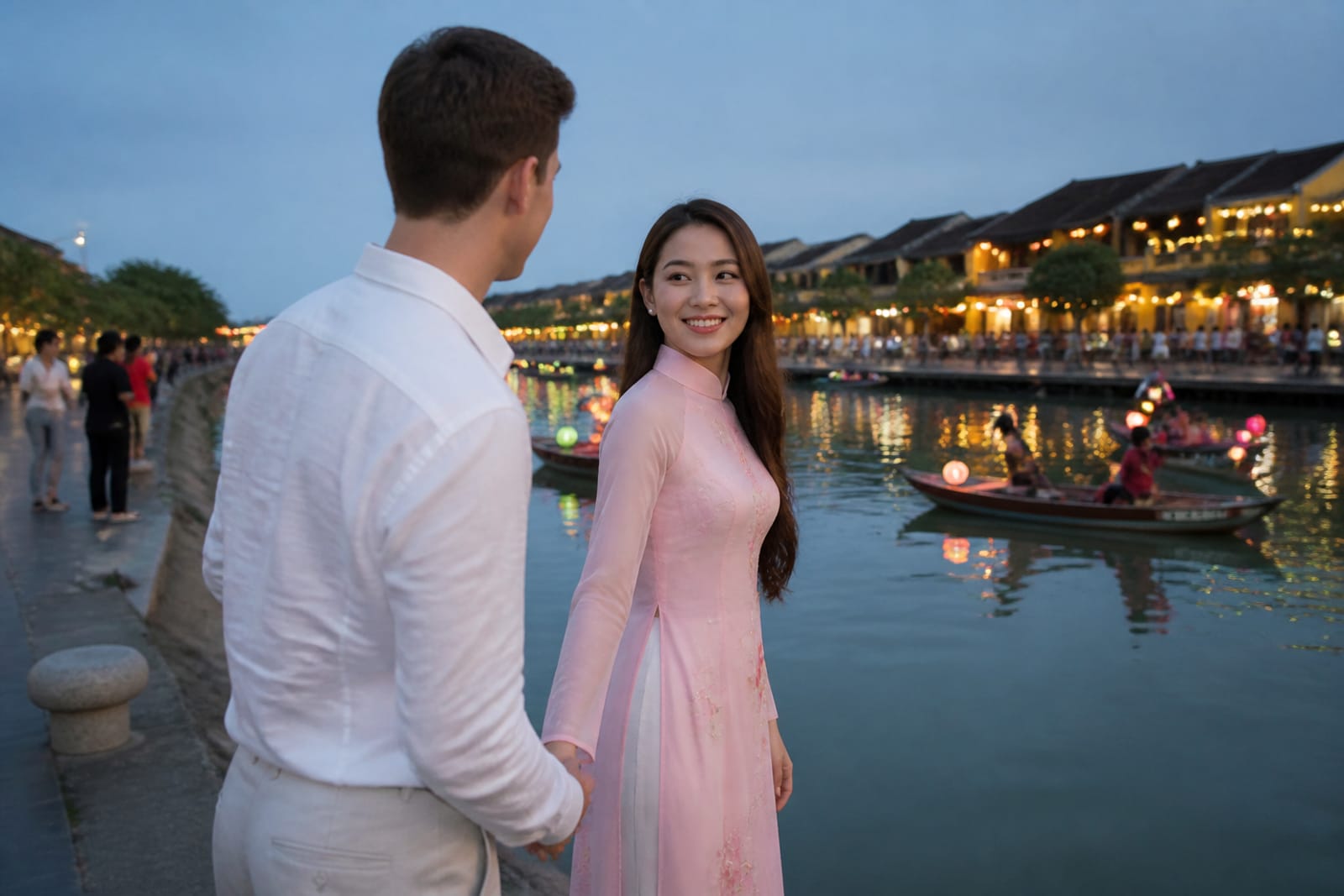
Sunrise is the only window. Between 5:30 and 6:30 am (winter) or 5:00 and 5:45 am (summer), the sun rises east across the Thu Bon River; the bridge's west-facing side catches a soft, angled light that models the red paint and the curve without flattening it. By 7:00 am, tourists start arriving. By 9:00 am, the light is overhead and harsh. By noon, you're shooting in shadows or blown whites. Sunset (around 6:00–6:45 pm in winter, 6:30–7:15 pm in summer) is the second option: the bridge is lit from the west, which silhouettes it and turns the lanterns golden — but the Ancient Town remains crowded until after 7:00 pm, and you'll share the bridge with other visitors. Most proposals happen at dawn. Cáo Studio's director arrives 90 minutes early, positions you in the light, and shoots before the first tour groups.
📸 Book on WhatsApp — proposal & anniversary package
How Do Permits and Crowds Affect the Session?
Entry tickets are required to enter the Ancient Town; the ticket booth opens around 7:00–7:30 am. Arrive at the gate 15 minutes before it opens, then walk the 10 minutes from the entrance to the bridge. During the walk, the town is nearly empty — lanterns are unlit, shops are closed, and you're alone on narrow lanes. This walk itself is a photo moment: Cáo Studio captures it. Once on the bridge, you have perhaps 20–30 minutes of usable light and minimal foot traffic before the first groups arrive. The bridge is managed by the Hoi An Heritage Site; no special filming permits are required for personal photoshoots, but respect the 5-person maximum per group on the bridge (a wedding party of 10, for example, would need two time slots). Ask the Cáo Studio team on WhatsApp whether they've scouted the bridge recently — seasonal flooding (Oct–Nov) can close access entirely, and crowd patterns shift with Vietnamese holidays and international travel seasons.
| Proposal Timing Option | Best For | Light Quality | Crowd Level | Outfit Considerations |
|---|---|---|---|---|
| Sunrise (5:00–6:00 am) | First proposals, couples prioritizing light and solitude | Soft, directional, models the red bridge | Minimal; staff only | Ao dai photo-ready; makeup applied at your hotel, no touch-ups needed |
| Early morning (6:30–7:30 am) | Those who want slightly easier logistics | Still soft but heading toward neutral | Very light; first few tourists | Ao dai remains elegant; makeup may need one 5-minute check before walking to the bridge |
| Sunset (6:00–7:15 pm) | Couples happy to share the bridge, prefer golden hour silhouettes | Warm backlight, lanterns glow | Moderate to busy; tour groups frequent | Ao dai dramatic in silhouette; makeup must withstand 8+ hours; hair must hold after a full day |
The table compares proposals by the single biggest variable: light and crowds. Sunrise is the choice for control and romance. Sunset trades solitude for warmth and lantern ambiance — and asks more of your outfit and makeup.
What Outfit Choices Fit the Bridge's Scale?
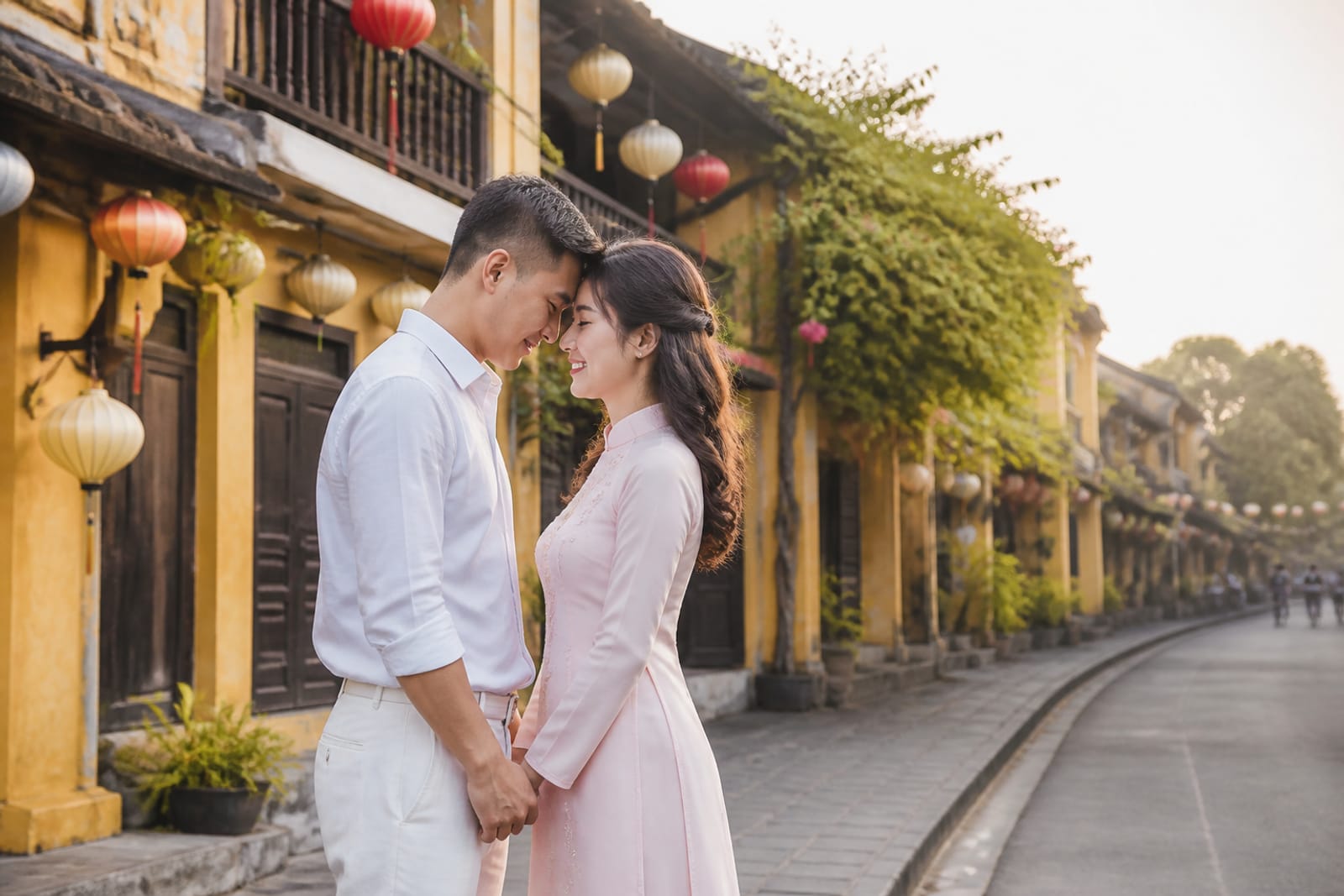
An ao dai is non-negotiable: it's the only garment that frames the bridge's architecture without overwhelming it or getting lost in the shadows. A red ao dai echoes the bridge's color and risks visual confusion; jewel tones (emerald, navy, burgundy) and pastels (blush, cream, soft blue) read clearly against the red and photograph in a wider range of light. White or ivory ao dai is classic — it glows in soft sunrise light and reads clearly at any hour. A traditional floor-length ao dai (not a short, modern cut) respects the bridge's formality and photographs with more movement and grace. Cáo Studio's team brings three outfit options; you choose on location based on the morning light and how you feel. An ao dai rental is included in the proposal package, or wear your own — confirm on WhatsApp. Shoes: flat sandals or embroidered slippers (traditional) are practical on the bridge's narrow curve; heels are risky. Hair: styled up (a bun, a braided crown) or loosely waved — avoid hair covering your face, which kills the proposal moment. Makeup: applied at your hotel by Cáo Studio's makeup artist (part of the session), waterproof mascara and long-wear lipstick, no heavy contouring that competes with the bridge.
Which Season Shoots Best at the Japanese Bridge?
February to April is ideal: the temperature is mild (18–25°C), the sky is often clear, and the rice fields around Hoi An are vivid green. December to mid-January is cool and often drizzly — soft light but unpredictable. May to August is dry but fiercely hot (often 35°C+); sunrise light is still golden, but you'll sweat through makeup and the heat is exhausting. September to December is the rainy and typhoon season; October and November are the worst (frequent flooding closes the Ancient Town entirely). Book February to April if possible. If you're visiting in summer or autumn, confirm with Cáo Studio on WhatsApp whether the bridge is accessible — flooding closes it without notice, and rebooking is possible but requires flexibility.
How Does Cáo Studio Direct a Proposal Differently?
A proposal is not a wedding day; it's a single, unrepeatable moment. Cáo Studio doesn't pose you in front of the bridge like tourists. Instead, the director scouts the bridge the evening before, identifies where the light will fall, and plans the sequence: you two approach from opposite ends, meet at the center, pause, embrace, walk toward the camera or away. The photographer shoots wide first (the bridge, the water, you both), then medium (your faces, the moment), then detail (the ring, your hands, the lanterns). The makeup artist and stylist stay nearby but out of frame. A short vertical video captures the audio — your words, her response, the river. Edited photos and the video are ready in 48 hours. This is not a 4-hour formal session; it's a 90-minute dawn outing designed around one moment. Cáo Studio's calendar fills quickly for February–April proposals; ask on WhatsApp at least 4–6 weeks ahead.
What to Check Before You Book
Dates and availability. Confirm the bridge is accessible (flooding closes it Sep–Nov). Ask when Cáo Studio last scouted it and whether any recent changes affect light or access.
Outfit. Do you rent an ao dai through Cáo Studio, or bring your own? If renting, confirm the color and fit are available for your chosen date. Ao dai rental details.
Makeup and hair. Confirm your hotel location; Cáo Studio's makeup artist travels to you. Discuss makeup style (natural, bold, waterproof) and hair (up, down, accessory) so there are no surprises at 5:30 am.
Delivery. Ask exactly how many edited photos, the format (digital files, print-ready, social-media ready), how many raw files you receive, and when you get the vertical video. Confirm whether edits include the ring detail and the embrace.
Cost factors. The session price depends on season (Feb–Apr costs more), travel time (if Hoi An is far from your hotel, Cáo Studio may add a travel fee), and outfit choices (three rental ao dai or your own). There is no hidden fee. Ask on WhatsApp for a quote tailored to your exact date and choices.
Backup plan. If the bridge is flooded or too crowded on your date, what's the alternative? Ask whether Cáo Studio offers a reshuffle to another location in Hoi An (the riverside lantern shops, a quiet alley, the rice fields outside town) or a full refund.
Link to the proposal & anniversary pillar: Proposal and Anniversary Photoshoots
For couples in Hanoi: Cáo Studio Hanoi. For those in Ho Chi Minh City: Cáo Studio Saigon. Hoi An sessions are by appointment — ask the team on WhatsApp.
FAQ
Can we propose at the Japanese Bridge if we're not wearing traditional Vietnamese clothing?
You can, but the bridge is architectural and narrow; Western formalwear (suits, dresses) doesn't frame it as elegantly as an ao dai. An ao dai is not required, but it photographs infinitely better in that space. Cáo Studio's director advises on fabric and cut so the outfit complements the bridge, not competes with it.
What happens if it rains or the bridge is closed on our proposal date?
Rainfall is rare Feb–Apr but possible. Rain creates soft, moody light — many couples ask to shoot anyway. If the bridge is flooded (Oct–Nov risk), Cáo Studio offers a reschedule to your next available date or an alternate Hoi An location scouted by the team. Confirm the cancellation and rescheduling policy on WhatsApp before booking.
Do we need a permit or permission to propose on the Japanese Bridge?
No special permit is required for personal photoshoots. You need entrance tickets to the Ancient Town (required for all visitors). Cáo Studio knows the staff and timing; the team arrives before the ticket booth opens to maximize your solo time on the bridge.
How many people can be on the bridge during our session?
The bridge is narrow and ancient; a maximum of 5–6 people (you, your partner, the photographer, the makeup artist, and one stylist) is safe and respectful. Larger wedding parties need to split into multiple time slots. Ask on WhatsApp if you're bringing additional guests.
How long does the whole proposal session take from pickup to final photos?
The shoot itself is 90 minutes (45 minutes on the bridge and the walk, 45 minutes for backup shots and detail frames). Makeup and hair at your hotel is 45 minutes beforehand. Edited photos and video are delivered in 48 hours. Ask on WhatsApp for the exact timeline and whether the session includes hair and makeup or just the bridge shoot.
Can we incorporate Vietnamese wedding traditions or symbols into the proposal shoot?
Yes. Cáo Studio has directed proposals that include betel nut offerings, family blessings, or a written vow read aloud on the bridge. These moments are shot as part of the sequence. Discuss your traditions on WhatsApp so the director plans the light and framing around them.
คำถามที่พบบ่อย
Can we propose at the Japanese Bridge if we're not wearing traditional Vietnamese clothing?
You can, but the bridge is architectural and narrow; Western formalwear (suits, dresses) doesn't frame it as elegantly as an ao dai. An ao dai is not required, but it photographs infinitely better in that space. Cáo Studio's director advises on fabric and cut so the outfit complements the bridge, not competes with it.
What happens if it rains or the bridge is closed on our proposal date?
Rainfall is rare Feb–Apr but possible. Rain creates soft, moody light — many couples ask to shoot anyway. If the bridge is flooded (Oct–Nov risk), Cáo Studio offers a reschedule to your next available date or an alternate Hoi An location scouted by the team. Confirm the cancellation and rescheduling policy on WhatsApp before booking.
Do we need a permit or permission to propose on the Japanese Bridge?
No special permit is required for personal photoshoots. You need entrance tickets to the Ancient Town (required for all visitors). Cáo Studio knows the staff and timing; the team arrives before the ticket booth opens to maximize your solo time on the bridge.
How many people can be on the bridge during our session?
The bridge is narrow and ancient; a maximum of 5–6 people (you, your partner, the photographer, the makeup artist, and one stylist) is safe and respectful. Larger wedding parties need to split into multiple time slots. Ask on WhatsApp if you're bringing additional guests.
How long does the whole proposal session take from pickup to final photos?
The shoot itself is 90 minutes (45 minutes on the bridge and the walk, 45 minutes for backup shots and detail frames). Makeup and hair at your hotel is 45 minutes beforehand. Edited photos and video are delivered in 48 hours. Ask on WhatsApp for the exact timeline and whether the session includes hair and makeup or just the bridge shoot.
Can we incorporate Vietnamese wedding traditions or symbols into the proposal shoot?
Yes. Cáo Studio has directed proposals that include betel nut offerings, family blessings, or a written vow read aloud on the bridge. These moments are shot as part of the sequence. Discuss your traditions on WhatsApp so the director plans the light and framing around them.