Cáo Studio · 越南寫真攻略 · 越南ao dai攝影課程:3種套餐比較與預訂指南
Ao dai couple photos at Son Tra & Linh Ung Pagoda Da Nang
Cáo Studio 團隊 · 河內 · 2026-10-02
Son Tra Peninsula and Linh Ung Pagoda are two of Da Nang's most atmospheric couple-photoshoot locations: the peninsula's 1,000+ m elevation brings cool fog and soft, diffused light ideal for ao dai detail work, while the pagoda's clifftop views and golden Buddha statue create intimate, spiritual framing without crowds if you arrive by 6:30 a.m. Sessions typically run 2–4 hours across both sites; you'll trek rocky paths and narrow pagoda steps, so wear grip shoes under your rental ao dai. February to August offers the clearest light (May–Aug are hot and humid); October–November risk typhoons and flood closures. Cáo Studio – Makeup & Photoshoot does not operate in Da Nang — this guide walks you through location logistics and how to find and vet a local photographer for your couple shoot. 📸 Book on WhatsApp — ao dai photoshoot | 💄 Makeup & hair at your hotel | 🌸 Ideas & lookbook
Son Tra Peninsula (Son Tra 半島) and Linh Ung Pagoda (靈應寺) are two of Da Nang's most atmospheric couple-photoshoot locations: the peninsula's 1,000+ m elevation brings cool fog and soft, diffused light ideal for ao dai detail work, while the pagoda's clifftop views and golden Buddha statue create intimate, spiritual framing without crowds if you arrive by 6:30 a.m. Sessions typically run 2–4 hours across both sites; you'll trek rocky paths and narrow pagoda steps, so wear grip shoes under your rental ao dai. February to August offers the clearest light (May–Aug are hot and humid); October–November risk typhoons and flood closures. Cáo Studio – Makeup & Photoshoot does not operate in Da Nang — this guide walks you through location logistics and how to find and vet a local photographer for your couple shoot.
Why do couples choose these two sites together?
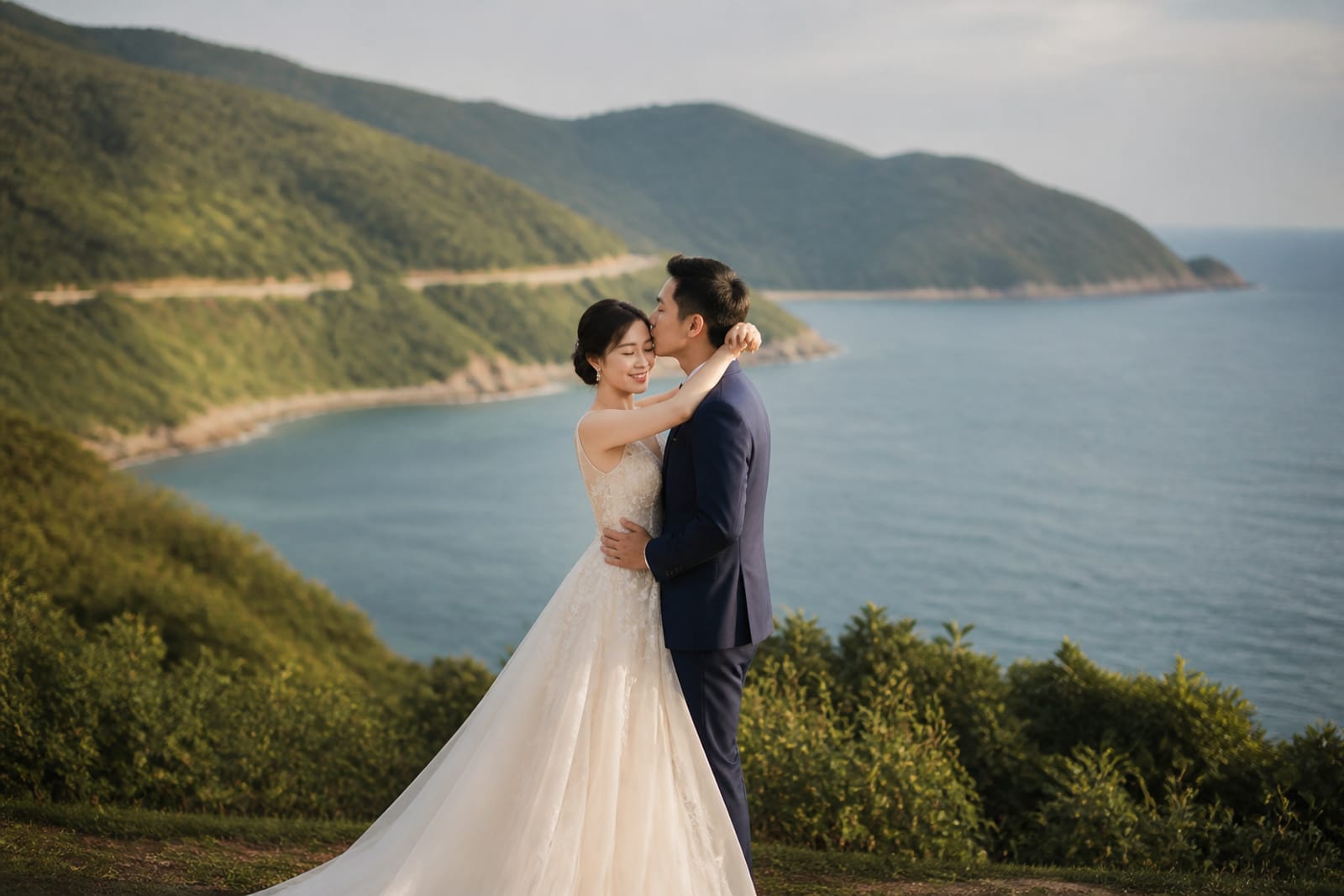
Both locations sit within 30–40 km of Da Nang city center and offer complementary aesthetics in a single journey. Son Tra's winding mountain road delivers soft, overcast light and lush forest canopy — perfect for intimate close-ups and ao dai fabric detail. Linh Ung Pagoda sits 680 m above the South China Sea; its white statue and ornate temple architecture frame wide-angle couple poses with spiritual grandeur. Combining them in one session (rather than choosing one) lets you shift from serene natural light to architectural geometry without changing outfits. Early morning (5:30–8:00 a.m.) captures mist clinging to peaks and temple grounds before tour buses arrive; many couples report this timing as non-negotiable for genuine quiet and directional golden hour on the pagoda's east-facing steps.
When is the light and season actually right?
Da Nang sits on Vietnam's central coast, where the climate splits sharply. February to August is the dry, clear season — best for visibility and color saturation in ao dai fabric. May–August bring intense heat and high humidity; you'll want makeup designed for sweat and quick touch-ups between locations. September to December is the rainy and typhoon season; October–November see the worst weather and occasional road closures into Son Tra. December–January can surprise with cool, grey mornings ideal for soft light, but Tet (late January–mid February) brings crowds and closed services.
Golden-light windows are brief: sunrise (5:50–6:30 a.m. in Feb–Mar, 5:20–6:00 a.m. in May–Jun) illuminates Linh Ung's east face and the pagoda's golden Buddha; by 8:00 a.m., tour groups arrive and midday sun flattens texture. If you're booking a local photographer, ask them to scouted timings for your specific month — weather and daylight shift enough that generic "sunrise sessions" often miss the best 20–30-minute window.
How do you actually navigate the terrain in an ao dai?
Ao dai (áo dài 襤褦) is a floor-length silk tunic split to the waist; it flows elegantly in still air but snags on rough ground and heavy moisture. Son Tra's approach involves:
- Cable car or car + uphill walk (15–40 minutes on paved/gravel paths, depending on your target viewpoint). Wear slip-on grip shoes or flat sandals under the ao dai; remove them only for final portrait frames.
- Linh Ung's pagoda steps and temple courtyards: 100+ stone steps, many uneven and worn. Couples often hike these in ao dai but risk snagging fabric or slipping. Ask your photographer to bring a runner or fabric tie to lift the back panels for climbing; you'll re-drape for photos.
- Mist and morning dew dampen ao dai hem and silk lining, adding weight and wrinkle risk. Bring a small towel or absorbent cloth for quick drying before each shot.
If you're renting ao dai locally, confirm with the rental shop (e.g., at a Da Nang hotel or tailoring studio) that the hem length suits your height and intended movement. Over-length ao dai catch rock crevices; too-short loses the garment's grace. A professional ao dai tailor can adjust hem in 24–48 hours if booked ahead.
What's the comparison: Son Tra alone vs. Linh Ung alone vs. both?
| Option | Best for | Light & season | Why it works |
|---|---|---|---|
| Son Tra only | Intimate, moody, fabric-focused portraits | Soft diffuse light year-round; Feb–Aug clearest; May–Aug hot | Mist and canopy give natural fill light; fewer crowds; shorter travel time |
| Linh Ung only | Wide-angle, spiritual, architectural context | Sunrise (5:50–6:30 a.m.) east face; Feb–Aug visibility | Golden Buddha, pagoda geometry, sea views; early arrival essential to avoid buses |
| Both in one session | Full narrative arc: natural → spiritual; varied backdrops | Sunrise at Linh Ung (6:00–8:00 a.m.), then Son Tra by 8:30 a.m. | Maximizes light windows; long enough session (3–4 hours) to chase soft light as sun rises; no outfit change needed |
Cost factors (never fixed amounts — ask your photographer): fuel and timing for two sites vs. one; whether the photographer books a vehicle or expects you to arrange transport; early-morning availability (some charge premiums for pre-dawn departures); post-processing for mixed lighting (mist + golden hour require different color grading). Couples choosing both typically book 3–4-hour sessions and allocate 1.5 hours per site plus 30–45 min travel and setup.
How do you find and vet a local Da Nang photographer for this shoot?
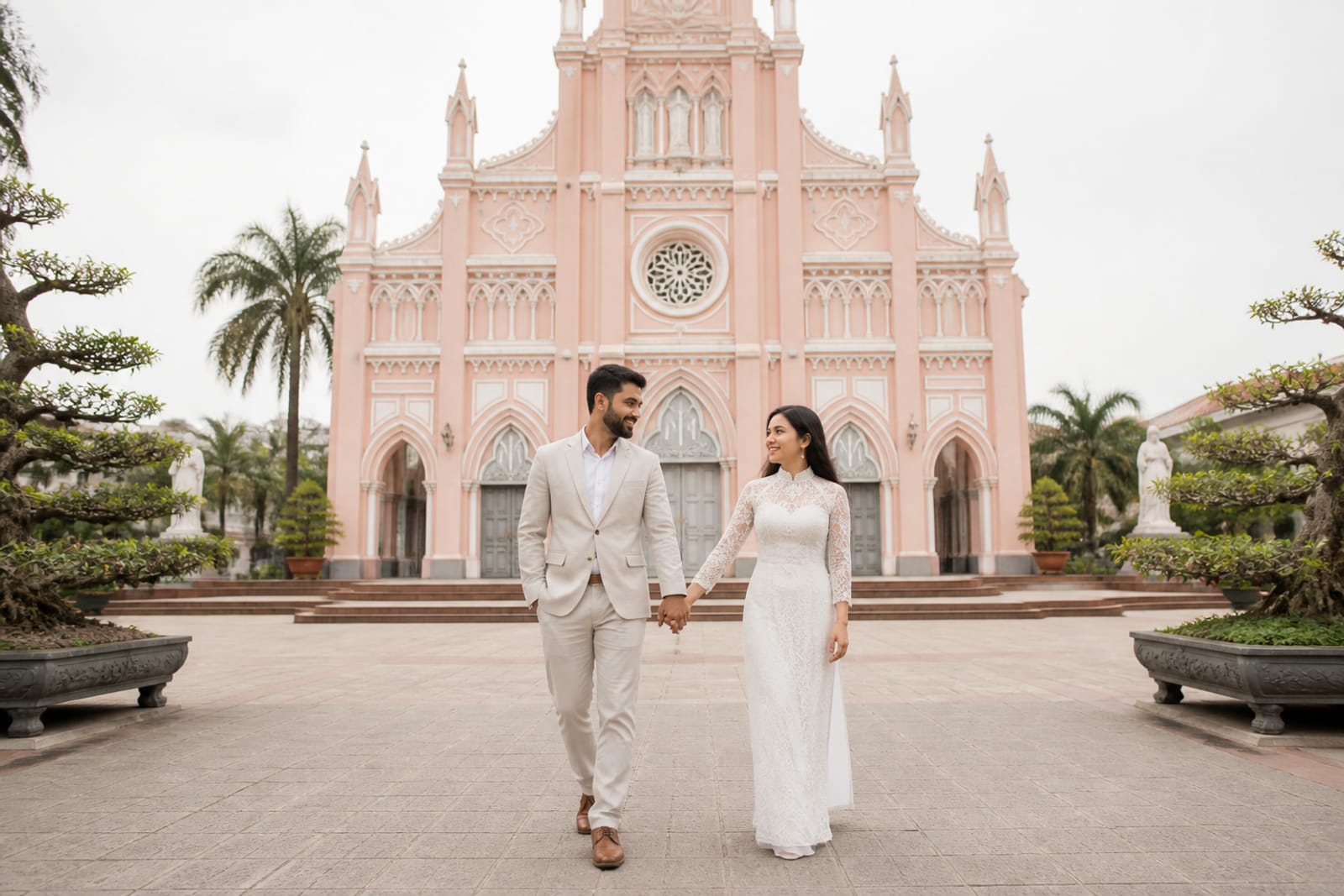
Cáo Studio – Makeup & Photoshoot operates in Hanoi, Ho Chi Minh City and Hoi An only — not Da Nang. For a local shooter in Da Nang, use this vetting checklist:
- Portfolio: Ask for 5+ couple sessions at Son Tra + Linh Ung specifically. Generic "Da Nang couple" albums are common; you need proof they've handled ao dai on this terrain in your target season.
- Early-morning availability: Confirm they've worked 5:30–7:00 a.m. starts (some photographers don't). Ask whether they arrive early to scout light and scout transport logistics.
- Ao dai handling: Do they know how to position, fold and light ao dai fabric? Ask for a close-up detail shot from a past couple session (collar, sleeve, hem texture). Poor lighting or posing flattens the garment's value.
- Weather contingency: What's their plan if mist is too thick or typhoon warnings close roads? Ask for a written cancellation/reschedule clause before paying.
- Turnaround on edits: Ask how many edited files you'll receive, when delivery happens, and whether you can request additional edits. Couples often need 1–2 weeks for albums or printed keepsakes.
Interview red flags: vague promises ("we'll find the best light"), inflated couple counts (e.g., "we've shot 500 couples here" — ask for gallery proof), no reference to season or weather, or reluctance to discuss ao dai logistics.
What to check before you book a local Da Nang photographer
| Checkpoint | Why it matters | What to ask |
|---|---|---|
| Season & weather fit | Oct–Nov typhoons close roads; Dec–Jan cool but grey; Feb–Aug ideal. | "What month are you free, and how does weather affect light/access that month?" |
| Early-start capability | Best light is 5:50–7:30 a.m.; midday kills detail. | "Can you start at 5:30 a.m.? Will you scout locations the evening before?" |
| Ao dai experience | Cheap photographers flatten silk and miss folds; pros light seams and layers. | "Show me a close-up ao dai detail (collar, cuff, hem) from a recent couple shoot." |
| Vehicle & logistics | Can they drive, or do you hire transport separately? Affects session flow. | "Do you have transport? If not, who coordinates the car rental and route timing?" |
| Edits & delivery | Vague timelines lead to delays; couples need files for albums or keepsake gifts. | "How many edited images? When delivered? Can I request revisions?" |
| Cancellation & weather | Typhoons or road closures will happen; written terms protect both sides. | "What's your reschedule policy if weather closes access or visibility fails?" |
---
💄 Makeup & hair at your hotel | 🌸 Ideas & lookbook | 📸 Book on WhatsApp — couple & family photoshoot
---
Makeup and hair strategy for Son Tra mist and pagoda steps
Ao dai couple shoots in Da Nang demand makeup designed for moisture and movement. If you're traveling to Da Nang for this shoot, arrange on-location makeup and hair with a local hotel beauty service or include it in your photographer's package (ask directly). Key needs:
- Waterproof base: morning mist and sweat on skin require long-wear primer and setting spray. Standard makeup melts or streaks by the second location.
- Ao dai collar framing: makeup artists familiar with ao dai know to leave cheekbones and jawline sharp so the high neckline doesn't overwhelm your face. Ask for a test if working with someone unfamiliar.
- Hair in wind: Si Trang's wind and Linh Ung's exposed steps mean loose waves or curls snarl fast. Tight braids, low buns or half-updos stay polished across 3+ hours.
If you're booking from outside Vietnam, Cáo Studio does not offer remote makeup for Da Nang sessions — but our makeup & hair at your hotel page outlines how to brief a local artist. Alternatively, if you're visiting Hanoi before or after Da Nang, consider a trial session with us to test makeup durability and style choices.
---
🌸 Ideas & lookbook | 📸 Book on WhatsApp — couple & family photoshoot
---
Next steps: planning your couple ao dai shoot
If you're committed to Son Tra and Linh Ung, reserve 2–3 months ahead during peak season (Feb–Apr). Da Nang's best local photographers book early, and you'll need time to arrange ao dai rental or shipping if you're bringing your own. Use our ao dai photoshoot guide and couple photoshoot pages to refine your vision and reference-build.
Not yet sure whether Da Nang is your destination? Consider alternatives:
- Hanoi: Cáo Studio's home base; we offer ao dai photoshoots and couple sessions across temples, lakes and colonial gardens. See Cáo Studio Hanoi.
- Ho Chi Minh City: Urban and suburban couple backdrops, warmer year-round. See Cáo Studio Saigon.
- Hoi An: Historic town and rice-field light; we travel by appointment. See photoshoots in Hoi An.
If you choose Da Nang, brief your local photographer on the comparative guide above and confirm their ao dai and early-morning track record before deposit. The difference between a polished session and a flat one often comes down to 30-minute arrival windows and fabric-handling skill — not luck.
FAQ
Do I need a professional makeup artist for a Son Tra + Linh Ung shoot?
Not mandatory, but strongly recommended. Morning mist and physical exertion (pagoda steps) compromise makeup durability. A waterproof setup and ao dai-framing contouring make a visible difference across 3–4 hours. Ask your local photographer whether makeup is included or recommend a local artist.
Can we shoot both sites in bad weather (mist or drizzle)?
Mist adds drama and soft light, which many couples prefer. Heavy drizzle or typhoon warnings (Oct–Nov risk) create safety hazards on uneven steps and reduce visibility. Ask your photographer their threshold — some welcome light drizzle; others reschedule for storms. Check weather 48 hours before and confirm a backup date in your contract.
How much time do we need at each location?
Plan 1.5–2 hours per site: 45–60 min for setup, outfit adjustments, and varied poses; 30 min travel + transition between locations. A combined session typically runs 3.5–4.5 hours. Earlier start (5:30 a.m.) lets you capture light before crowds; later starts (7:00+ a.m.) save on early fees but risk missing mist and golden hour.
What ao dai colors photograph best at these locations?
Jewel tones (emerald, sapphire, burgundy) stand out against grey mist and pagoda gold. Pastel pink or white reads softer on cloudy days but risks blending into overcast sky. Ask your local photographer to show how their past clients' ao dai colors rendered in Feb–Aug light — color grading varies by photographer's edit style.
Should we hire a separate hair and makeup artist, or bundle with the photographer?
Either works if clearly contracted. Separate artists give flexibility and specialized skill; bundled services simplify logistics and ensure timing coordination. If hiring separately, confirm the photographer and makeup artist have worked together and agree on arrival times (makeup artist needs 45–60 min before 5:30 a.m. start). Get both in writing.
Can we do this shoot in December or January?
Yes. December is cool (15–20°C on the mountain) and often grey — soft, even light ideal for detail work. January is similar but risks Tet (late Jan–mid Feb) closures and tourist crowds. Book your photographer and transport 6–8 weeks ahead if targeting these months; availability tightens fast. Weather is stable compared to Oct–Nov typhoon risk, so reschedule clauses are rarely triggered.
常見問題
Do I need a professional makeup artist for a Son Tra + Linh Ung shoot?
Not mandatory, but strongly recommended. Morning mist and physical exertion (pagoda steps) compromise makeup durability. A waterproof setup and ao dai-framing contouring make a visible difference across 3–4 hours. Ask your local photographer whether makeup is included or recommend a local artist.
Can we shoot both sites in bad weather (mist or drizzle)?
Mist adds drama and soft light, which many couples prefer. Heavy drizzle or typhoon warnings (Oct–Nov risk) create safety hazards on uneven steps and reduce visibility. Ask your photographer their threshold — some welcome light drizzle; others reschedule for storms. Check weather 48 hours before and confirm a backup date in your contract.
How much time do we need at each location?
Plan 1.5–2 hours per site: 45–60 min for setup, outfit adjustments, and varied poses; 30 min travel + transition between locations. A combined session typically runs 3.5–4.5 hours. Earlier start (5:30 a.m.) lets you capture light before crowds; later starts (7:00+ a.m.) save on early fees but risk missing mist and golden hour.
What ao dai colors photograph best at these locations?
Jewel tones (emerald, sapphire, burgundy) stand out against grey mist and pagoda gold. Pastel pink or white reads softer on cloudy days but risks blending into overcast sky. Ask your local photographer to show how their past clients' ao dai colors rendered in Feb–Aug light — color grading varies by photographer's edit style.
Should we hire a separate hair and makeup artist, or bundle with the photographer?
Either works if clearly contracted. Separate artists give flexibility and specialized skill; bundled services simplify logistics and ensure timing coordination. If hiring separately, confirm the photographer and makeup artist have worked together and agree on arrival times (makeup artist needs 45–60 min before 5:30 a.m. start). Get both in writing.
Can we do this shoot in December or January?
Yes. December is cool (15–20°C on the mountain) and often grey — soft, even light ideal for detail work. January is similar but risks Tet (late Jan–mid Feb) closures and tourist crowds. Book your photographer and transport 6–8 weeks ahead if targeting these months; availability tightens fast. Weather is stable compared to Oct–Nov typhoon risk, so reschedule clauses are rarely triggered.