/ao-dai-photoshoot
Ao dai wedding photos at Fansipan summit: season, light, and logistics
A Fansipan summit ao dai photoshoot captures your traditional dress against alpine scenery—Vietnam's highest peak at 3,143 m—in light that's soft, cool and clear above the clouds. Best shot Mar–May or Sep–Nov when weather is stable; avoid Dec–Feb fog and Jun–Sep monsoon risk. The cable car runs from dawn; summit conditions shift fast, so sessions work best in early morning (6:00–8:00 am, 2–3 hours on-site including changes and setup). A local professional photographer—or a team from Hanoi—must carry gear safely and know altitude protocol; Cáo Studio coordinates shoots here with a Hanoi-based director who handles outfit, makeup and camera as one unit. Expect thin air, rapid temperature swings, and limited shelter—not ideal for long, elaborate setups. Most couples pair a brief summit session with lower-altitude shoots (French hill, Sapa town) in the same day. ---
Can you shoot ao dai at Fansipan in every season?
No. Fansipan is safe for ao dai shoots only Mar–May and Sep–Nov. Dec–Feb brings dense fog (visibility near zero), frost and occasional snow—you'll see nothing, and traditional silk gets damp fast. Jun–Sep carries monsoon risk; July–August are rainiest. Winter is also cold enough (near 0°C, sometimes below) that models and crew suffer, and emergency descent becomes serious if weather turns. Spring and autumn offer stable early mornings with clear skies and moderate wind—the window when summit light is reliable.
---
Why is morning light better than afternoon at the summit?
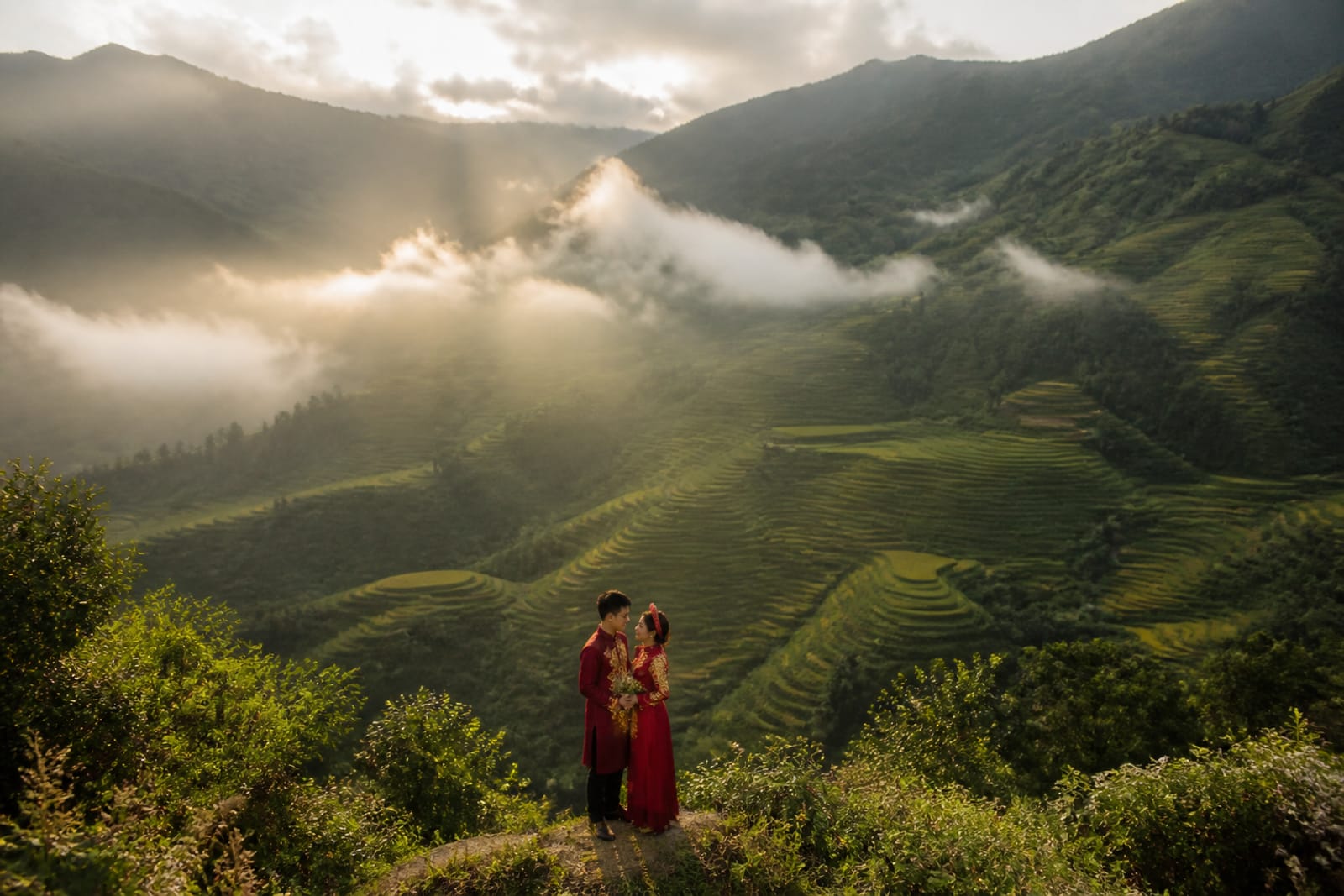
Fansipan catches east-facing light from 6:00 am onward, creating soft, low-angle illumination before cloud cover builds. By 10:00 am, thermal currents push clouds up from the valleys; by noon, the summit is often socked in. Afternoon descents are also safer when you leave by 9:00–10:00 am—the cable car can close in bad weather without warning. A 6:00 am start means riding the car in darkness, arriving as light arrives; by 7:30 am, you're shooting in the best condition. If you leave later, you risk either hazy light or cancelled operations.
---
What do you wear under an ao dai at high altitude?
Ao dai alone won't keep you warm at 3,143 m. Wear a fitted thermal or moisture-wicking base layer (long sleeves, leggings) under the outer tunic—it's hidden and won't bulk out the waistline. Bring a thin merino or wool cardigan to change into between shots; it layers under the ao dai without distorting the silhouette. Avoid cotton; it traps moisture. Socks must be warm merino or wool (heavy boots aren't an option under the skirt—wear them on the cable car, change to flat heels at the summit and carry them down). Even in May, temperature can drop 15°C from base to peak; wind-chill is real. The makeup artist should have thermal hand warmers and lip balm ready—fingers numb fast, and cracked lips show in close-ups.
---
How does the cable car schedule affect your shoot timing?
The cable car is the only way up; it opens at 6:00–7:00 am (check the day before—hours vary). The last descent is usually 5:00–5:30 pm. A typical session books the 6:00–6:30 am car, shoots 6:45–9:00 am (including outfit changes and setup), and descends by 9:30 am. This window is tight: wardrobe changes, makeup touch-ups, and walking between photo spots (the summit is a 30-minute circuit) must fit inside. If the car is delayed (bad weather, maintenance, crowds), your shoot compresses or cancels. Cáo Studio coordinates directly with the cable-car operator to confirm availability and adjust timing; you pay cable-car tickets separately (check the official Fansipan site for current prices). No walk-up bookings work—the photographer must pre-arrange access and brief your group on descent time.
---
Fansipan summit vs. lower-altitude Sapa: which suits your ao dai shoot?
| Option | Best for | Light & season | Altitude challenge | Outfit fit | Booking ease |
|---|---|---|---|---|---|
| Fansipan summit (3,143 m) | Alpine drama, rare vistas, couple or small party | Mar–May, Sep–Nov; soft 6:00–9:00 am light; clear skies rare after 10:00 am | Thin air, cold, fast weather shifts, cable-car schedules bind timing | Ao dai works; requires thermal base layer & wind prep | Coordinator needed; cable-car slot required in advance |
| French hill, Sapa town (1,600 m) | Traditional ao dai in colonial scenery, longer shoot window | Mar–Nov (Mar–May & Sep–Nov safest); light good 6:00 am–4:00 pm if overcast | Mild, walkable, no altitude sickness risk, weather more forgiving | Ao dai fits naturally; minimal thermal layers needed | Easier; local taxis and guides available same-day |
| Rice-terrace viewpoint, Sapa valley (1,400–1,600 m) | Water reflections, green slopes (Jun–Aug), golden terraces (mid-Sep–Oct) | Jun–Aug (terraces flooded, greener); Sep–Oct (harvest, golden); avoid Nov–Feb (frost, low water) | Low; weather can shift, but descent is on foot (no cable car) | Ao dai on wet ground risks mud; flat-soled shoes essential | Local guides common; flexible timing |
Why it matters: Fansipan delivers a once-in-a-trip shot—but the cable car window and cold are strict. Sapa town offers equally beautiful light with more flexibility and comfort. Many couples combine both: French hill in early morning (7:00–9:00 am), lunch, then Fansipan cable car for midday shots if conditions hold. Ask Cáo Studio on WhatsApp which suits your timeline and tolerance for altitude.
---
What gear and logistics does a professional team need at the summit?
A camera operator carries a minimal kit—body, 2–3 lenses, a tripod (lightweight carbon fiber; a large stand is too cumbersome and catches wind). Makeup and hair artist brings a backpack with touch-up essentials (powder, lip balm, a small mirror, bobby pins, thermal hand warmers). The stylist carries a backup outfit and wind-break fabric if you're doing multiple changes. A porter or assistant helps manage garment bags and stabilize poses in wind. Drones are banned at Fansipan without permit—check current rules on-site. No generator or external lighting—all work with natural light, which means you shoot when the sun says so, not when you want to. Hydration is critical (dehydration at altitude worsens in dry mountain air); bring 2–3 liters of water and electrolyte sachets. The descent is steep and narrow; wear proper footwear on the cable car and on-summit paths. Cáo Studio's Hanoi team includes a Fansipan-experienced director; they coordinate the full load with guides and ensure no one is left behind.
---
How long does a Fansipan ao dai shoot actually take?
A realistic session runs 2.5–3 hours on-site: 30 min cable-car ride up, 15 min acclimatization and outfit setup, 60–90 min shooting (two looks, walking between viewpoints), 30 min makeup/wardrobe touch-up and final shots, 30 min descent. Some clients book a "base and summit" combo—1 hour in Sapa town (French hill or old market), then cable car for the peak shoot. This stretches the day to 5–6 hours total, but the light-to-comfort ratio is better. Very elaborate pre-wedding shoots (3+ outfits, multiple locations) are not practical on Fansipan; use it as a signature finale after a full day's shoot in Sapa town. Cáo Studio quotes what's feasible based on your outfit count and descent timing.
---
What happens if weather closes the summit on your shoot day?
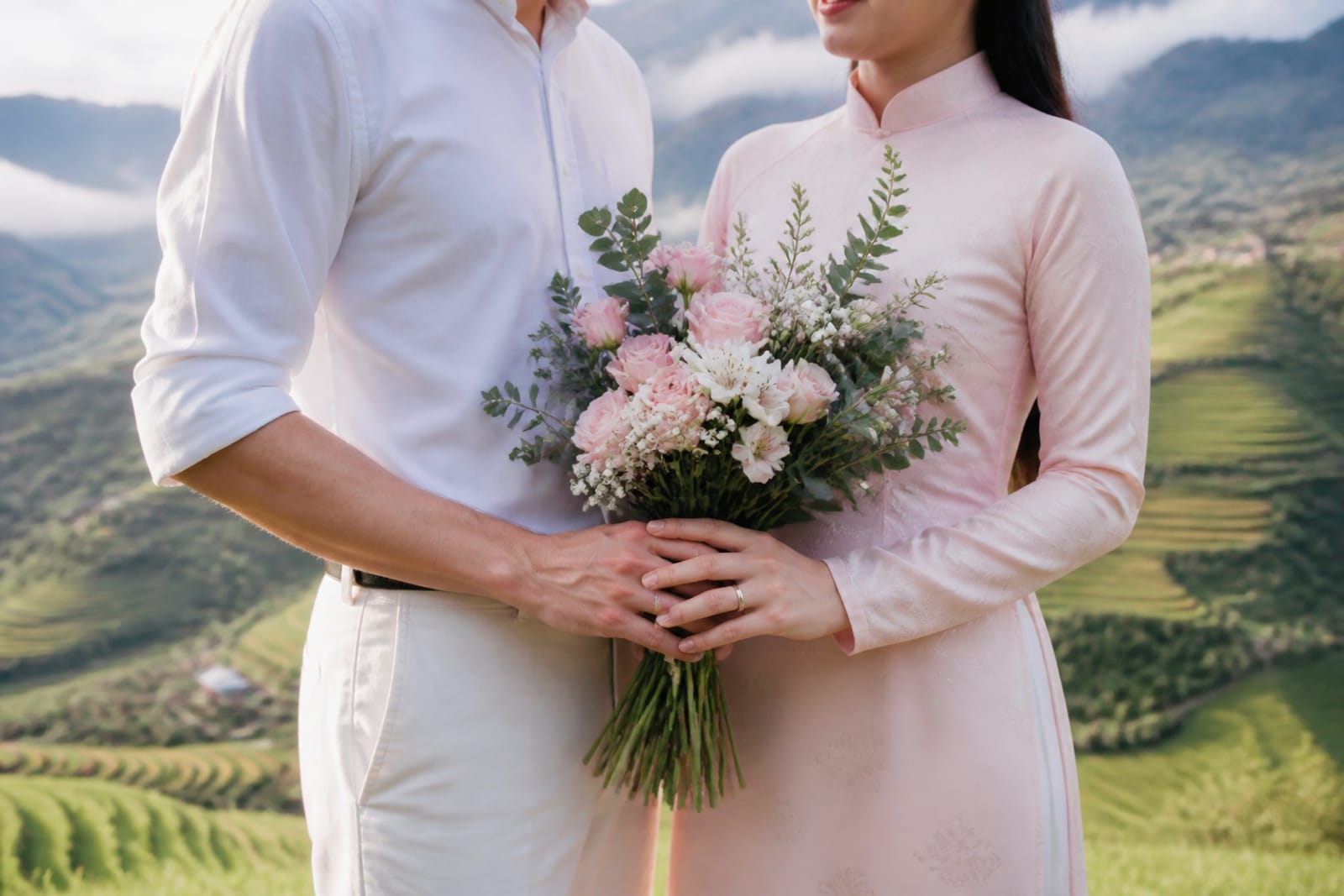
If fog, rain or high wind hits before you ride up, the cable car doesn't operate—your session reschedules. If weather deteriorates after you're on the summit, guides may ask everyone down early; you lose shooting time but not your safety. There is no refund policy for weather; instead, Cáo Studio typically re-books you for the next available clear day in the same season, if feasible. Book a Fansipan shoot only if you have 3–5 flexible days in your Sapa window. Clients on fixed 1–2 day trips should prioritize French hill (more reliable light) and use Fansipan as a bonus if conditions permit. Check the weather forecast at least 5 days before; ask your coordinator for a go/no-go call 24 hours prior.
---
Booking a Fansipan ao dai shoot: what to confirm before you book
- Dates & cable-car availability: Confirm the specific date, time slot (usually 6:00–6:30 am departure), and backup dates in case of closure.
- Outfit & thermal layers: Agree on what you'll wear under the ao dai, including shoes and accessories that won't slip on steep paths.
- Altitude suitability: Disclose any heart, lung or circulation concerns to your coordinator—3,143 m is safe for most but not all.
- Descent timing: Confirm your departure time from the summit (usually 9:00–9:30 am) and whether you're descending by cable car or staying for other Sapa shoots.
- Crew size & roles: Clarify who's on your team—photographer, makeup artist, stylist, assistant, plus any family or friends. Only essential crew rides the cable car.
- Backup location: If Fansipan closes, which location (French hill, town market) is your fallback shoot?
- Cost factors: Cable-car tickets, transportation from your hotel to the base, and any local guide fees are separate from the photoshoot. Ask for a full breakdown on WhatsApp.
---
📸 Book on WhatsApp — ao dai photoshoot
---
How Cáo Studio approaches Fansipan shoots
Cáo Studio's Hanoi director has shot Fansipan three seasons running; they know the cable-car politics, the cold wind patterns off the north face, and how to move a small crew safely on narrow paths. They arrive early (sometimes 5:00 am at the base) to secure the right car slot, brief guides on the shoot plan, and identify light positions before dawn. They shoot wide first—the summit vista and your ao dai silhouette against it—then medium (waist-up, walking, looking toward each other), then detail (close-up of embroidery, your hand against the sky). No standing stiffly in front of monuments; instead, real moments—walking out of frame, laughing as the wind catches the skirt, looking down at a valley while light hits your profile. By 9:00 am, they're descending with 150–200 edited frames and a 60-second vertical film shot on-site.
If fog comes in at 7:30 am, they pivot: shoot the white-out (rare ethereal aesthetic) or move to the pre-dawn cable car and French hill for backup light. You don't lose the day—you get different frames.
They know what not to promise: Fansipan shoots are weather-dependent, cable-car-dependent, and tight on time. They also know what only happens there—that moment when you step out of the cable car into alpine air, ao dai catching the first light, nothing but sky and stone around you. That's the shot people keep.
---
---
Pair Fansipan with other shoots in Sapa and beyond
If you're already in Sapa for 2–3 days, layer your Fansipan session into a broader itinerary:
- Day 1: French hill + old market — shoot early morning at French hill, Sapa town, then lunch and town exploration.
- Day 2: Fansipan cable-car shoot — 6:00 am departure, finish by 9:30 am; afternoon rest or explore town.
- Day 3: Rice-terrace viewpoint or Cat Cat village — if weather was poor on Day 2, use Day 3 for a backup high-altitude or valley shoot.
For a full pre-wedding photoshoot, many couples book Sapa (2 days) + Hanoi (1 day). This spreads the ao dai love across landscapes and gives weather backup. Cáo Studio's Hanoi team can arrange Sapa sessions; ask on WhatsApp for Sapa operator coordination and available dates.
Solo and family vacation photoshoots also work at Fansipan—it's a once-in-a-trip moment, not only for couples. A family photoshoot on the summit in coordinated ao dai or modern jackets creates heirloom frames.
---
📸 Book on WhatsApp — ao dai photoshoot
---
Comparing total-day costs: what factors into a Fansipan session
Fansipan shoots are priced differently than valley shoots because of logistics. Here are the cost factors—never a fixed "package price," but variables you'll hear on the quote call:
- Crew travel: If you're based in Hanoi, Cáo Studio's team travels to Sapa (5+ hours by road or 1 hour by domestic flight). That's a cost factor.
- Cable-car tickets: The operator's price; check their official site for current rates.
- Makeup & hair: Applied at your hotel before the 5:00–6:00 am cable-car ride; factored into the photoshoot quote.
- Outfit count: One ao dai on the summit is standard. A second outfit (changed at the cable-car base) adds time and crew labor.
- Backup day: If weather closes Fansipan, do you re-book or shoot French hill instead? Confirm your re-booking policy upfront.
- Editing & delivery: Frames and a short film delivered within 48 hours (standard for Cáo Studio); no surcharge for a high-altitude shoot.
Ask Cáo Studio for a full breakdown on WhatsApp—they'll walk you through each factor and give a transparent quote, not a sales pitch.
---
Real Fansipan ao dai moments: what actually happens on the day
Your alarm goes at 4:30 am. By 5:00 am, the makeup artist is braiding your hair in your Sapa hotel room (you showered the night before, skin prepped). By 5:30 am, you're in the ao dai, thermal layers hidden underneath, and you're in the van heading to the cable-car base in fading darkness. The air is cool and still.
At 6:00 am, you board the cable car. The sun isn't up yet. By 6:25 am, you're at the summit station—the air is thin, it's 5–10°C colder than base, and wind picks up. You step out. The sky is turning pink. A guide walks you 50 meters to the best viewpoint; the photographer is already in place, camera steady. The light is soft, coming from the east. No tourists yet.
You walk toward each other. The photographer shoots. You're not posing—you're walking, and the ao dai moves around you, and the sky is massive behind you. It takes 10 minutes. You're a little breathless (altitude), but you're smiling genuinely because this is it—the summit, the light, your dress. That's the shot.
By 6:50 am, the first tour groups are arriving. You change into a second ao dai (or into a modern jacket if you prefer) in a sheltered spot. Another 30 minutes of shooting, now the sun is higher, clouds are forming far below. By 7:30 am, tourists are everywhere, and the light is starting to flatten.
By 8:00 am, you and the team are heading back to the cable car. By 9:00 am, you're at breakfast in Sapa town. By evening, your coordinator sends a preview of 20 frames—the wide shots, the close-ups, the one where the wind caught your skirt just right. By the next morning, 150+ edited images and a film are in your inbox.
That's a real Fansipan session.
---
FAQ
Is Fansipan safe for ao dai shoots if I've never been at high altitude before?
Yes, 3,143 m is safe for most people. Avoid strenuous activity the day before; hydrate well; breathe slowly. Disclose any heart, lung or circulation concerns to your coordinator beforehand. Symptoms of altitude sickness (headache, nausea) are rare below 3,500 m and very rare on Fansipan if you ascend by cable car (no exertion). If you feel unwell, descend immediately—guides know the protocol.
Can I wear a regular silk ao dai at the summit, or do I need special fabric?
Regular silk is fine; it's beautiful in wind and cool air. Avoid heavy brocade (it's too bulky under thermal layers) or very delicate embroidered pieces that snag on rough stone. Bring a backup ao dai to the base in case the first one tears or soils. Flat, gripped shoes (not heels) are essential—the paths are narrow and steep.
What if I want to do multiple outfit changes at the summit?
Limit yourself to two looks (one ao dai, one modern jacket or second ao dai). The summit is not a dressing room; wind, cold and tight timing make elaborate changes impractical and uncomfortable. Most couples do one outfit change at the cable-car base station before ascending, then one final look at the summit.
How far in advance do I need to book a Fansipan ao dai shoot?
Ideal lead time is 2–3 weeks to ensure cable-car availability and crew scheduling. Fansipan has limited daily slots (the cable car carries ~600 people per hour, multiple tours operate), and peak season (Mar–May, Sep–Oct) fills fast. Ask Cáo Studio on WhatsApp for available dates; they'll check with the operator and confirm.
What if the cable car is fully booked on my preferred date?
Alternative dates in the same week or season are usually available. If not, pivot to a Sapa-based shoot (French hill, town market, rice terraces)—equally stunning and more flexible. Cáo Studio can offer a full-day Sapa itinerary without the altitude or cable-car dependency.
Do I need to book a local Sapa guide, or does Cáo Studio handle everything?
Cáo Studio's Hanoi team coordinates with Fansipan guides and the cable-car operator; they manage logistics. You don't need a separate guide. However, if you want extended Sapa valley exploration (treks, village visits) outside the photoshoot hours, book that separately through a local operator.
Can I bring family members or friends on the cable car with us during the shoot?
Yes, but only essential crew rides up (photographer, makeup artist, stylist). Extra guests take up space and are uncomfortable during a 2.5-hour session. They're welcome to ride up separately and meet you at the summit café, or wait at the base. Discuss this with your coordinator so everyone has a clear plan.
FAQ
Is Fansipan safe for ao dai shoots if I've never been at high altitude before?
Yes, 3,143 m is safe for most people. Avoid strenuous activity the day before; hydrate well; breathe slowly. Disclose any heart, lung or circulation concerns to your coordinator beforehand. Symptoms of altitude sickness (headache, nausea) are rare below 3,500 m and very rare on Fansipan if you ascend by cable car (no exertion). If you feel unwell, descend immediately—guides know the protocol.
Can I wear a regular silk ao dai at the summit, or do I need special fabric?
Regular silk is fine; it's beautiful in wind and cool air. Avoid heavy brocade (it's too bulky under thermal layers) or very delicate embroidered pieces that snag on rough stone. Bring a backup ao dai to the base in case the first one tears or soils. Flat, gripped shoes (not heels) are essential—the paths are narrow and steep.
What if I want to do multiple outfit changes at the summit?
Limit yourself to two looks (one ao dai, one modern jacket or second ao dai). The summit is not a dressing room; wind, cold and tight timing make elaborate changes impractical and uncomfortable. Most couples do one outfit change at the cable-car base station before ascending, then one final look at the summit.
How far in advance do I need to book a Fansipan ao dai shoot?
Ideal lead time is 2–3 weeks to ensure cable-car availability and crew scheduling. Fansipan has limited daily slots (the cable car carries ~600 people per hour, multiple tours operate), and peak season (Mar–May, Sep–Oct) fills fast. Ask Cáo Studio on WhatsApp for available dates; they'll check with the operator and confirm.
What if the cable car is fully booked on my preferred date?
Alternative dates in the same week or season are usually available. If not, pivot to a Sapa-based shoot (French hill, town market, rice terraces)—equally stunning and more flexible. Cáo Studio can offer a full-day Sapa itinerary without the altitude or cable-car dependency.
Do I need to book a local Sapa guide, or does Cáo Studio handle everything?
Cáo Studio's Hanoi team coordinates with Fansipan guides and the cable-car operator; they manage logistics. You don't need a separate guide. However, if you want extended Sapa valley exploration (treks, village visits) outside the photoshoot hours, book that separately through a local operator.
Can I bring family members or friends on the cable car with us during the shoot?
Yes, but only essential crew rides up (photographer, makeup artist, stylist). Extra guests take up space and are uncomfortable during a 2.5-hour session. They're welcome to ride up separately and meet you at the summit café, or wait at the base. Discuss this with your coordinator so everyone has a clear plan.
Ao dai, makeup, hair and a local photographer in Hanoi or Saigon — one WhatsApp message.