/ao-dai-photoshoot
Ao dai wedding photos at Marble Mountains: guide & booking
Marble Mountains, located near Da Nang on the central coast, combines dramatic limestone formations, spiral staircases through cave temples, and panoramic city views—ideal for ao dai wedding portraits if you book a photographer who knows the light, heat, and logistics there. Sessions typically run 2–3 hours (starting sunrise or late afternoon to avoid midday glare); the climb involves steep, uneven temple stairs and tight passages, so outfit choice (lightweight silk ao dai, sturdy shoes under the robe, minimal undergarments) and physical conditioning matter. Cáo Studio – Makeup & Photoshoot does not operate a Da Nang branch, but we coordinate pre-wedding and ao dai shoots in Hanoi and Ho Chi Minh City, and can advise on finding a vetted local Danang photographer. Success depends on planning the route (Golden Gate and Thuy Son temple offer the best elevation and framing), timing the tide and cloud cover, and confirming the photographer has temple etiquette experience and backup lighting for cave interiors. --- Marble Mountains draw wedding couples for its romance, but the location demands precision planning. This guide covers what to expect, how to prepare, and how to evaluate whether a Marble Mountains session fits your vision and stamina.
Why do couples choose Marble Mountains for ao dai wedding photos?
Marble Mountains delivers a narrative arc. You ascend through Buddhist temples (a spiritual motif many couples value), pass through cave shrines with natural light filtering through cracks, and emerge onto ridgetops with the Da Nang cityscape, South China Sea, and neighboring limestone peaks as your backdrop. The ao dai drapes dramatically on stairs and echoes the vertical rhythm of the architecture. Unlike flat urban parks, every few steps offer a distinct visual environment—foreground detail, mid-ground religious iconography, and distant landscape. Most Western couples unfamiliar with Vietnamese temple culture find the sensory experience (incense, cool shadows, elevated vistas) more memorable than a studio or beach backdrop.
Practical truth: The site is genuinely stunning between 6–7 a.m. (golden light, minimal foot traffic) and 4–5 p.m. (directional sidelighting, fewer tour groups). Midday is harsh and crowded; evening light fades fast after 5:30 p.m. The climb is real—30–45 minutes of ascent, some passages requiring hands and knees. If either partner has mobility concerns, discuss them frankly with your photographer before booking.
How does light and weather shape a Marble Mountains session?
Da Nang's central-coast climate is driest and warmest Feb–Aug, with clear, consistent light ideal for photography. May–Aug brings heat (32–35°C on the beach; cooler at elevation, but still intense) and occasional afternoon clouds. Sep–Dec is typhoon and rainy season (worst Oct–Nov), when cloud cover is thick, visibility poor, and stairs slippery—avoid entirely if possible.
Light timing and angle:
- 6–7 a.m.: Golden light bathes the eastern temple faces and the sea horizon. Shadows are long and sculptural. Most professional couples aim here.
- 4–5 p.m.: Sidelighting rakes the limestone textures and creates separation between subject and background. City lights begin to glow in the distance.
- Midday (10 a.m.–3 p.m.): Harsh overhead sun. Faces fall into shadow under temple eaves. Unforgiving for skin tone and ao dai fabric detail.
Weather reality: Even in the dry season, mist can roll in by 7 a.m., obscuring the view for 30–60 minutes. Cloud cover is unpredictable. A photographer experienced at Marble Mountains carries reflectors (to fill shadows in cave light) and has a shot list that works in overcast or dramatic conditions, not just clear sky. Ask your photographer how they adapt if visibility drops.
What should you wear under and over the ao dai?
The ao dai's sheer side panels and flowing split skirt reveal everything beneath. Under-garment choice shapes the silhouette and comfort.
| Consideration | Lightweight option | Structured option | Why it matters |
|---|---|---|---|
| Undergarment | Silk slip or none | Fitted bicycle shorts + high-rise briefs | Stair climbing + movement define visibility |
| Footwear under robe | Flat sandal or barefoot (for temple) | Pointed flat ballet shoe | Visible in side-profile frames; barefoot is traditional indoors |
| Ao dai weight | Lightweight silk crepe | Standard silk (slightly stiffer) | Heat and climbing stamina; light fabric moves dramatically on wind |
| Underlay color | Neutral (cream, tan) | Matching ao dai (white, pink, gold) | Contrast shows in shadows and side light; matching erases the undergarment visually |
Practical logic: Lightweight silk ao dai (breathable, moves beautifully in wind and stair drafts) paired with a barely-there slip or high-rise nude bicycle shorts lets you climb without overheating and maintain modesty in temple. Avoid heavy brocade or structured ao dai for this session—the weight, heat, and stiffness will exhaust you before the best light window closes. Have your photographer confirm whether they'll shoot from below (making undergarments visible against sky) or above (hiding them).
How do you evaluate a photographer who knows Marble Mountains?
A skilled Marble Mountains photographer has solved problems unique to that site. Vet them using these questions:
1. Have they shot ao dai at Marble Mountains before? Ask to see a portfolio folder from at least two prior sessions (not a single image). Look for proof they've navigated different light conditions, captured both detail shots (fabric, rings, jewelry) and environmental scale, and handled the staircase and cave passages without rushed framing.
2. Do they know the temple etiquette and access rules? Marble Mountains is an active Buddhist pilgrimage site. Shoulders and knees must be covered (ao dai satisfies this). Photography is allowed on marked tourist routes, but some inner sanctums prohibit images. A photographer who fumbles this will waste time and irritate monks. Confirm they've navigated access with the temple authority or a local guide.
3. What is their backup plan for light and weather? Ask: "If it's overcast at sunrise, what's your shot list?" "If the tide is high and water blocks the lower path, where do we pivot?" Vague answers suggest they've not pre-scouted. Good photographers name alternate routes, secondary setups, and how they'll use available light creatively.
4. Do they carry equipment suited to the environment? Marble Mountains has deep shadows (cave interiors), intense reflected light (limestone), and uneven terrain. A photographer should mention reflectors, diffusers, and a sturdy bag setup for stairs. If they arrive with a camera and one lens, that's a red flag.
5. How do they handle the heat and climbing? If the photographer is winded and struggling to keep pace, your session suffers. Ask how many prior Marble Mountains sessions they've done; experienced photographers time breaks, hydrate, and position themselves efficiently.
What does a typical Marble Mountains ao dai session look like?
Timeline and logistics:
4:45 a.m.–5:15 a.m.: Meet at the base (arrange transport from your hotel the evening before—taxis are available, but arrive early to secure one). The photographer conducts final makeup and ao dai drape checks in vehicle or at the entrance.
5:30 a.m.–6:30 a.m.: Ascent and first light setups. You'll climb to Golden Gate (the iconic narrow passage with city views) and Thuy Son temple. Photographer captures motion shots (ascending, pausing in doorways, silhouettes against openings) and static portraits. You're moving constantly; trust the photographer's direction.
6:30 a.m.–7:30 a.m.: Mid-temple details and interior cave light. Slower pacing; more deliberate framing. Light is now side-angled, flattering for close-ups.
7:30 a.m.–8:30 a.m.: Wind-down and "bonus light" shoots (if the couple has stamina). Descend to less-visited temple branches or lower vantage points. Photographer captures candid moments and outfit detail (rings, ao dai hem, jewelry).
8:30 a.m.+: Finish. You'll be warm, slightly damp from exertion and mist, and relieved. Return to hotel for shower and breakfast. Total time on-site: ~3 hours. Total time commitment: ~4–4.5 hours (including transport and setup).
What typically goes wrong:
- Underestimated stairs. Physically unprepared couples tire by hour two; quality declines.
- Wrong ao dai weight. Heavy fabric + heat + no air-conditioning on stairs = exhaustion and heat stroke risk.
- Poor timing. Couples arrive at 6:30 a.m. hoping to beat crowds but miss golden light. Or they book midday "because it's easier to wake up" and regret harsh shadows all day.
- Inadequate footwear under the robe. Slippery sandals on wet stone stairs cause falls. Barefoot is traditional indoors but risky on exterior stairs.
- Photographer inexperienced with temples. They photograph as if it's a generic staircase, missing the spiritual and architectural narrative.
How to avoid these: Book a photographer experienced with ao dai and elevation. Climb the stairs together one morning before the shoot (if you're visiting Da Nang a day or two early) to gauge your fitness. Choose lightweight silk ao dai. Wear secure footwear under the robe. Start before dawn. Confirm final details and a weather backup plan 2–3 days before the session.
Marble Mountains vs. other Da Nang wedding photo locations: which fits your vision?
Comparison framework:
| Location | Best for | Light & season | Fitness/time | Why choose it | Trade-off |
|---|---|---|---|---|---|
| Marble Mountains | Spiritual narrative, environmental scale, drama | Golden hour (6–7 a.m., 4–5 p.m.); Feb–Aug | High; 3–4 hours; stairs & elevation | Iconic, layered backdrop; unforgettable | Strenuous climb; weather-dependent; crowds if timing is wrong |
| My Khe Beach | Romance, simplicity, soft light | Sunrise (5:30–6:30 a.m.); all seasons | Low; 2–3 hours; flat sand | Accessible, timeless, golden-hour light reliable | Less narrative; crowded beach venue; ao dai hem drags in wet sand |
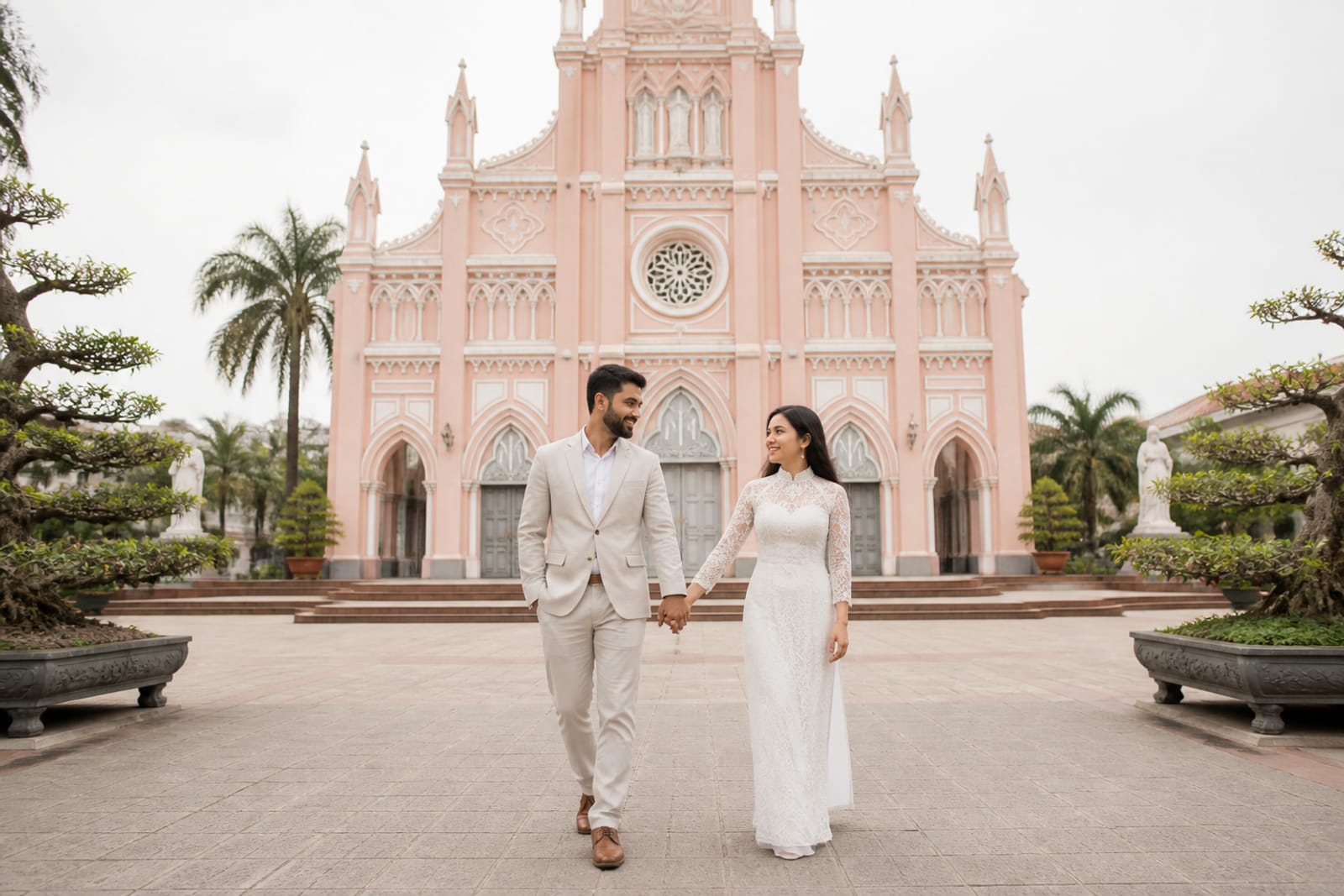
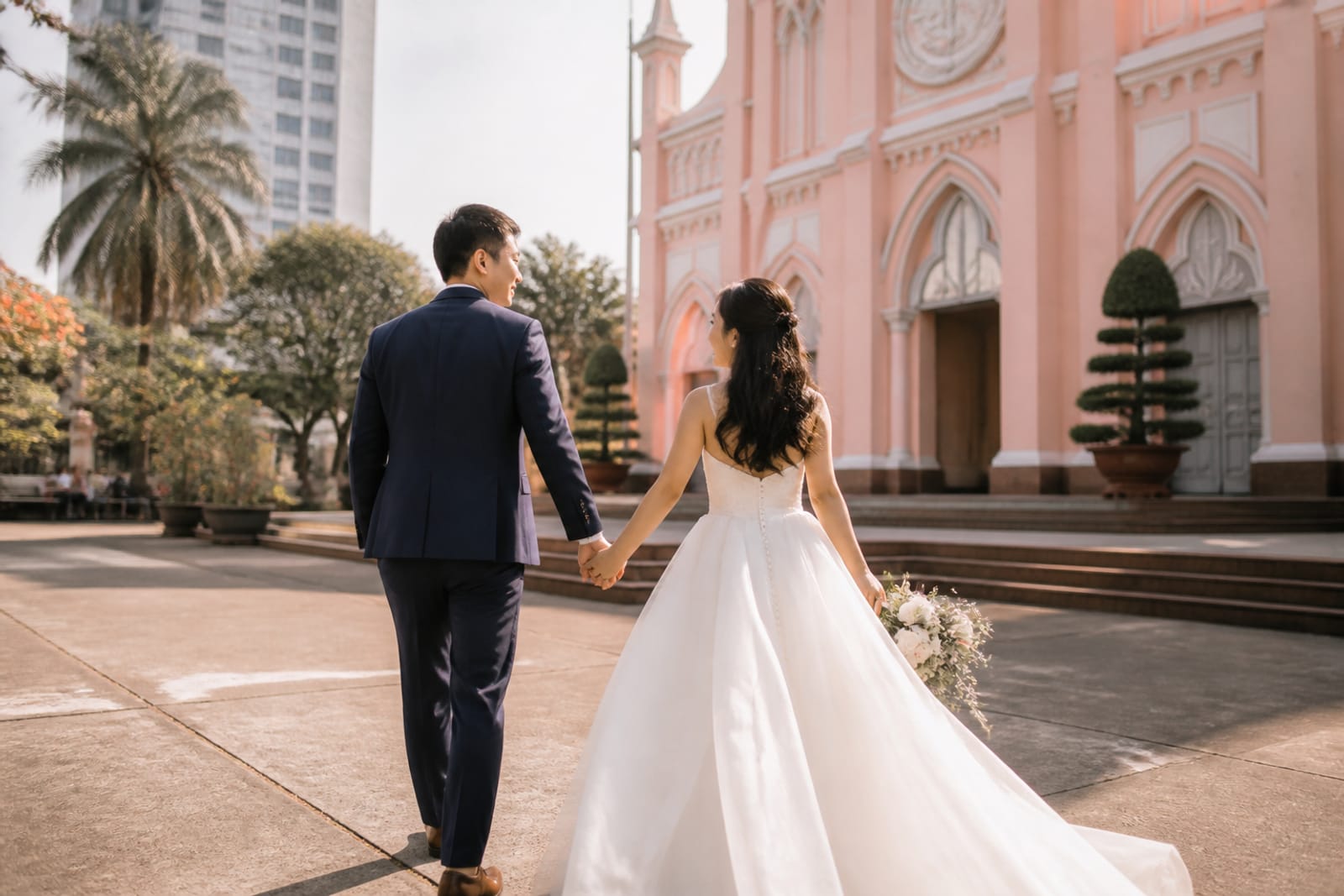
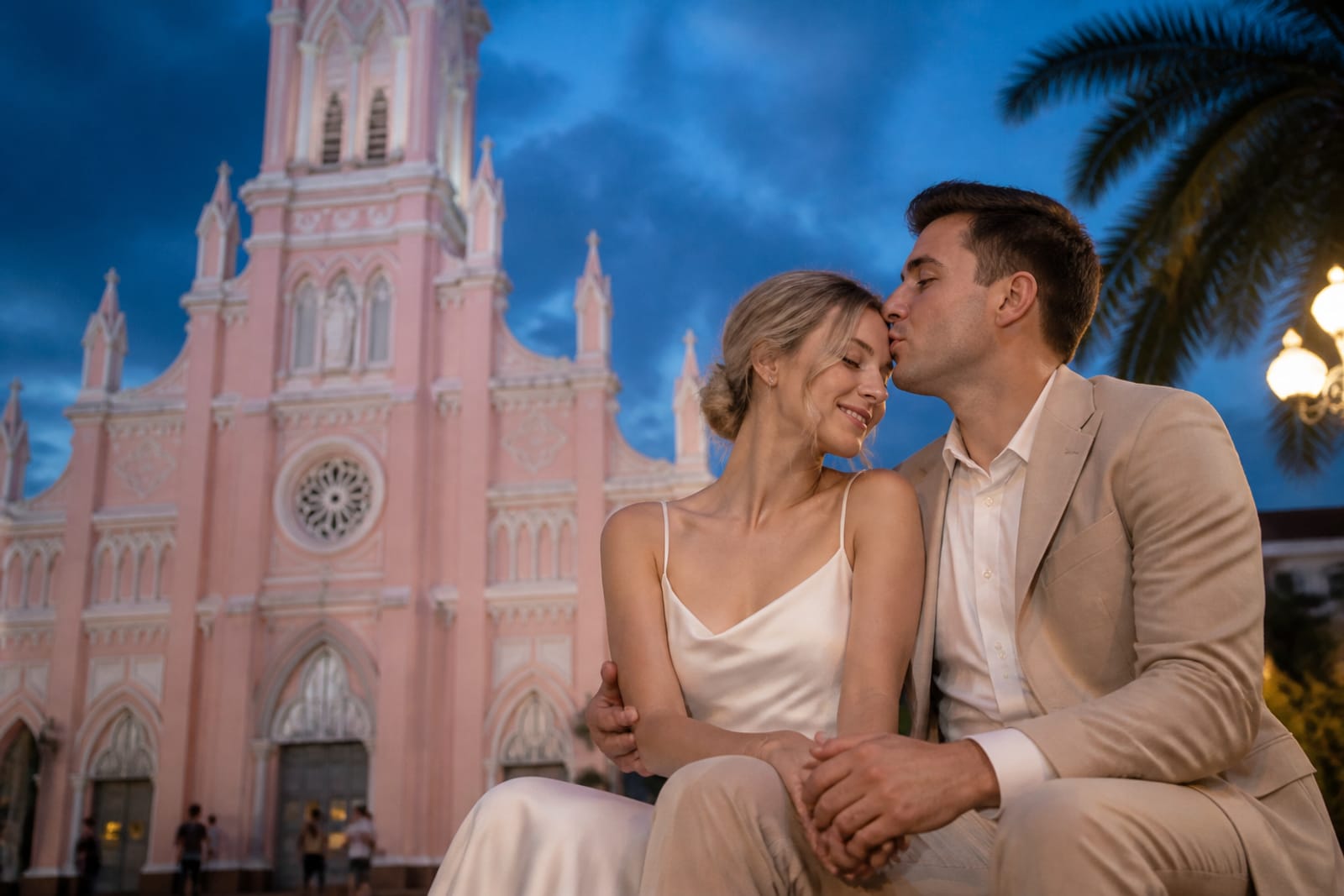
| Da Nang Cathedral | Architectural elegance, intimate framing | Golden hour; Feb–Aug | Low; 1.5–2 hours; flat ground | Modernist icon; clean, compositional backdrop | Limited time on-site; interior light is dim; less "story" than temples |
| Hoi An Ancient Town | Cultural immersion, lantern-lit streets, narrow alleys | Late afternoon (3–5 p.m.); Feb–Aug | Medium; 3–4 hours; uneven lanes | UNESCO heritage, intimate human-scale, magical evening light | Crowded tourist zone; canals limit vantage points; ao dai is traditional costume here (blends rather than stands out) |
Decision: Choose Marble Mountains if you want drama, physical engagement, and an unforgettable story. Choose My Khe if you prioritize ease and reliable light. Choose Hoi An if you want cultural embedding and evening mood.
If Marble Mountains is your choice, prepare ruthlessly:
- Confirm your photographer has ao dai + Marble Mountains experience and can produce references.
- Pre-book transport (dedicated driver, not taxi search at 5 a.m.).
- Finalize the ao dai fit and undergarment plan with the photographer 1 week prior.
- Ask about weather contingency and reshoot policy.
- Hydrate and train on stairs the week before if you're not a regular climber.
📸 Book on WhatsApp — ao dai photoshoot | 🎥 See wedding day & pre-wedding video
---
What to check before you book a Marble Mountains session.
Photographer & location vetting:
- Portfolio proof: Minimum two full Marble Mountains ao dai sessions, not single images.
- Temple access credentials: Confirm they've worked with temple authority or employ a local guide; show evidence of prior sessions without complaints.
- Equipment & expertise: Ask what reflectors, diffusers, and backup lighting they carry; what lens range they use for both environmental and detail frames.
- Backup plan: Get a written weather contingency and rescheduling terms before you pay any deposit.
Session logistics:
- Transport & timing: Who arranges arrival transport? Does the photographer meet you or your hotel? What is the exact start time (6 a.m.? 5:30 a.m.?) and total duration?
- Ao dai & undergarment fit: Will the photographer conduct a fitting 1–2 weeks prior? Do they provide ao dai rental and slip options, or do you source it yourself?
- Inclusions: Confirm what is included in the quote (makeup, hair, number of ao dai options, edited photos, delivery timeline, print options). Prices vary—ask for a WhatsApp quote on the exact package.
- Reshoot policy: If weather forces a cancellation or your photos are unsatisfactory, what is the rescheduling or refund process?
---
Ready to plan your Marble Mountains ao dai session?
Marble Mountains is rewarding for couples willing to invest in physical preparation and a photographer who knows the site deeply. If you're based in Hanoi or Ho Chi Minh City and want a professional, guided ao dao photoshoot at a location your photographer knows, Cáo Studio – Makeup & Photoshoot coordinates pre-wedding and ao dai sessions with teams experienced in location scouting and timing. We don't operate in Da Nang, but we can share vetting criteria and advise on finding a local photographer.
For more on ao dai shoots, explore our lookbook and ao dai rental options. If you're planning a couple's or family session in Hanoi or Ho Chi Minh City, we'd love to guide you—reach out on WhatsApp.
💄 Makeup & hair at your hotel | 👰 Explore pre-wedding & elopement | 🌸 See the lookbook
---
FAQ
Can I do a Marble Mountains ao dai shoot if I'm not very fit?
The climb is 30–45 minutes of stairs and uneven stone. If you have joint or cardiovascular concerns, try a beach or temple site closer to the base. You can also do a hybrid: light ao dai portraits at the lower temple levels only (20 minutes up), skipping the peak.
What is the best season for Marble Mountains ao dai photos?
Feb–Aug is dry and clear (best light). Avoid Sep–Dec (typhoon and rain season; Oct–Nov is worst). Within Feb–Aug, May–Aug is hot (plan hydration); Feb–Apr is cooler and still has excellent light.
Should I book sunrise or late afternoon at Marble Mountains?
Sunrise (6–7 a.m.) is ideal if you're a morning person; light is golden and predictable, crowds are minimal. Late afternoon (4–5 p.m.) offers sidelighting and fewer tourists, but light fades quickly after 5:30 p.m. and you'll finish in dusk. Sunrise is safer for timing and stamina.
Do temples at Marble Mountains allow photography?
Photography is allowed on marked tourist routes. Inner sanctums and active prayer areas may restrict cameras; a respectful photographer knows this. Ao dai is appropriate dress (shoulders and knees covered), but confirm with your photographer whether any sanctum prohibits portraits specifically.
What if it rains on my Marble Mountains session day?
Stairs become slippery and visibility drops. Ask your photographer about their weather contingency before you book. Good photographers offer reshoot dates within a season if weather is severe; confirm this in writing.
FAQ
Can I do a Marble Mountains ao dai shoot if I'm not very fit?
The climb is 30–45 minutes of stairs and uneven stone. If you have joint or cardiovascular concerns, try a beach or temple site closer to the base. You can also do a hybrid: light ao dai portraits at the lower temple levels only (20 minutes up), skipping the peak.
What is the best season for Marble Mountains ao dai photos?
Feb–Aug is dry and clear (best light). Avoid Sep–Dec (typhoon and rain season; Oct–Nov is worst). Within Feb–Aug, May–Aug is hot (plan hydration); Feb–Apr is cooler and still has excellent light.
Should I book sunrise or late afternoon at Marble Mountains?
Sunrise (6–7 a.m.) is ideal if you're a morning person; light is golden and predictable, crowds are minimal. Late afternoon (4–5 p.m.) offers sidelighting and fewer tourists, but light fades quickly after 5:30 p.m. and you'll finish in dusk. Sunrise is safer for timing and stamina.
Do temples at Marble Mountains allow photography?
Photography is allowed on marked tourist routes. Inner sanctums and active prayer areas may restrict cameras; a respectful photographer knows this. Ao dai is appropriate dress (shoulders and knees covered), but confirm with your photographer whether any sanctum prohibits portraits specifically.
What if it rains on my Marble Mountains session day?
Stairs become slippery and visibility drops. Ask your photographer about their weather contingency *before* you book. Good photographers offer reshoot dates within a season if weather is severe; confirm this in writing.
Ao dai, makeup, hair and a local photographer in Hanoi or Saigon — one WhatsApp message.