/ao-dai-photoshoot
Ao Dai Wedding Photos at Thien Mu Pagoda: Guide & Booking
Ao dai wedding photos at Thien Mu Pagoda require a shoot during dry season (February to April) when morning light hits the pagoda's seven-story tower cleanly and crowds thin by midday. Cáo Studio – Makeup & Photoshoot operates in Hanoi, Ho Chi Minh City, and Hoi An; Hue is outside our service area, so you'll book a local Hue photographer directly. Thien Mu itself allows paid entry and photography, but tripods and commercial equipment need gate approval—arrive early to scout light, confirm permissions, and plan outfit changes around foot traffic. Avoid October to November (typhoons, flooding) and the week before Tet (crowds). A half-day session (3–4 hours including travel to the site and makeup) is typical; budget time for the 3-hour round trip from Hue city center via minivan or taxi. ---
Why is Thien Mu Pagoda the top choice for ao dai wedding photos in Hue?
Thien Mu's seven-story octagonal tower dominates every frame and reads instantly as Vietnamese heritage. The riverside setting, manicured gardens, and weathered stone create depth—foreground flowers or archways frame the couple while the pagoda anchors the background. Local couples have shot here for decades, making it a cultural reference point rather than a tourist snapshot. Light quality matters: morning sun from the east (5:30–7:30 a.m.) gives golden, directional rays that flatter ao dai fabrics and skin tone without harsh shadows. By 9 a.m., the temple opens fully and foot traffic builds. A local Hue photographer knows exactly where security allows tripods and how to time a 30-minute window before school groups arrive.
Thien Mu works best for couples seeking iconic, culture-rooted imagery rather than private, undiscovered spots. The site's fame is also its trade-off: exclusivity is limited.
Which season and time of day deliver the best light?
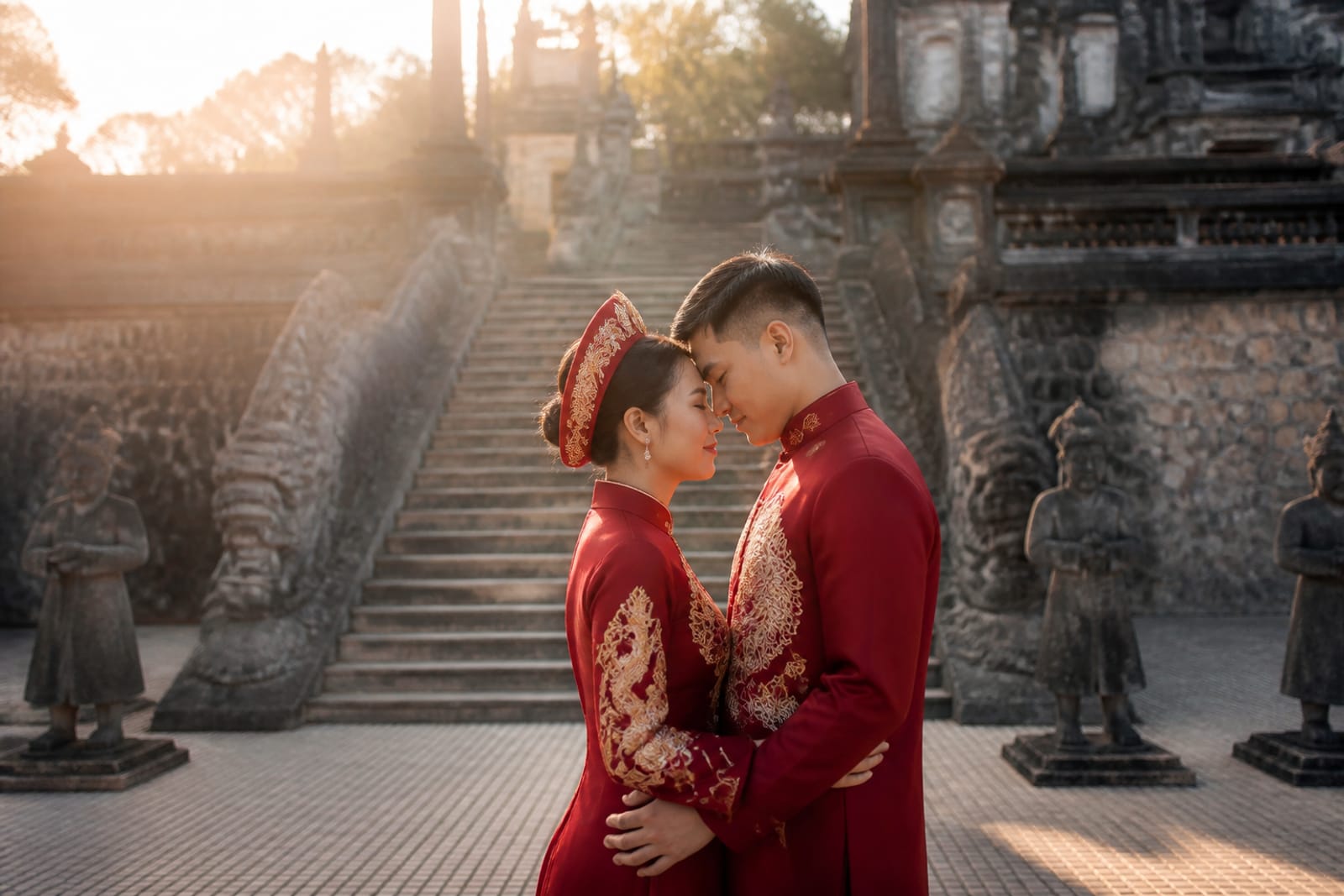
Hue's central-coast climate peaks dry and clear from February to April; May onwards, humidity thickens the air and afternoon clouds loom by 2 p.m. June to September brings oppressive heat (31–35°C) and afternoon downpours—not ideal for ao dai (fabric soaks, makeup runs, water damage to gowns). October and November are the worst: typhoon season brings flooding and unpredictable storms that can cancel shoots within hours. December to January is mild and dry but cool enough to require heavier fabrics.
Golden window: 5:30–7:30 a.m., February–April. Sunrise light is warm, directional, and uncluttered. By 8 a.m., security gates fully open and visitors start arriving. If you shoot 6–7 a.m., you'll have the pagoda nearly alone. Afternoon shoots (3–5 p.m.) work only in January–February when the sun stays low; in other months, harsh overhead light washes out fabric color and creates unflattering shadows on the face. A local photographer will have a preferred early-morning slot booked with temple staff; booking that slot weeks ahead is standard.
What do you need to know about Thien Mu's rules and permissions?
Thien Mu charges entry fees (check the official Hue tourism site for current prices). Beyond the gate fee, photography permissions vary: casual handheld cameras are always allowed; professional tripods, reflectors, and lighting rigs need approval from the gate office or temple staff—some days approval is instant, others the staff may ask you to shoot without tripods. Commercial shoots (wedding, magazine, fashion) technically require a temple permit, though enforcement is inconsistent. A local Hue photographer navigates these informally—they'll know the head guard, time your shoot before inspection rounds, or call ahead to confirm that day's permissions.
Key specifics to confirm with a local photographer before booking:
- Can tripods go inside the main courtyard or only in the garden areas?
- Which zones allow couple poses and which are reserved for prayer?
- Will the temple staff ask for a permit letter or written authorization?
- Is there a "quiet hours" window (often 5–8 a.m.) when monks are in ceremonies and tourists are scarce?
Ao dai hems can catch on ancient stone and roots—wear sturdy flats or flat sandals during scouting; save heels for the actual shoot. Don't pose on altar platforms or in the main shrine; stick to garden walls, archways, and riverside spots.
How do you choose between booking a local Hue photographer vs. traveling to Hanoi or Hoi An with Cáo Studio?
| Option | Best For | Light & Season | Logistics | Trade-offs |
|---|---|---|---|---|
| Local Hue photographer | Couples centered in Hue; single shoot at Thien Mu | Early-morning dry season (Feb–Apr); familiar with monsoon timing | Meet locally; no travel; tight temple permissions | Variable photo quality; limited editing portfolio; communication in Vietnamese often required |
| Cáo Studio in Hoi An | Couples exploring central Vietnam; Hoi An + Thien Mu combo | Dry Feb–Aug; Hoi An Ancient Town light is excellent; can travel to Thien Mu by appointment | Contact on WhatsApp for Thien Mu dates; team travels; makeup included | Higher travel cost; requires advance booking; Hoi An Ancient Town is 2 hours from Thien Mu |
| Cáo Studio Hanoi or Saigon + local guide | Couples blending Thien Mu with a guided Hue itinerary | Hanoi/Saigon base; local guide manages temple permissions | Book studio in home city; hire local Hue fixer; coordinate timing | Coordination complexity; two payment streams |
Recommendation framework:
- Local Hue photographer: You live in Hue, want a single two-hour morning session, and budget is the priority.
- Cáo Studio in Hoi An: You're touring central Vietnam (Hoi An, Da Nang, or a longer trip) and want a professional makeup and multi-location shoot; email WhatsApp to confirm Thien Mu availability and travel dates.
- DIY + local guide: You're comfortable self-directing a photoshoot and hiring a temple liaison; this is the most flexible but requires detailed pre-planning.
📸 Book on WhatsApp — ao dai photoshoot
What should you wear under and with your ao dai at Thien Mu?
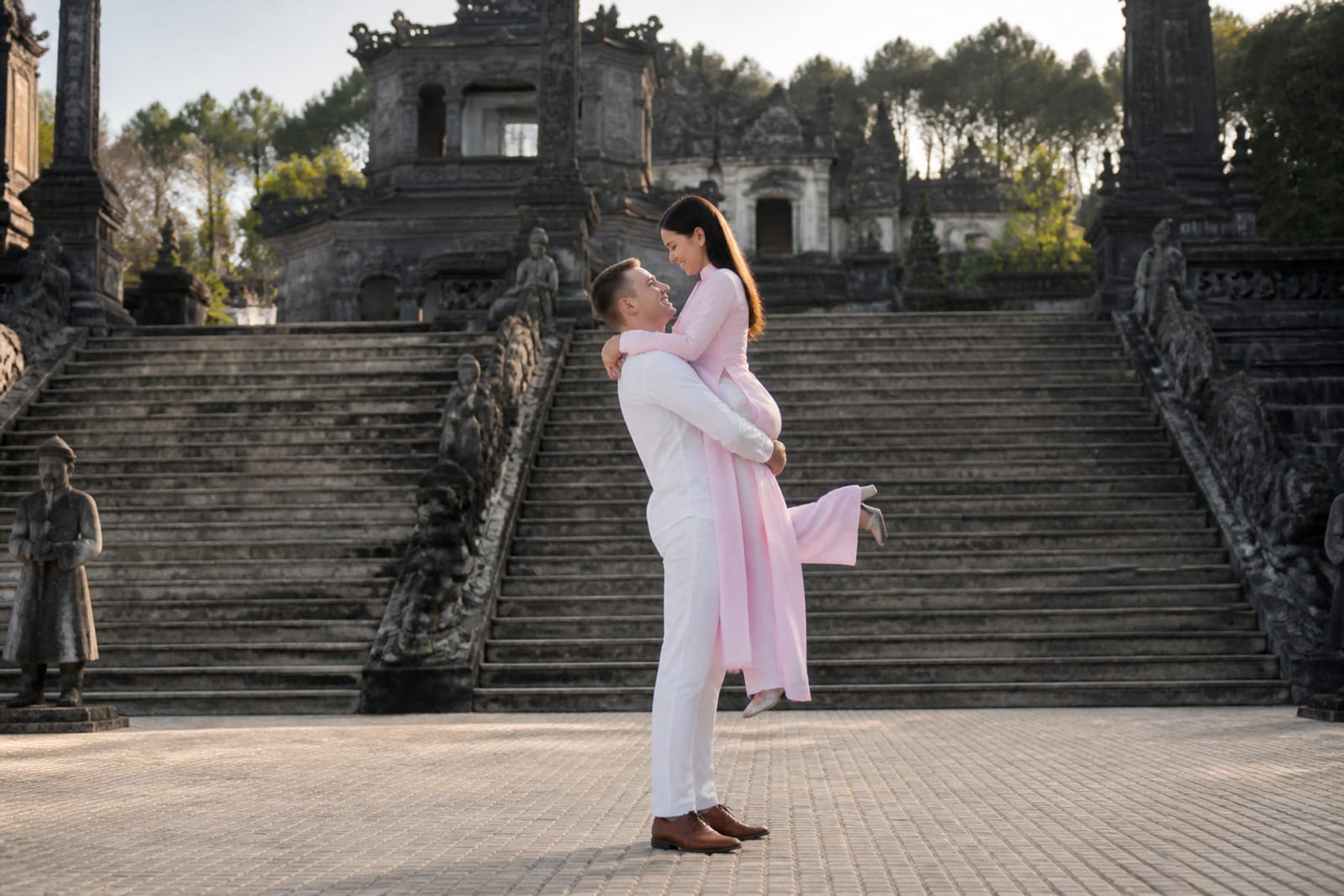
Thien Mu's outdoor light, stone pathways, and riverside breeze create specific demands. Wear a fitted slip or underdress in white or neutral silk—the ao dai's traditional silk and linen are semi-transparent in direct sunlight, and the slip ensures modesty during movement and kneeling. Footwear must be practical for scouting (flat sandals, walking shoes) but photogenic for frames (barefoot, flat metallic sandals, embroidered flats). Jewelry should complement the fabric: gold or silver minimalist pieces; avoid large dangling earrings that distract in close-ups. If you're wearing a traditional ao dai dai (floor-length tunic), hem length matters—Thien Mu's gardens have roots, loose stones, and steps; a hem that drags gets dirty and catches. Work with your photographer to plan outfit changes: bring two ao dai (contrasting colors work well with the grey stone; deep jewel tones and blush are popular) and plan 10–15 minutes per outfit change to adjust fabric, touch up makeup, and reset light.
Groom or partner: a matching ao groom (tunic + pants) or formal Western suit both photograph beautifully. Ao groom fabrics should be lightweight if shooting in warm season. If wearing a suit, choose a lightweight linen blend (heavy wool overheats in Hue's humidity and photographs stiffly). Bare feet for certain frames work—negotiate this detail with your photographer beforehand, as temple etiquette evolves. If renting locally, ask the vendor to deliver outfits the night before so you're not rushed on shoot day.
How do you find and vet a local Hue photographer if you're not using Cáo Studio?
Hue's photography community is smaller than Hanoi or Ho Chi Minh City; word-of-mouth is reliable. Start with reviews on Google Maps (filter "photographer" or "wedding photographer") and Instagram hashtags like #hue_wedding_photos, #thiemupagoda_shoots. Contact 3–5 photographers and ask for:
- Portfolio specific to Thien Mu: Ask to see 5+ full shoots (not just one-off frames). Do they nail the early-morning light? Is the pagoda framed naturally or does it look forced? Are faces well-lit even in backlit golden hour?
- Communication style: Can they explain their process in English (or your language)? Do they respond within 24 hours? Do they ask about your vision or push a single style?
- Thien Mu permissions: Have they shot there in the last year? Do they know the gate staff? Can they secure early-morning access or confirm current tripod rules?
- Editing consistency: Are colors warm and natural or over-saturated? Do skins look alive or plastered? Ask for a full edited gallery (not a highlight reel).
- Availability and cost factors: Peak season (Feb–Mar) books fast—some photographers have 2–3 month waits. Confirm they're available on your preferred date. Ask what factors affect their rate (number of outfits, location travel, album size, video add-on). Never ask for a price in writing before confirming scope—rates vary wildly by what's included.
Reference questions to ask:
- "How many frames per hour do you typically deliver?" (Look for a range; someone claiming 1,000+ photos is likely overshooting and under-editing.)
- "Do you edit every frame or curate a gallery?" (Curation is professional; delivery of raw bulk is not.)
- "What happens if it rains on shoot day?" (A pro has a backup plan; a novice says "we reschedule.")
What are the practical logistics of a Thien Mu shoot day?
A typical Thien Mu morning involves:
5:00 a.m.: Photographer or assistant picks you up from your hotel (or you meet on-site). Ao dai is already fitted; makeup artist (if booked separately) meets you at the pagoda or applies makeup at the hotel 4:15 a.m.
5:30–6:30 a.m.: Scout light, take opening frames. Soft, golden sun, zero foot traffic. First outfit is usually the hero shot—take your time here.
6:30–7:30 a.m.: Outfit change top; second set of locations (riverside archway, garden staircase, main tower backdrop).
7:30–8:30 a.m.: Temple opens; staff begins inspections. Light is now bright but still directional. Finish hero couple frames and group shots (if family is joining).
8:30 a.m. onwards: Crowds build. A second morning shoot (9:00–11:00 a.m.) is possible but light is flatter and you're competing for angles. Most photographers wrap by 8:30 a.m.
Challenges & how to avoid them:
- Fog in cool months (Dec–Feb): Arrive even earlier (5:15 a.m.) to shoot before mist burns off. Some photographers have contingency indoor locations (Hue's Citadel, royal tombs) if fog is thick.
- Tripod denial: Confirm permissions the day before. Have a backup camera bag with a monopod or handheld gimbal (lighter, less intrusive).
- Outfit changes in open air: Bring a privacy screen or rent a nearby room at a garden cafe for quick changes.
- Makeup durability: If not using a professional makeup artist, choose long-wear foundation and water-resistant eyeliner. Riverside humidity and exertion (walking stairs, sitting on stones) test makeup endurance.
Timing expectation: A typical Thien Mu half-day shoot is 3–4 hours on-site including one outfit change, scouting, and travel. Full-day shoots (two locations, 2+ outfits) add 2+ hours and require careful scheduling to avoid mid-morning crowds.
---
What to check before you book
- Photographer's Thien Mu portfolio: Ask for 3+ full shoots, not highlights.
- Temple permissions current as of your shoot month: Rules shift; confirm via WhatsApp or email.
- Sunrise slot booking: Early morning (5:30–7:30 a.m.) is non-negotiable for light quality; confirm availability now.
- Makeup service: Is it included or separate? If separate, is the makeup artist reliable at pre-dawn timing?
- Outfit rental or ownership: Confirm ao dai ownership/delivery—don't assume it's rented locally without a contract.
- Weather contingency: What's the reschedule policy if it rains? Thien Mu is outdoor-only; an alternative indoor location (royal tombs, Hue Citadel) should be pre-planned.
- Edited gallery timeline: When will photos be ready? Typical is 1–3 weeks post-shoot.
- Cost factors (never ask for a price before scope): number of outfits, retouching depth, album design, delivery format. Communicate these via WhatsApp or email to the photographer.
---
---
If you're based in or visiting Hoi An and want to combine Thien Mu with professional makeup and pre-wedding or ao dai photoshoots, Cáo Studio in Hoi An can travel to Thien Mu by appointment—ask on WhatsApp for availability and dates. For a standalone Thien Mu shoot, hire a local Hue photographer using the vetting framework above. For broader central Vietnam photo planning, see our couple & family photoshoot guide and vacation photoshoot options.
FAQ
Can Cáo Studio – Makeup & Photoshoot shoot at Thien Mu Pagoda?
Cáo Studio operates in Hanoi, Ho Chi Minh City, and Hoi An (by appointment). Thien Mu is in Hue, outside our service area. However, if you're in Hoi An, contact us on WhatsApp to check availability for a Thien Mu travel shoot. Otherwise, hire a local Hue photographer using the vetting tips in this guide.
What is the best month to shoot ao dai photos at Thien Mu?
February to April (dry, cool, golden light). Avoid October–November (typhoons, flooding) and May–September (afternoon storms, heat). January works but is cooler; December is mild. Early morning (5:30–7:30 a.m.) is essential year-round.
Do I need a permit to shoot a wedding photo session at Thien Mu?
Entry fees are required; check the official Hue tourism website for current prices. Commercial shoots technically need temple permission. Tripods and professional equipment may need approval at the gate—a local photographer will navigate this. Confirm permissions the day before.
How long does a typical Thien Mu ao dai shoot take?
Half-day is 3–4 hours on-site (5:30 a.m.–8:30 a.m.), including one outfit change, scouting, and round-trip hotel transfer. Full-day (two locations, 2+ outfits) takes 6–8 hours. Peak early-morning light lasts only 2–3 hours.
Should I hire a local Hue photographer or book Cáo Studio?
Book local if you live in Hue or want a single budget-friendly shoot. Book Cáo Studio in Hoi An if you're touring central Vietnam and want professional makeup included. Use this guide's vetting framework to vet any local photographer—ask for Thien Mu portfolio, early-morning availability, and monsoon contingencies.
What should I wear under an ao dai at Thien Mu?
A fitted slip or underdress in white or neutral silk (ao dai is semi-transparent in sunlight). Choose practical footwear for scouting (flats), photogenic for frames (barefoot or flat sandals). Avoid long hems that catch on roots and stones. Bring two ao dai in contrasting colors for outfit changes.
FAQ
Can Cáo Studio – Makeup & Photoshoot shoot at Thien Mu Pagoda?
Cáo Studio operates in Hanoi, Ho Chi Minh City, and Hoi An (by appointment). Thien Mu is in Hue, outside our service area. However, if you're in Hoi An, contact us on WhatsApp to check availability for a Thien Mu travel shoot. Otherwise, hire a local Hue photographer using the vetting tips in this guide.
What is the best month to shoot ao dai photos at Thien Mu?
February to April (dry, cool, golden light). Avoid October–November (typhoons, flooding) and May–September (afternoon storms, heat). January works but is cooler; December is mild. Early morning (5:30–7:30 a.m.) is essential year-round.
Do I need a permit to shoot a wedding photo session at Thien Mu?
Entry fees are required; check the official Hue tourism website for current prices. Commercial shoots technically need temple permission. Tripods and professional equipment may need approval at the gate—a local photographer will navigate this. Confirm permissions the day before.
How long does a typical Thien Mu ao dai shoot take?
Half-day is 3–4 hours on-site (5:30 a.m.–8:30 a.m.), including one outfit change, scouting, and round-trip hotel transfer. Full-day (two locations, 2+ outfits) takes 6–8 hours. Peak early-morning light lasts only 2–3 hours.
Should I hire a local Hue photographer or book Cáo Studio?
Book local if you live in Hue or want a single budget-friendly shoot. Book Cáo Studio in Hoi An if you're touring central Vietnam and want professional makeup included. Use this guide's vetting framework to vet any local photographer—ask for Thien Mu portfolio, early-morning availability, and monsoon contingencies.
What should I wear under an ao dai at Thien Mu?
A fitted slip or underdress in white or neutral silk (ao dai is semi-transparent in sunlight). Choose practical footwear for scouting (flats), photogenic for frames (barefoot or flat sandals). Avoid long hems that catch on roots and stones. Bring two ao dai in contrasting colors for outfit changes.
Ao dai, makeup, hair and a local photographer in Hanoi or Saigon — one WhatsApp message.