/pre-wedding-photoshoot
Hidden photo corners near Moc Chau tea hills for couples
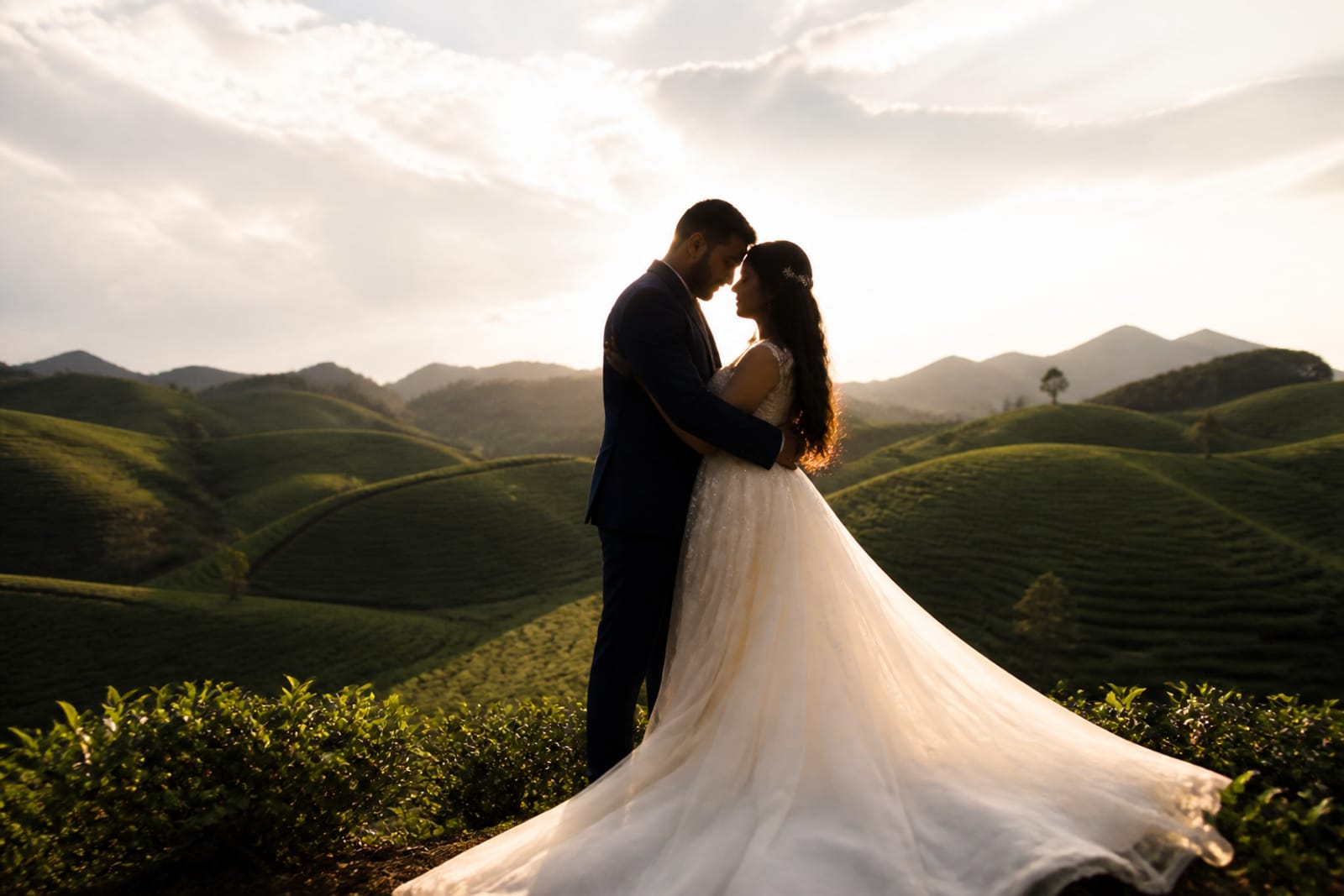
Moc Chau's hidden corners—plum orchard lanes (Jan–Feb), tea terraces at sunrise (Oct–Apr), and weathered temples—suit couples seeking frames beyond the main viewpoint. Light peaks at dawn (6:30–7:30 am) on hillsides and inside temple courtyards where side light flatters faces without harsh shadows. A directed couple photoshoot with makeup, outfit and one camera team works better than a solo tripod: the photographer guides you to walk, look at each other, and pause at the right frame, while your outfit and hair stay camera-ready. Sessions take 2–4 hours depending on locations. Winter (Dec–Feb) brings cool mist and blossoms; spring (Mar–Apr) is clear and green. Avoid midday (11 am–2 pm) when sun is overhead and unflattering. If you're in Hanoi and want a pre-wedding shoot with the team, ask on WhatsApp about Moc Chau dates; otherwise, hire a local photographer and reference this guide for spots and timings. ---
How is Moc Chau different from Hanoi couple photoshoot spots?
Moc Chau sits 160 km southwest of Hanoi—a half-day drive through mountains and farmland. Unlike urban locations (Old Quarter lanes, Red River, temples in the city), Moc Chau trades crowds for open air, tea terraces and seasonal blooms. Light here is softer and more directional: the terrain forces sun angles that suit portraiture. The trade-off is travel time and fewer backup indoor spaces if weather turns. Best suited for couples with 1–2 days available and who want landscape as a co-star, not a backdrop.
🌸 See the lookbook for couple frames shot in similar terrain.
When should you shoot: blossom season or tea-picking months?
Timing comparison:
| Season | Best for | Light & weather | Walking ease | Outfit fit |
|---|---|---|---|---|
| Jan–Feb (plum/cherry blooms, Tet prep) | Colour and texture; intimate framing | Cool, misty mornings; flat light mid-morning | Steep orchard paths, muddy after rain | Layers; light jacket over ao dai works |
| Mar–Apr (spring, clear skies) | Clean landscape; long shadows at dawn | Sharp side light 6:30–8 am; harsh by 10 am | Well-trodden paths; dry | Light fabrics; no jacket needed |
| May–Sep (tea-picking, rainy season) | Emerald terraces; fewer crowds; short afternoon downpours | Heavy overcast; soft but dim light | High grass, muddy, leeches possible | Long sleeves; waterproof bag essential |
| Oct–Nov (post-typhoon, clearest air) | Sharpest visibility; cool mornings; lowest crowds | Golden dawn light; crisp shadows; glare by 9 am | Dry, easy walking | Layers; morning chill |
Conclusion: Jan–Feb and Oct–Nov deliver the best light-to-walking ratio. Mar–Apr works if you arrive by 6:30 am and finish by 8:30 am.
Which hidden corner suits your story: temple, terrace or orchard lane?
Three micro-locations each tell a different frame. Temple courtyards (Suoi Giang or local pagodas near Moc Chau town) have weathered stone, shade, and quiet morning energy—ideal for intimate, slow-paced sequences where you walk hand-in-hand and pause under eaves. Side light enters from the east, soft before 8 am. Walking effort is minimal; outfit (ao dai or dress) stays clean. Downside: access depends on caretaker goodwill; arrive early or book via your guide.
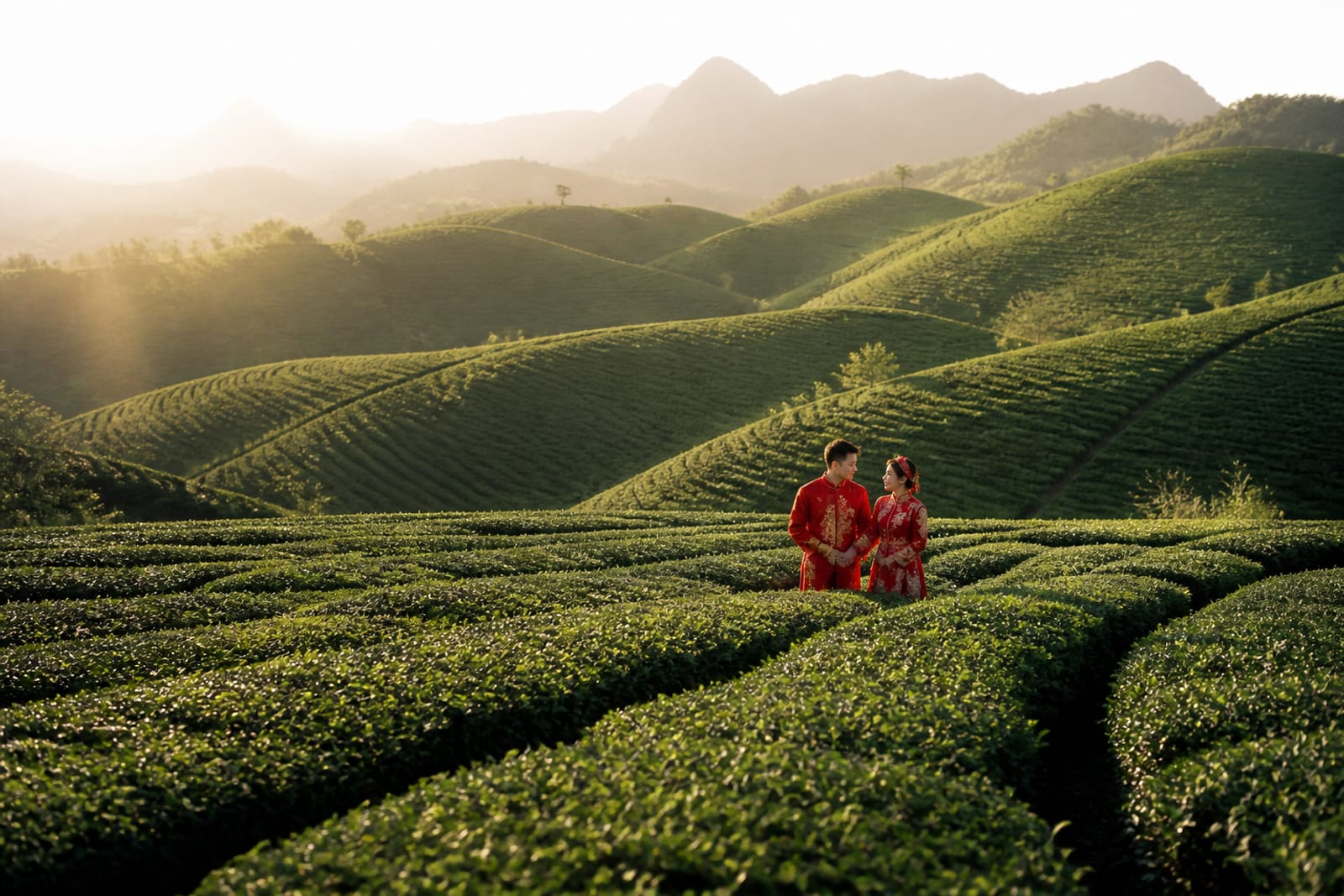
Tea terraces (commercial plantations open to visitors) reward early starts. Walk the edge rows at 6:30 am when mist clings to the slopes—light is diffused, shadows are long, and the geometry of vines creates leading lines. You'll walk 20–30 minutes uphill; sturdy shoes and a light layer matter. An ao dai works but tea-stained knees are a risk; consider a linen dress or trousers for this location.
Plum orchard lanes (Jan–Feb only, around Moc Chau northeast) bloom white and pink—a natural color story. Narrow paths between trees create a tunnel effect; side light filters through branches. 10–15 minute walks; minimal climbing. Blossom falls like confetti if wind picks up—your hair and outfit become part of the frame. Best for couples who want a cinematic, almost-accidental aesthetic.
Conclusion: Each suits a different mood and timeline. Orchard = colour + intimacy; terrace = scale + geometry; temple = stillness + texture.
💄 Makeup & hair at your hotel ensures you're camera-ready at dawn, even after a mountain drive.
Why does a directed team beat a self-guided or tripod session in Moc Chau?
A directed couple photoshoot with a photographer, makeup artist and stylist works because three things happen at once: (1) Light timing is locked. The photographer knows Moc Chau's dawn angles and positions you in the sweet spot—not guessing with a tripod timer. (2) Your outfit and face stay fresh. Hair and makeup are done on-site or at your hotel 1–2 hours before the shoot; touchups happen between locations. (3) You're guided, not posed. Instead of stiff "look at camera" moments, the director says "walk toward the terraces, look at each other, slow down here"—motion and genuine connection replace awkwardness.
Self-guided or tripod sessions miss these layers: you're tired before the best light hits, your hair has fallen, and frames feel static. Moc Chau's scattered locations also mean logistics—parking, access permissions, timing shifts if weather changes. A team handles these calls on the fly.
For pre-wedding photoshoots, a Cáo Studio team can travel to Moc Chau if you're based in or near Hanoi; ask on WhatsApp for dates and logistics. Otherwise, a local Hanoi-based photographer who knows Moc Chau is your best option—vet them on shot composition and light sense, not follower counts.
What to check before you book a Moc Chau photoshoot session?
Before committing, confirm these with your photographer:
- Season & light. If you're set on Jan–Feb, book 4–6 weeks ahead (blossom dates shift; photographer must scout). If Oct–Nov, you have more flexibility but confirm the exact dawn time for your shoot date.
- Travel & parking. Does the team drive, or do you? If they drive, is fuel or mileage built into the quote? Moc Chau has limited parking near prime spots—ask how they access terraces or temples (guide needed? permissions required?).
- Outfit & hair. If you're wearing an ao dai, confirm the photographer can work around wet grass and possible stains. If makeup is included, ask about touch-up frequency—a 3–4 hour session in mountain air means powder and lipstick refresh every 60–90 minutes.
- Weather backup. Moc Chau is misty Oct–Feb. Ask: if fog is too thick for landscape frames, do you reschedule, or does the team pivot to temple close-ups and detail work?
- Delivery timings. When are frames edited? Moc Chau sessions often take longer to edit (more locations, varied light) than city shoots. Confirm the turnaround—is it 48 hours, one week, or longer?
- Permits or fees. Some tea plantations charge entry; temples may request a small donation. Ask who covers these costs.
Honest reality: Moc Chau shoots are more complex than city sessions. You're paying for travel time, early starts, and a team that navigates variable terrain and light. If cost is the main factor, a Hanoi session (Old Quarter, Tay Ho) is faster and cheaper. Moc Chau is for couples who want landscape storytelling and are willing to wake at 5 am.
---
What's the outfit strategy for Moc Chau terrain?
For ao dai wearers: An ao dai at sunrise in cool mist is atmospheric—silk catches soft light beautifully. Pair it with trousers (not a skirt underneath) so you can walk uphill without tangling. Wear closed-toe hiking shoes, not sandals; mud and rocks are common. The hemline will brush dew; accept this as texture, not a problem. A light cardigan over the ao dai works in Jan–Feb without disrupting the frame.
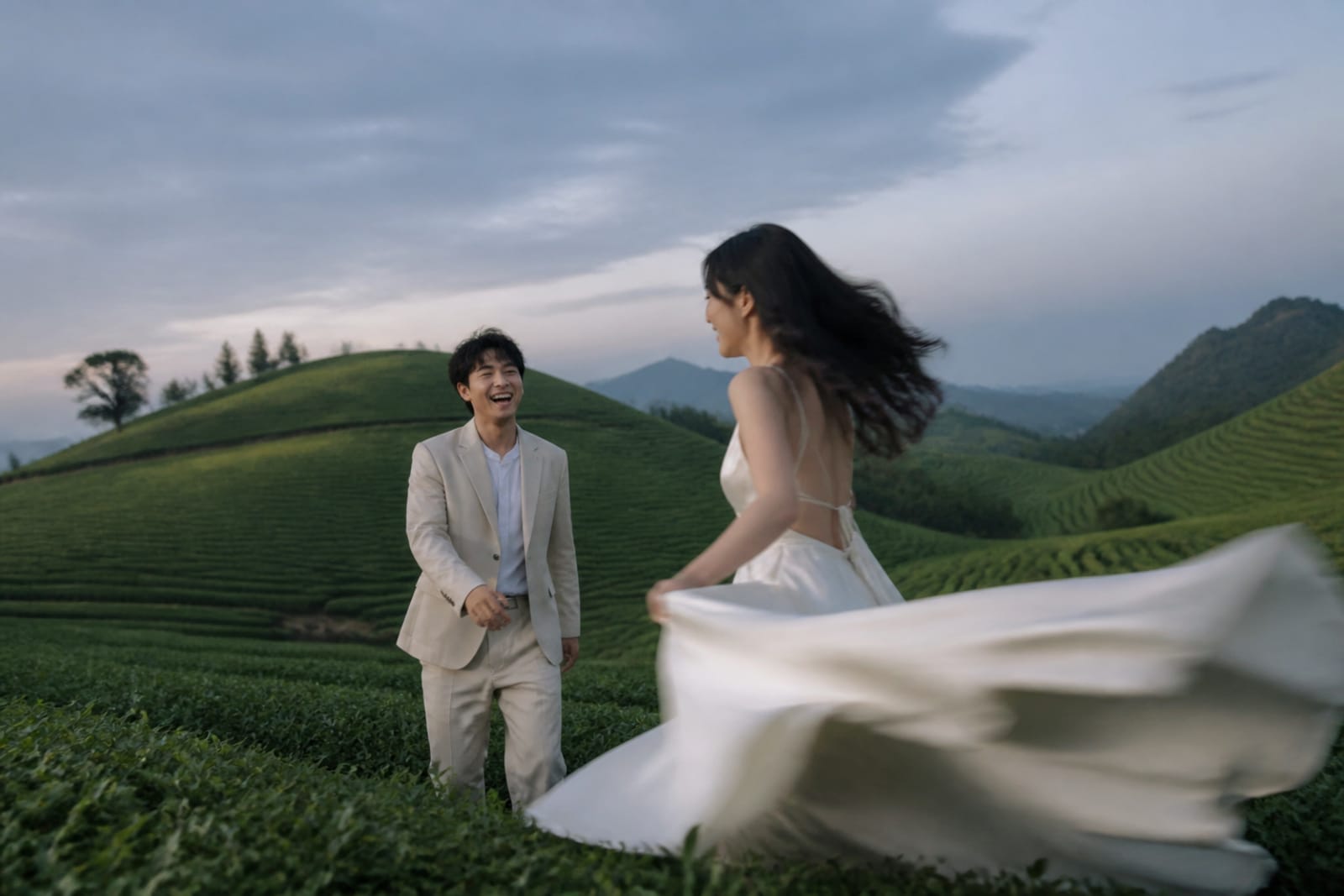
For Western dress: A linen or cotton midi dress works better on terraces than an ao dai—easier to walk in, less risk of staining. Neutral tones (cream, sage, tan) read better against green tea than bright colours. Avoid anything with heavy beading or long sleeves if May–Sep humidity is a factor.
For grooms/partners: Neutral linen shirt and lightweight trousers. A vest or unstructured jacket (not formal) adds texture without overheating. Avoid logos and busy patterns—simplicity lets landscape and your faces lead the frame.
Footwear: Non-negotiable—waterproof, grippy soles. Moc Chau paths are slippery after rain. You'll change into heels (if desired) for final portraits at a flat location like the temple courtyard.
---
How to find and vet a local Moc Chau photographer if Cáo Studio isn't available?
If you're not booking through Cáo Studio, hire locally but smart. Check their portfolio for:
- Light sensitivity. Do their images show strong directional light and shadow play, or are they flat and filtered? Moc Chau light is subtle—a photographer who understands it will show couples lit from the side, not blown-out or underexposed.
- Terrain handling. Are there frames taken on slopes, in overgrown spots, or near water? If their portfolio is all studio or flat urban locations, they may struggle with Moc Chau's uneven terrain and variable light.
- Motion over pose. Do subjects look natural while walking or interacting, or stiff and directed? Moc Chau frames work when you're moving through the landscape.
- Seasons. Ask them directly: have they shot in Moc Chau in your intended season? What was the light like? How did they handle weather?
Questions to ask:
- How many shoots have you done in Moc Chau? (If fewer than 5, they're learning the location.)
- What's your dawn arrival time and why?
- Do you include makeup and hair, or just photography?
- What's your backup plan if mist is heavy or rain arrives?
- When will edited frames be ready?
📸 Book on WhatsApp — ao dai photoshoot or ask us to recommend a trusted local photographer in Moc Chau.
---
What to know about Moc Chau weather and how it affects your shoot?
Dec–Feb (winter, cool & misty): Temperatures drop to 10–15°C at dawn. Mist is common, especially 6–8 am—atmospheric but reduces visibility and sharpness. Plum and cherry blossoms peak around Tet (late Jan–mid Feb); dates vary year to year. Rain is rare but paths are muddy from overnight dew. Bring a fleece or thermal layer under your outer outfit.
Mar–Apr (spring, clear): Crisp mornings (12–18°C), clear skies by sunrise. Golden light is predictable and strong—arrive early to catch it before glare. Paths dry fast. Rain is uncommon. Ideal for sharp landscape frames.
May–Sep (rainy season, humid & green): Afternoon downpours are standard 2–5 pm. Mornings can be misty and dim. Humidity peaks; makeup and hair suffer. Tea is being picked (great texture but crowds). Leeches appear after rain—wear socks and check legs afterward. Not ideal unless you want moody, overcast aesthetic.
Oct–Nov (autumn, clearest light & lowest crowds): Cool mornings (15–20°C), sharp shadows, brilliant clarity. Lowest rainfall. Paths are dry. This is the photographer's dream season for Moc Chau. Sunset light is equally strong, if you're willing to shoot evening.
Practical note: If you're in Hanoi and booking a pre-wedding photoshoot in Moc Chau, ask your team about real-time weather checks—cloud cover can shift in one hour at elevation. A flexible itinerary (multiple locations, indoor backup) beats a rigid shot list.
---
Comparison: Moc Chau couple shoot vs. nearby alternatives?
| Location | Light character | Terrain & walking | Crowd level | Best season | Outfit fit | Why choose it |
|---|---|---|---|---|---|---|
| Moc Chau tea hills | Soft, directional at dawn; misty Oct–Feb; golden Mar–Apr | Rolling slopes, 20–40 min cumulative walking, muddy after rain | Very low; mostly locals & tea workers | Oct–Nov, Jan–Apr | Ao dai risky on wet grass; linen dress safer | Landscape storytelling; intimate scale; blossom season (Jan–Feb) |
| Ninh Binh (Trang An, Mua) | Dramatic limestone backlight at sunrise; harsh midday | Flat boat rides + 500 steps to summit; high climbing effort | Medium–high; tour groups afternoon | Oct–Apr (dry) | Ao dai fine on boats; bring shoes for steps | Iconic, cinematic; vertical drama; water reflections |
| Ha Giang loop (Ma Pi Leng) | Harsh, unforgiving midday light; golden dawn on switchbacks | Extreme; 6+ hours motorbike or driving | Very low; remote | Oct–Apr (cool) | Casual trousers/jacket only | Adventure aesthetic; extreme scale; very few couples attempt |
| Hoi An Ancient Town | Soft urban light at dusk; lantern glow after 6 pm | Flat, walkable lanes; no climbing | High–very high; tourists crowding evening hours | Oct–Apr (dry, cool evenings) | Ao dai ideal (town tradition); rental shops everywhere | Cultural backdrop; easy logistics; ao dai rental on-site |
| Ha Long Bay | Scattered light through karst; often overcast; dramatic if clear | Boat-based; no walking; prone to seasickness | Medium; cruise-dependent | Sep–Oct, Nov–Apr (calm seas) | Casual dress recommended; ao dai impractical on deck | Epic scale; water reflections; all-weather option |
Conclusion: Moc Chau suits couples who value intimate, directional light and are happy to wake early and walk. Ninh Binh is faster and more iconic but crowded. Hoi An is easiest logistically and ao dai-friendly. Ha Giang is for adventurers; Ha Long is for drama and sea air.
---
Should you hire a videographer for Moc Chau as well?
Moc Chau's light and motion—sunrise mist, you walking between tea rows, wind through orchard blossoms—translate beautifully to short-form video (reels, tiktok, wedding day previews). A wedding & pre-wedding video crew working alongside the photographer captures movement and sound (wind, birds, footsteps) that stills alone can miss.
Trade-offs: Videography adds travel time and crew size (more logistical complexity on uneven terrain). Cost is a factor; ask if video is a separate rate or bundled. Most couples film video only if it's for a wedding day highlight or anniversary reel—not every session needs it.
If Cáo Studio is handling your pre-wedding photoshoot and you want video, confirm Moc Chau capability on WhatsApp; otherwise, a local photo-video team doubles your coordination but ensures both are optimized for the location.
---
What to check before you book:
- Photographer's Moc Chau portfolio. Do frames show strong light and natural motion? Are there images from your target season?
- Logistics ownership. Who arranges transport, parking and location access—you or the team? Clarify costs and timing.
- Outfit & hair plan. Will makeup refresh happen mid-shoot? Can the photographer work around ao dai on wet terrain?
- Weather contingency. If mist is heavy or rain arrives, what's the pivot—reschedule, indoor locations, or minimal-light reframing?
- Delivery timeline. Moc Chau shoots take longer to edit (multiple terrains, scattered light). Confirm turnaround—48 hours, one week, or custom?
---
Ready to book? Cáo Studio can arrange a Moc Chau couple photoshoot if you're in or near Hanoi. Ask on WhatsApp about dates, travel logistics and include your target season. If you're based elsewhere, use this guide to vet a local photographer—light, terrain and motion matter more than credentials.
📸 Book on WhatsApp — ao dai photoshoot | 🌸 See the lookbook | 💄 Makeup & hair at your hotel
---
FAQ
Can you shoot in Moc Chau if I'm not in Hanoi?
Cáo Studio is based in Hanoi and Saigon. If you're near Hanoi, we can travel to Moc Chau—ask on WhatsApp for dates and logistics. If you're elsewhere, hire a local Moc Chau photographer using the vetting tips in this guide.
What's the best time for plum blossoms at Moc Chau?
Plum and cherry blossoms peak late Jan to mid-Feb (around Tet), but exact dates shift yearly. Confirm with your photographer 4–6 weeks ahead. Blooms last 10–14 days once they open.
Is Moc Chau safe for an ao dai shoot?
Yes, but with caveats. Wear trousers under the ao dai, not a skirt. Pair it with closed-toe hiking shoes. The hem will touch damp grass and possibly stain—this is texture, not failure. If staining worries you, choose a linen dress or trousers instead.
How long does a Moc Chau couple session take?
Typically 2–4 hours depending on location count and walking pace. Add 1–2 hours for travel if you're starting from Hanoi. Most shoots run dawn (6–7 am) through mid-morning (9–10 am) to capture best light.
What should I wear under an ao dai for comfort and movement?
Wear full-length trousers (white, black or nude) under the ao dai, not a slip skirt. Avoid tight leggings—movement should be free. A thin thermal layer or cotton undershirt works in cool Jan–Feb. Avoid anything bulky that shows through the silk.
Can we reschedule if weather is bad on shoot day?
Yes, but confirm the reschedule policy before booking. Moc Chau weather is unpredictable (mist, sudden rain). Ask: does the team offer one free reschedule? After that, is there a rebooking fee? A flexible couple and a flexible photographer make bad weather manageable.
How soon will edited photos be ready after a Moc Chau shoot?
Moc Chau shoots typically take 5–10 days to edit (longer than city shoots due to varied terrain and light). Ask your photographer for a guaranteed delivery date before booking. Rush editing (48 hours) may cost extra.
Should I book a videographer for my Moc Chau couple shoot?
Video adds richness (motion, sound, atmosphere) but also cost and crew logistics. Book it if you want a wedding highlight reel or anniversary short film. For stills-only couples, photos alone are usually enough—check your photographer's video quality before deciding.
FAQ
Can you shoot in Moc Chau if I'm not in Hanoi?
Cáo Studio is based in Hanoi and Saigon. If you're near Hanoi, we can travel to Moc Chau—ask on WhatsApp for dates and logistics. If you're elsewhere, hire a local Moc Chau photographer using the vetting tips in this guide.
What's the best time for plum blossoms at Moc Chau?
Plum and cherry blossoms peak late Jan to mid-Feb (around Tet), but exact dates shift yearly. Confirm with your photographer 4–6 weeks ahead. Blooms last 10–14 days once they open.
Is Moc Chau safe for an ao dai shoot?
Yes, but with caveats. Wear trousers under the ao dai, not a skirt. Pair it with closed-toe hiking shoes. The hem will touch damp grass and possibly stain—this is texture, not failure. If staining worries you, choose a linen dress or trousers instead.
How long does a Moc Chau couple session take?
Typically 2–4 hours depending on location count and walking pace. Add 1–2 hours for travel if you're starting from Hanoi. Most shoots run dawn (6–7 am) through mid-morning (9–10 am) to capture best light.
What should I wear under an ao dai for comfort and movement?
Wear full-length trousers (white, black or nude) under the ao dai, not a slip skirt. Avoid tight leggings—movement should be free. A thin thermal layer or cotton undershirt works in cool Jan–Feb. Avoid anything bulky that shows through the silk.
Can we reschedule if weather is bad on shoot day?
Yes, but confirm the reschedule policy before booking. Moc Chau weather is unpredictable (mist, sudden rain). Ask: does the team offer one free reschedule? After that, is there a rebooking fee? A flexible couple and a flexible photographer make bad weather manageable.
How soon will edited photos be ready after a Moc Chau shoot?
Moc Chau shoots typically take 5–10 days to edit (longer than city shoots due to varied terrain and light). Ask your photographer for a guaranteed delivery date before booking. Rush editing (48 hours) may cost extra.
Should I book a videographer for my Moc Chau couple shoot?
Video adds richness (motion, sound, atmosphere) but also cost and crew logistics. Book it if you want a wedding highlight reel or anniversary short film. For stills-only couples, photos alone are usually enough—check your photographer's video quality before deciding.
Ao dai, makeup, hair and a local photographer in Hanoi or Saigon — one WhatsApp message.