/pre-wedding-photoshoot
Ho Chi Minh City or Quy Nhon for pre-wedding photos
Ho Chi Minh City works best if you want diverse urban architecture (colonial buildings, street markets, modern districts), predictable light year-round, and no travel logistics—Cáo Studio – Makeup & Photoshoot operates a full Saigon branch with makeup and styling on-site. Quy Nhon suits couples seeking golden-hour beach and cliff photography, but requires coordination: the central coast is driest and clearest February through August; the team travels there by appointment only, so book well ahead. Ho Chi Minh City shoots are faster to organize (same-day hair and makeup possible); Quy Nhon demands weather windows and coordinated timing. Choose Ho Chi Minh City for convenience and year-round consistency; Quy Nhon for dramatic, light-dependent coastal drama during the dry season.
Ho Chi Minh City and Quy Nhon represent two fundamentally different pre-wedding narratives. Ho Chi Minh City—hot, dense, and constantly lit by urban geometry—favors couples drawn to texture, vintage colonial walls, and street-level intimacy. Quy Nhon offers unobstructed seascapes, dramatic cliffs, and light that changes every hour. Neither is objectively "better"; the choice hinges on your aesthetic, timeline, and tolerance for logistics.
Why does light quality differ so much between these two locations?
Ho Chi Minh City sits in the southern lowlands and remains warm year-round (roughly 25–35°C). During December through April (the dry season), mornings offer soft, indirect light bouncing off buildings and streets—ideal for detail shots of hands, fabrics, and faces. Midday is harsh; golden hour (late afternoon into sunset) compresses between 5–6 p.m. because the city is dense with tall structures that cast hard shadows early. Quy Nhon, on the central coast, has unobstructed ocean horizons. During the dry season (February–August), the light is piercing and directional—no urban bounce to soften it. Early morning and late afternoon both work beautifully here, but the shoot window is longer because the coastline faces open water. During the rainy season (September–December, worst October–November), Quy Nhon suffers typhoons, heavy cloud cover, and unpredictable storms that cancel or drastically shorten sessions. Ho Chi Minh City light is consistent but compressed; Quy Nhon light is dramatic but seasonal.
| Aspect | Ho Chi Minh City | Quy Nhon |
|---|---|---|
| Best season | Dec–Apr (dry, mild); Jan–Feb coolest | Feb–Aug (clear, dry, unobstructed light) |
| Worst season | May–Oct (humidity, afternoon storms) | Sep–Dec (typhoon risk, rain, cloud) |
| Light character | Soft, diffused by urban structures; compressed to 5–6 p.m. | Piercing, directional over water; long golden window |
| Backup weather | Covered arcades, colonial interiors, markets | None—coastal weather is binary |
| Logistics | Studio on-site; same-day hair/makeup | Travel by appointment; coordinate weeks ahead |
| Wardrobe fit | Ao dai, modern dress, city casual blend easily | Ao dai works; heavier fabrics catch wind and sea spray |
How does travel time and logistics change the shoot experience?
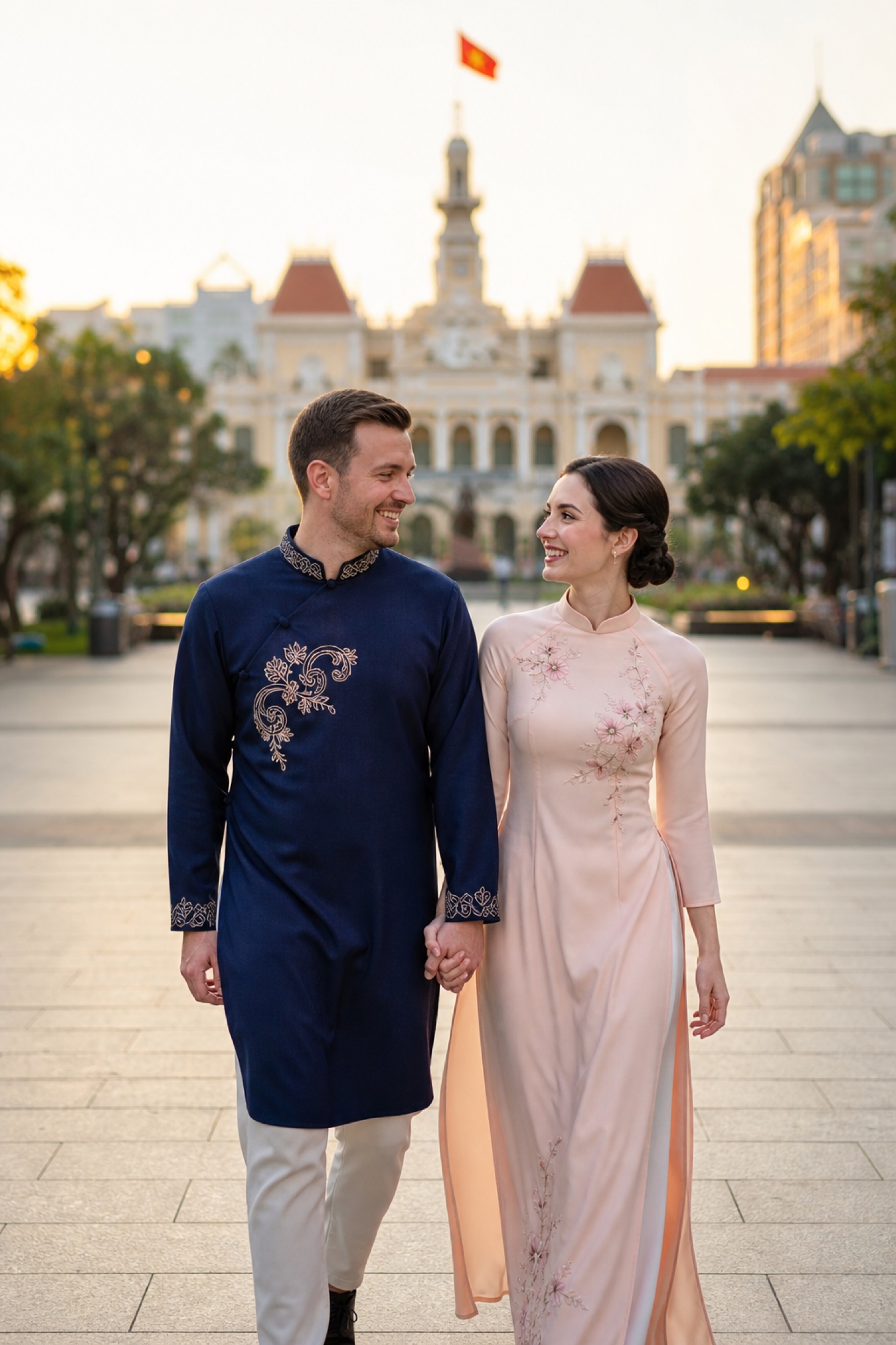
Shooting in Ho Chi Minh City means no travel friction. Cáo Studio operates makeup and hair services at your hotel, so the morning unfolds at your pace—hair and makeup happen in your room, then the team meets you at the first shoot location. Parking, meeting points, and route changes are handled same-day. If weather turns (rare but possible May–October), indoor backup spots—colonial villas, hotel corridors, market arcades—exist within minutes. The shoot feels seamless because there are no moving parts.
Quy Nhon requires advance coordination. The team travels by appointment only, so booking must happen weeks ahead to align schedules. You either travel separately and meet the photographer at a landmark, or arrange group travel. Morning light on the coast is stunning but unforgiving—if clouds roll in (common even in the dry season), the shoot softens immediately. There's no fallback venue; you adapt or reschedule. The 200+ km journey from Ho Chi Minh City or 100 km from Nha Trang adds fatigue, which shows in later frames. However, couples who commit to Quy Nhon often find the isolation and coastal drama worth the friction—fewer crowds, cleaner horizons, fewer competing angles. Choose Ho Chi Minh City if you value frictionless logistics; Quy Nhon if you're willing to plan and travel for a specific aesthetic.
Which outfits and ao dai styles work best in each location?
In Ho Chi Minh City, you're layering textures and prints against varied backdrops. Traditional ao dai works wonderfully, especially in jewel tones (emerald, sapphire, burgundy) that pop against grey colonial concrete and warm-lit shop fronts. Modern dresses, tailored trousers, and statement pieces also photograph well because the urban environment absorbs and reflects color differently than open sky. Lightweight fabrics move naturally in the heat, and structured garments (crisp white ao dai, tailored blazers) read clearly even under harsh midday sun if you're shooting covered arcades or building interiors. Accessories—gold jewelry, vintage handbags, scarves—add layers without looking overdressed. Consider renting or creating contrast pieces: a bold red ao dai against a faded yellow colonial wall, or a structured white jacket against a shadowed market interior. See ao dai rental for period and modern styles suited to urban shoots.
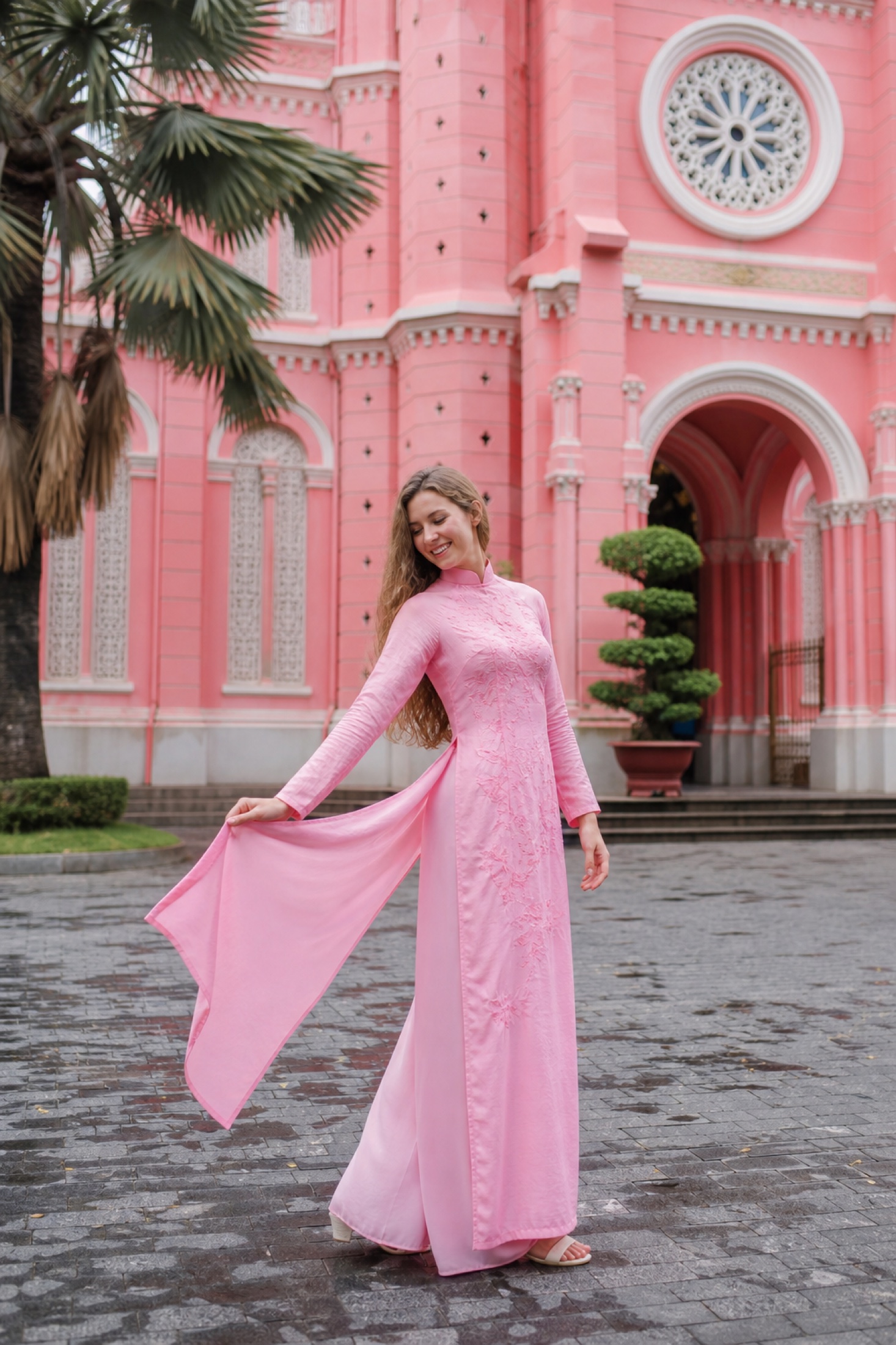
Quy Nhon is a coastal environment where lighter, flowing fabrics dominate. An ao dai in pale silk or linen catches sea light beautifully but risks wind tangles and salt spray damage—heavier silk or a protective layer underneath matters. Neutral tones (ivory, soft peach, pale blue) harmonize with sky and water; bold colors can jar against such vast, serene horizons. Bare feet or sandals work on sand and rocks in a way they never do in a city. Jewelry should be minimal—wind and sea spray tarnish or lose pieces easily. Some couples opt for simpler, less formal dress here (linen shirts, flowing skirts) because the landscape already carries drama. If you're set on an ao dai, choose one you trust in wind and salt air, or plan an additional formal-wear shoot in Ho Chi Minh City afterward. Urban shoots tolerate pattern and complexity; coastal shoots favor simplicity and fabric weight.
📸 Book on WhatsApp — pre-wedding photoshoot
What season should you choose for each location?
Ho Chi Minh City: December through February is ideal—it's the coolest and driest the city gets. Humidity is lower, and afternoon light is clearer. March and April remain dry but heat climbs toward oppressive; plan shoots before 10 a.m. or after 4 p.m., and hydrate constantly. May through October is wet season with frequent afternoon downpours and sticky heat. Mornings are safer, but cloud cover is thick and light is flat. Tet (Lunar New Year, typically late January to mid-February) closes some landmarks and crowds others; book your shoot dates outside this window if you value empty streets.
Quy Nhon: February through August is the only reliable window. February and March are the clearest—skies are deep blue, humidity is lower, and the sea is calm. April–August remain dry but heat builds, and occasional early-season storms can surprise. September through December is typhoon season; the central coast is hit hard (worst October–November). Even outside typhoon peaks, rainfall is heavy, cloud cover is persistent, and the sea roughens. Rescheduling is common and expected here. If you're committed to Quy Nhon, lock in a date February–April for maximum certainty, or June–August for heat tolerance. Never book Quy Nhon October–November without accepting a high reschedule risk. Ho Chi Minh City suits spontaneous booking; Quy Nhon demands season-first planning.
How do you actually decide: a framework for couples
Start with your emotional aesthetic. Do you want drama—cliffs, unobstructed light, solitude—or do you want texture and variety? Coastal shoots reward stillness and intimacy; urban shoots embrace movement and layered backgrounds. Next, assess your schedule and risk tolerance. If you're visiting Vietnam for one week and need photos locked in, Ho Chi Minh City is safer—same-day coordination, weather fallbacks, no reschedule risk. If you're flexible or building a multi-location trip, Quy Nhon becomes viable, especially February–April. Third, consider your ao dai and wardrobe. If you've invested in a formal, delicate ao dai, Ho Chi Minh City's controlled indoor options (colonial interiors, covered markets, hotel ballrooms) protect it. If you're comfortable with flowing, salt-resistant fabrics, coastal shoots suit you. Finally, think about effort—do you want to show up and shoot, or are you willing to drive 200+ km and coordinate weeks ahead for a specific look?
Step-by-step decision checklist:
- Write down your top three aesthetic inspirations (urban, coastal, mixed).
- Check your available dates—are they in dry season for your chosen location?
- Confirm how many days you're in Vietnam; if fewer than 5 days, Ho Chi Minh City is lower-risk.
- Ask us on WhatsApp whether the team is available for your dates and location.
- If Quy Nhon interests you, request a mood board of recent shoots there to confirm the light matches your vision.
- Book makeup and hair services—they're available at your hotel in Ho Chi Minh City, or coordinated for Quy Nhon shoots.
Cáo Studio – Makeup & Photoshoot operates full pre-wedding and elopement services in both locations, with Hoi An available by appointment as well. Explore the lookbook to see how both environments read in finished images.
What does a typical shoot day actually look like in each place?
Ho Chi Minh City: You wake up, have breakfast in your hotel room. Hair and makeup artist arrives by 7–8 a.m., works for 1.5–2 hours. You're ready by 9 a.m., when light is still soft and golden. The photographer meets you at the first location (often a colonial villa or hotel courtyard). You shoot until 11 a.m., grab water and shade, possibly scout or have a break. Afternoon shooting starts around 4 p.m. (golden hour compresses here), runs until 5:30 p.m. or sunset around 6 p.m. Total on-location time: 4–5 hours across two sessions. That evening, you rest; the team begins culling and color-grading. Turnover is typically 1–2 weeks for edited files, depending on package scope. No weather surprises; you've shot all planned locations.
Quy Nhon: You coordinate travel the day before or morning-of. Meet the team at a landmark by 5:30–6 a.m. (early light is precious here). Shoot for 2–3 hours while the sun is low and the sea is calm. Break for rest and food. Afternoon session (if booked) starts around 3–4 p.m., runs into golden hour around 5–6 p.m., ending by 6:30 p.m. Total on-location time: 4–6 hours, but compressed into one or two sessions with less downtime because the light window is shorter and the environment is more demanding physically (rocky terrain, sand, wind). If weather turns (clouds, wind gusts), the shoot adapts—perhaps fewer locations, tighter framing, or rescheduling if it's unsafe. Edited files take the same 1–2 weeks, but the shoot day itself is more intense and requires more trust in the photographer's real-time decisions.
What to check before you choose
- Season: Cross-check your travel dates against the dry/wet calendar above. If you're visiting May–November and set on coastal light, reconsider or accept reschedule risk.
- Makeup and hair: Confirm on WhatsApp that makeup and hair services are available for your location and date. Ho Chi Minh City offers hotel services; ask for Quy Nhon availability.
- Ao dai or dress: If renting an ao dai, check ao dai rental sizes and styles; confirm delivery to your location (Ho Chi Minh City direct, Quy Nhon by appointment).
- Edited timeline: Ask exactly when edited files will be delivered. Plan any prints or albums (see photo prints and frames) accordingly.
- Backup locations: For Ho Chi Minh City, ask where you'll shoot if weather turns. For Quy Nhon, clarify rescheduling policy if weather cancels the session.
- Travel logistics: If you're not local, confirm whether the team will arrange meeting points or if you arrange your own transport to locations.
FAQ
Can I shoot in both Ho Chi Minh City and Quy Nhon on the same trip?
Yes. Many couples book a city session (1–2 days) and a coastal session (1–2 days) 3–5 days apart. Plan Ho Chi Minh City first (it's flexible and on-demand), then Quy Nhon as a second session if your dates align with dry season. Ask us on WhatsApp about multi-location packages.
What if I want an ao dai AND modern dress—which location suits both?
Ho Chi Minh City handles both easily; you can shoot formal wear indoors (colonial villas, hotels) in the morning and casual or modern dress on the streets in late afternoon. Quy Nhon also works, but you'll want lighter, wind-resistant fabrics for the coastal session. Plan wardrobe changes and consider hotel storage between sessions.
Is Quy Nhon worth it if I only have one day to shoot?
Only if you're flexible on locations and content. One day in Quy Nhon gives you 4–6 hours of shooting across one or two sessions, but no buffer for travel delays or weather. If you're visiting Vietnam for fewer than 7 days total, Ho Chi Minh City is lower-stress. Quy Nhon rewards couples who can dedicate 2–3 days to the location.
How far in advance should I book Quy Nhon?
At least 3–4 weeks, ideally 6–8 weeks. The team travels by appointment, so their schedule fills faster than Ho Chi Minh City. Early booking also lets you choose your ideal date within the dry season (Feb–Aug).
Will my ao dai be damaged by salt spray or sand in Quy Nhon?
Risk exists, especially for delicate silk or embroidered pieces. Discuss fabric weight and care on WhatsApp when booking. Consider renting a simpler ao dai for coastal work, or plan an additional formal-wear session in Ho Chi Minh City. See ao dai rental for options.
What's included in a pre-wedding package—is makeup covered?
Exact inclusions (hours, number of photos, edited files, makeup, outfits, delivery time) are confirmed on WhatsApp. See FAQ for common questions, or ask us directly for a personalized quote.
Can I hire the team for video as well as photos?
Yes. See wedding and pre-wedding video services. Inquire on WhatsApp about bundling photography and video for your chosen location.
FAQ
Can I shoot in both Ho Chi Minh City and Quy Nhon on the same trip?
Yes. Many couples book a city session (1–2 days) and a coastal session (1–2 days) 3–5 days apart. Plan Ho Chi Minh City first (it's flexible and on-demand), then Quy Nhon as a second session if your dates align with dry season. Ask us on WhatsApp about multi-location packages.
What if I want an ao dai AND modern dress—which location suits both?
Ho Chi Minh City handles both easily; you can shoot formal wear indoors (colonial villas, hotels) in the morning and casual or modern dress on the streets in late afternoon. Quy Nhon also works, but you'll want lighter, wind-resistant fabrics for the coastal session. Plan wardrobe changes and consider hotel storage between sessions.
Is Quy Nhon worth it if I only have one day to shoot?
Only if you're flexible on locations and content. One day in Quy Nhon gives you 4–6 hours of shooting across one or two sessions, but no buffer for travel delays or weather. If you're visiting Vietnam for fewer than 7 days total, Ho Chi Minh City is lower-stress. Quy Nhon rewards couples who can dedicate 2–3 days to the location.
How far in advance should I book Quy Nhon?
At least 3–4 weeks, ideally 6–8 weeks. The team travels by appointment, so their schedule fills faster than Ho Chi Minh City. Early booking also lets you choose your ideal date within the dry season (Feb–Aug).
Will my ao dai be damaged by salt spray or sand in Quy Nhon?
Risk exists, especially for delicate silk or embroidered pieces. Discuss fabric weight and care on WhatsApp when booking. Consider renting a simpler ao dai for coastal work, or plan an additional formal-wear session in Ho Chi Minh City. See [ao dai rental](/ao-dai-rental) for options.
What's included in a pre-wedding package—is makeup covered?
Exact inclusions (hours, number of photos, edited files, makeup, outfits, delivery time) are confirmed on WhatsApp. See [FAQ](/faq) for common questions, or ask us directly for a personalized quote.
Can I hire the team for video as well as photos?
Yes. See [wedding and pre-wedding video](/wedding-video) services. Inquire on WhatsApp about bundling photography and video for your chosen location.
Ao dai, makeup, hair and a local photographer in Hanoi or Saigon — one WhatsApp message.