/pre-wedding-photoshoot
Kim Bong Carpentry Village Wedding Photos: Light and Timing
Kim Bong carpentry village, 15 km south of Hoi An, offers wooden shopfronts and artisan courtyards perfect for pre-wedding photos. Shoot between 5:30–7:30 am (sunrise through early morning) or 4:30–5:30 pm (late golden hour) to avoid harsh midday glare and crowds. Morning light skims the carved timber facades, casting shadow detail. Bring an ao dai or Western dress; layers help in cool dawn air. Cáo Studio directs shoots at Kim Bong with a single team (photographer, stylist, makeup) traveling from Hoi An by appointment. Sessions run 1–2 hours; expect edited frames and a short film within 48 hours. Avoid October–November (rainy season flooding) and midday heat (35°C+). Book on WhatsApp to confirm dates and inclusions.
Why does light change so much between 9 am and noon at Kim Bong?
Before 9 am, sidelight from the east catches the carved timber shopfronts and casts sharp, sculptural shadows across doorways and walkways. By 10 am, the sun climbs above the workshop rooflines and flattens into overhead glare—texture disappears, and the village becomes a heat haze. Wooden details that told a story in early light turn into silhouettes. Midday heat also empties the streets of artisans, stripping the location of human rhythm. Morning light is the difference between frames that breathe and frames that squint.
📸 Book on WhatsApp — pre-wedding photoshoot
Should you shoot Kim Bong in the dry season (Feb–Aug) or avoid it?
February through April is ideal: mild air (20–25°C), dry courtyards, and the rice fields surrounding the village still hold green. May–August is dry but hits 35°C+ by 10 am, forcing sunrise-only sessions and exhaustion. October–November brings typhoons, flooding on the village lanes, and closed workshops. December–January cools to 15–20°C and sometimes drizzles—moody, but unpredictable. Book Feb–Apr for consistent early-light work; book May–Aug only if you commit to 5:30 am starts and one outfit. Avoid Oct–Nov entirely for this location.
What should you wear to make the wooden backdrop work?
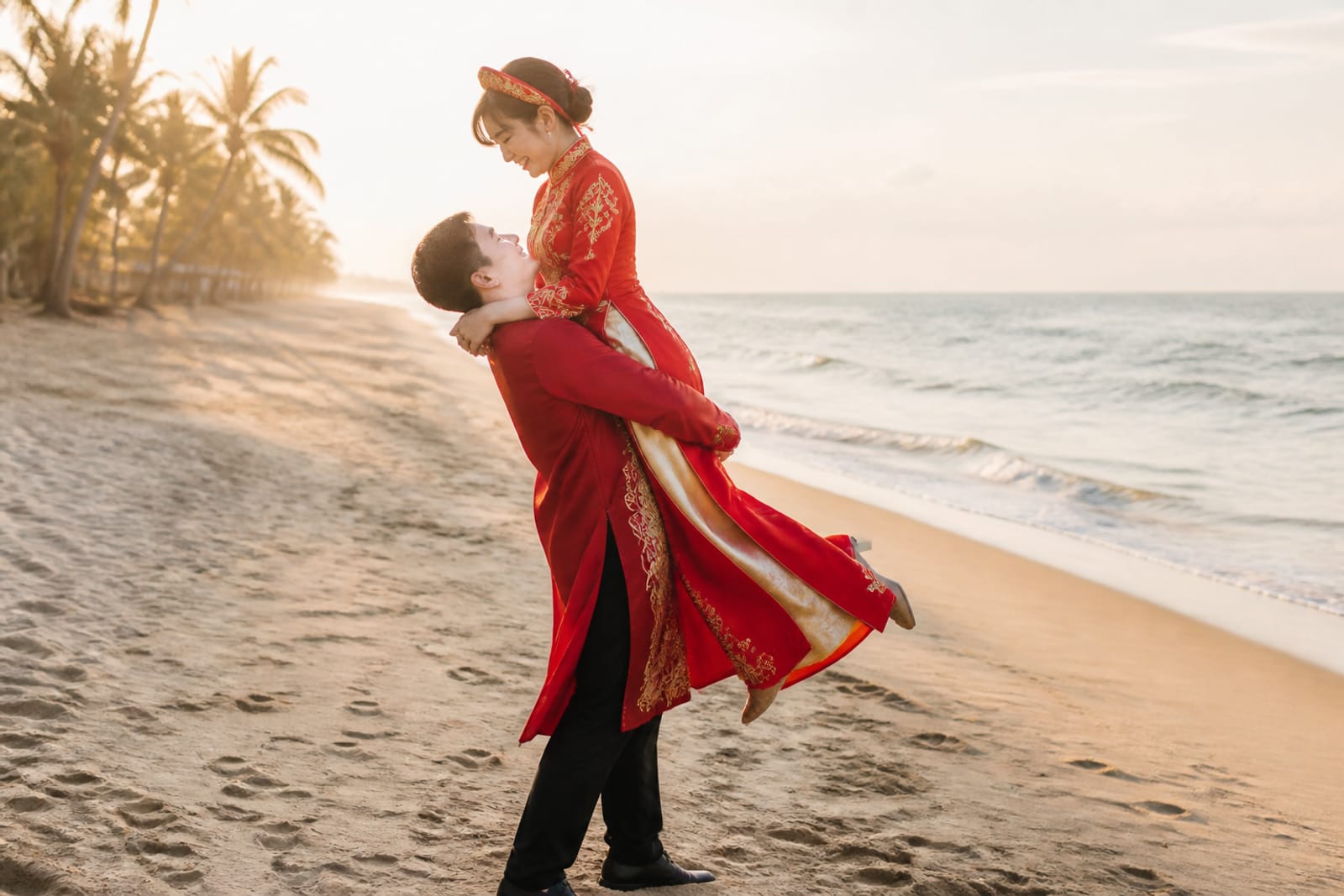
An ao dai (traditional Vietnamese silk tunic) reads as one brushstroke against carved timber—the saturation of silk doesn't compete with texture, it complements it. Jewel tones (emerald, sapphire, burgundy) photograph deeper in morning sidelight than pastels. If wearing a Western dress, choose simple, solid silhouettes; busy patterns or metallics jar against the crafted wood. Layers matter: Kim Bong sits inland with morning air at 18–20°C in winter, cooler than coastal Hoi An. A silk shawl or second color adds movement in the frames without clutter. Avoid white (overexposes against light-struck walls); avoid busy prints (they steal the carver's detail from view).
| Outfit type | Best season | Why it works | Light requirement |
|---|---|---|---|
| Ao dai (jewel tone) | Feb–Apr, May–Aug dawn | Silk reads clean, complements wood grain | Early sidelight, 5:30–7:30 am |
| Western dress (solid, minimal) | Feb–May | Silhouette clarity, no pattern clash | 6–8 am or 4:30–5:30 pm |
| Couple in matching silk | Mar–Apr | Symmetry and color pop in cooler light | 6–7:30 am (shadows sharpen frames) |
| Bridal gown (long, structured) | Feb–Apr early session | Weight sits still for detail shots; morning cool = no sweat | 5:30–7 am (avoid heat wrinkles) |
How does a single-team shoot (photographer + stylist + makeup) change Kim Bong framing?
When one coordinator directs outfit, hair and photography, the team doesn't reset between stations. You walk into a shopfront, the stylist adjusts the ao dai's hem in real light, the makeup artist touches the forehead before the photographer captures the moment—no "go back, redo hair, take three." Cáo Studio arrives with a plan (wide frame of you walking past a carver's bench, then medium of your face in the doorway shadow, then detail of hands on the wooden railing) rather than hunting poses on the fly. The village moves: artisans hammer, a customer enters a shop. That becomes your backdrop, not a monument you're posed in front of. One team reads the light and moment together; three separate vendors re-coordinate four times and miss the hour.
What time should you arrive, and how long does a Kim Bong session take?
Arrive by 5:15 am if shooting sunrise. The team meets you at your Hoi An hotel (or a meet point near the village) and drives 20 minutes. Shooting runs 6–8:30 am (2.5 hours of walking, pausing, framing); longer sessions invite heat and fatigue. Late-afternoon golden hour (4:30–5:30 pm) is shorter—one hour—and works for couples who can't wake pre-dawn. A typical session covers three to four locations within the village (a carver's workshop, a timber-stacked courtyard, a shopfront with morning customers, a quiet lane). Cáo Studio delivers edited frames and a short vertical film within 48 hours. Book on WhatsApp to discuss whether you prefer one long dawn session or two shorter visits (one at sunrise, one at golden hour) across separate days.
How do you compare Kim Bong to other Hoi An pre-wedding spots?
Kim Bong suits couples seeking texture and craftsmanship over postcard scenery. The Ancient Town's lantern light is softer but crowded and permit-dependent; rice fields near Hoi An are expansive but require 30 minutes' drive and don't frame intimate moments. Beaches near Cua Dai are bright but featureless at midday. Kim Bong stays local, shoots in less than an hour's round trip, and every frame has a wooden detail—a beam, a shadow, a tool—that tells the story of the place. If you're drawn to artisan villages, wood tones, and early-morning calm, Kim Bong delivers. If you want monumental scale or trendy Instagram backdrops, request a different location and ask Cáo Studio to plan it.
What should you check before booking a Kim Bong session?
Confirm the exact date with Cáo Studio — Hoi An shoots are by appointment, and the team travels from Hanoi or Saigon bases. Ask which weeks in your chosen month have the best light forecast and lowest flood risk.
Verify what's included: Ask on WhatsApp whether the quote covers both outfit changes, makeup touchups, and how many edited images you receive. Cáo Studio confirms inclusions per booking—never assume.
Check your outfit fit — If wearing an ao dai, confirm rental or bring your own three days before the shoot. Silk wrinkles in luggage; steaming takes time. If renting, see rental options.
Plan transport — You'll walk 1–2 km through the village on uneven lanes. Wear shoes with grip; avoid heels.
Ask about weather backup — If rain or flood warnings arrive, ask Cáo Studio's reschedule policy before you book.
Discuss the edit timeline — Confirm whether "48 hours" means calendar days or business days, and ask for a sample of their edit style (color grading, black-and-white conversions, film format).
Review the lookbook — Before you commit, check Kim Bong or similar artisan-village frames to see if Cáo Studio's directing style matches your vision.
---
FAQ
Can we shoot Kim Bong in June or July?
Yes, but only at sunrise (5:30–6:30 am). By 8 am, heat reaches 32°C+. A single pre-dawn session is feasible; confirm with Cáo Studio whether the team can accommodate very early departures from your hotel.
Do we need a permit to shoot in Kim Bong village?
No formal permit is required for small personal photoshoots. If your session includes a professional video crew or you're shooting a commercial project, ask Cáo Studio—they handle permissions on your behalf.
What if it rains the morning of our booking?
Light rain can add moodiness to wooden textures, but heavy rain floods the village lanes and closes workshops. Ask Cáo Studio's reschedule policy before you book. Confirm the forecast 2–3 days before and decide together whether to proceed or move your session.
How far is Kim Bong from Hoi An Ancient Town?
About 15 km south, roughly 25–30 minutes by car. Ask Cáo Studio to combine both locations if you want (Ancient Town sunrise, then Kim Bong mid-morning) or book them separately to avoid rushing.
Can we include our ao dai rental in the booking?
Yes. Ask Cáo Studio on WhatsApp whether ao dai rental is bundled in the pre-wedding package or quoted separately. Designer or custom-made ao dai may cost more.
How many photos do we get from a Kim Bong session?
The exact number of edited images depends on your booking. Ask Cáo Studio for clarity—standard sessions typically deliver a set confirmed on WhatsApp before the shoot. --- 📸 Book on WhatsApp — pre-wedding photoshoot | 🎬 Wedding video & film | 👗 Ao dai rental
FAQ
Can we shoot Kim Bong in June or July?
Yes, but only at sunrise (5:30–6:30 am). By 8 am, heat reaches 32°C+. A single pre-dawn session is feasible; confirm with Cáo Studio whether the team can accommodate very early departures from your hotel.
Do we need a permit to shoot in Kim Bong village?
No formal permit is required for small personal photoshoots. If your session includes a professional video crew or you're shooting a commercial project, ask Cáo Studio—they handle permissions on your behalf.
What if it rains the morning of our booking?
Light rain can add moodiness to wooden textures, but heavy rain floods the village lanes and closes workshops. Ask Cáo Studio's reschedule policy before you book. Confirm the forecast 2–3 days before and decide together whether to proceed or move your session.
How far is Kim Bong from Hoi An Ancient Town?
About 15 km south, roughly 25–30 minutes by car. Ask Cáo Studio to combine both locations if you want (Ancient Town sunrise, then Kim Bong mid-morning) or book them separately to avoid rushing.
Can we include our ao dai rental in the booking?
Yes. Ask Cáo Studio on WhatsApp whether [ao dai rental](/ao-dai-rental) is bundled in the pre-wedding package or quoted separately. Designer or custom-made ao dai may cost more.
How many photos do we get from a Kim Bong session?
The exact number of edited images depends on your booking. Ask Cáo Studio for clarity—standard sessions typically deliver a set confirmed on WhatsApp before the shoot. --- [📸 Book on WhatsApp — pre-wedding photoshoot](/pre-wedding-photoshoot) | [🎬 Wedding video & film](/wedding-video) | [👗 Ao dai rental](/ao-dai-rental)
Ao dai, makeup, hair and a local photographer in Hanoi or Saigon — one WhatsApp message.