/pre-wedding-photoshoot
Mistakes to avoid on a pre-wedding photoshoot in Quy Nhon
Pre-wedding shoots in Quy Nhon require booking a local photographer at least 4–6 weeks ahead (tourist season Feb–Aug fills fast), locking in a shoot date that avoids the rainy season (Sep–Dec, worst Oct–Nov) and scouting locations before dawn to catch the soft side light that coastal rock formations need. Common mistakes: shooting at midday when shadows are harsh; ignoring the tidal schedule (low tide reveals sand and tide pools; high tide closes coves); wearing colours that clash with turquoise water (avoid bright yellow or neon); and booking a one-person freelancer instead of a small team (hair, makeup and photographer in one booking prevents reshoots due to smudged makeup in salt spray). Cáo Studio does not operate in Quy Nhon, but the pre-wedding photoshoot guide covers the framework: one team, directed light, 48-hour turnaround. For Quy Nhon, hire a local photographer experienced with coastal Vietnam and brief them on tides, wind protection and outfit changes in salt air. ---
How do you choose the right season for a Quy Nhon pre-wedding shoot?
Quy Nhon's best light runs February through August — the dry season brings consistent early morning and late afternoon windows with minimal cloud cover. The central coast's rainy season (September–December, especially October–November) brings typhoons, flooding and overcast skies that flatten colour and reduce shooting hours. If you must shoot in the wet season, expect shorter windows (6:30–7:30 am and 5:00–5:45 pm) and a backup indoor plan (hotel suite, sheltered arcade, indoor market). Winter months (Dec–Feb) are cool and clear but crowds spike near Tet (late January–mid February), closing some sites and requiring pre-dawn starts to avoid tour groups at famous coves.
Booking tip: ask your photographer for a weather history for your chosen dates — they'll know which coves stay sheltered during monsoon swells.
What outfit mistakes ruin coastal pre-wedding frames?
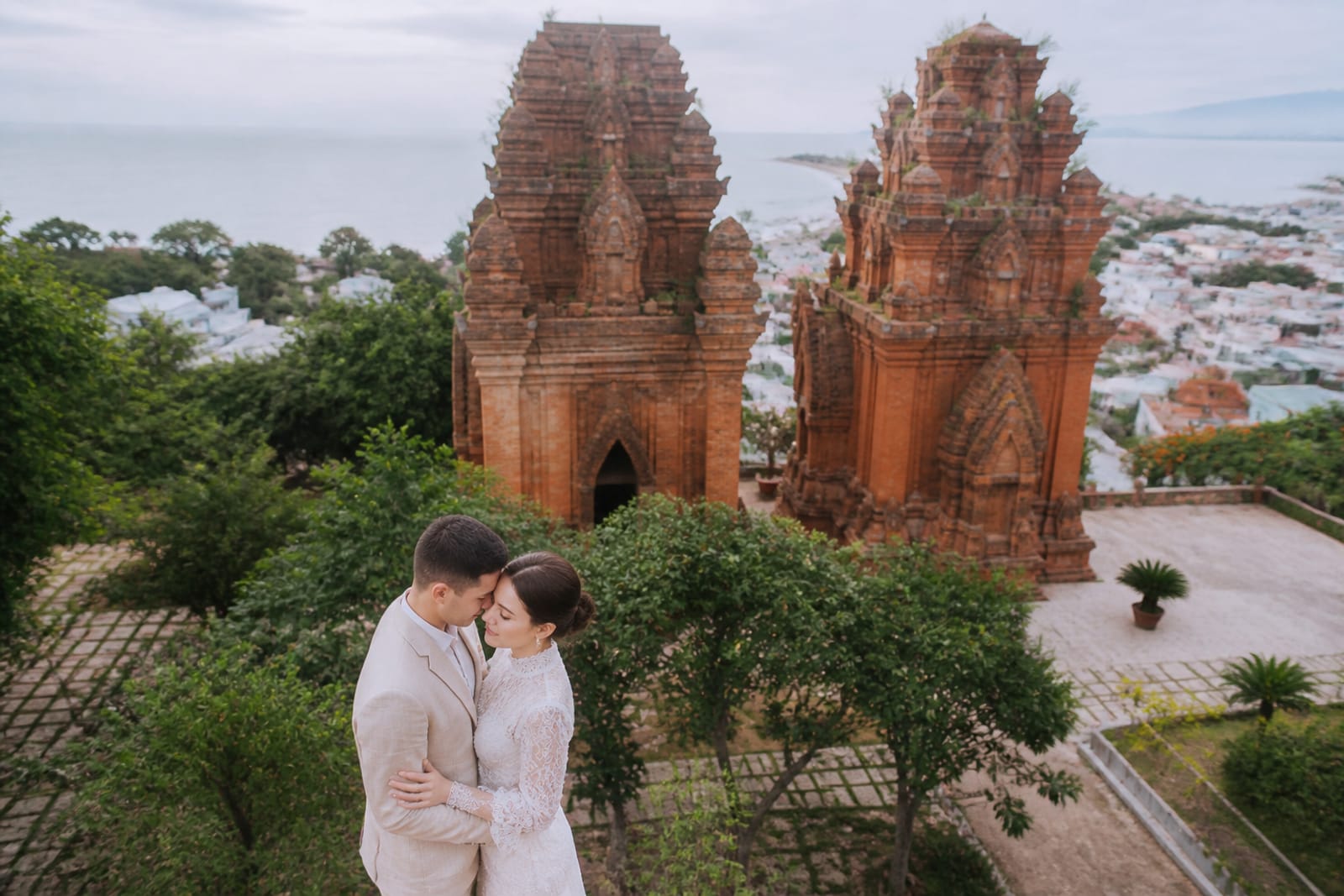
Salt spray stains pale or white fabrics within minutes; bright neon or fluorescent yellow clash with turquoise water and make you look washed out in the frame. Loose fabrics (scarves, veils, trailing hems) tangle in wind; heavy jewellery leaves tan lines and catches glare. Shoes matter: slippery soles on wet rock are a safety risk; dark or metallic heels photograph harsh against sand.
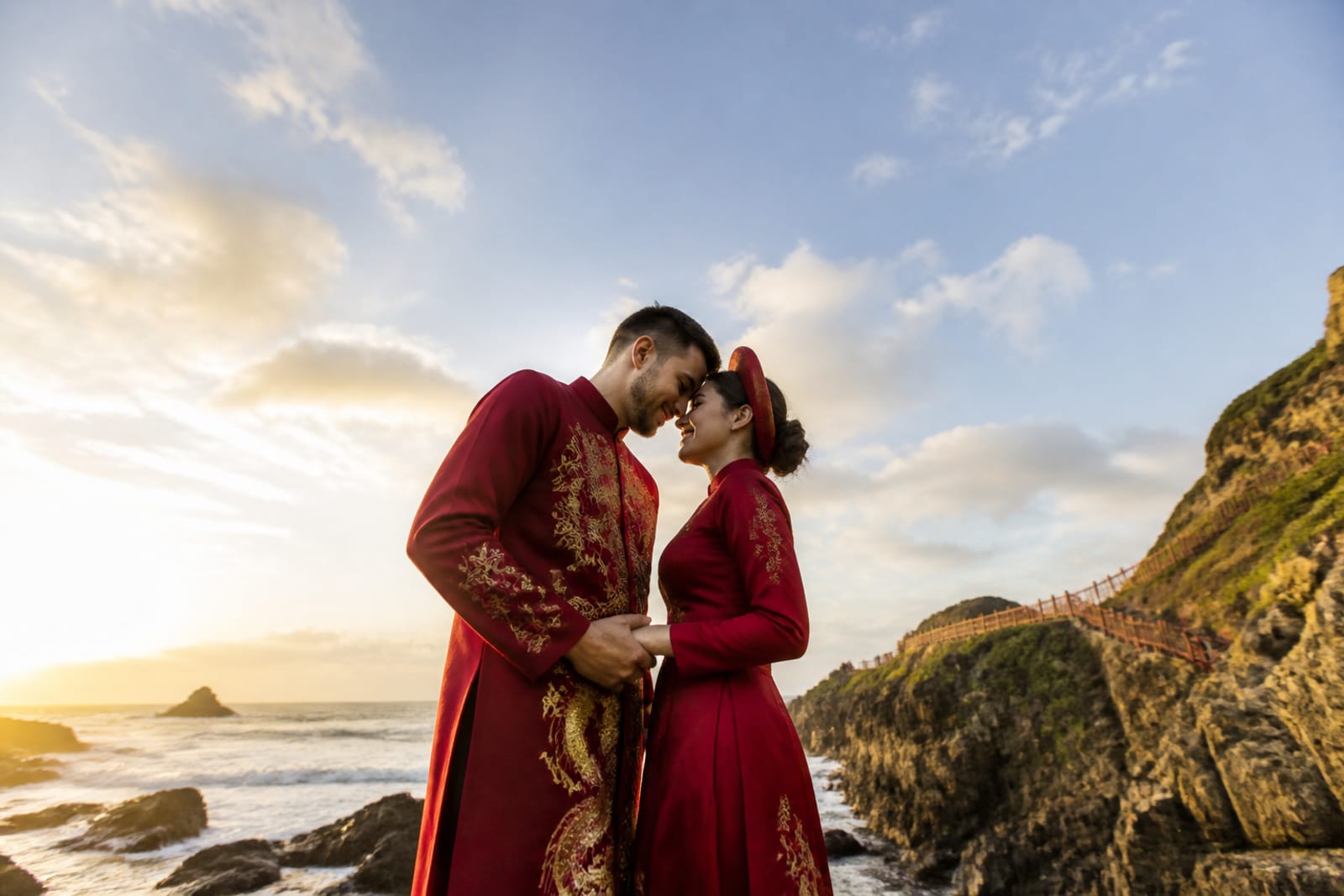
Better choices: deep jewel tones (sapphire, emerald, rust, burgundy), fitted or layered silhouettes, flat sandals or barefoot if the photographer frames you walking through shallow water, and a backup outfit for shade (a simple linen shirt in cream or soft grey for the sheltered cove shot). If wearing ao dai, ask the photographer how they'll manage the train in salt water — some suggest a silk slip dress under the tunic instead, or shooting the ao dai indoors and changing into Western wear for the coast.
📸 Explore ao dai rental for pre-wedding shoots
Why does timing within the day matter more than the date?
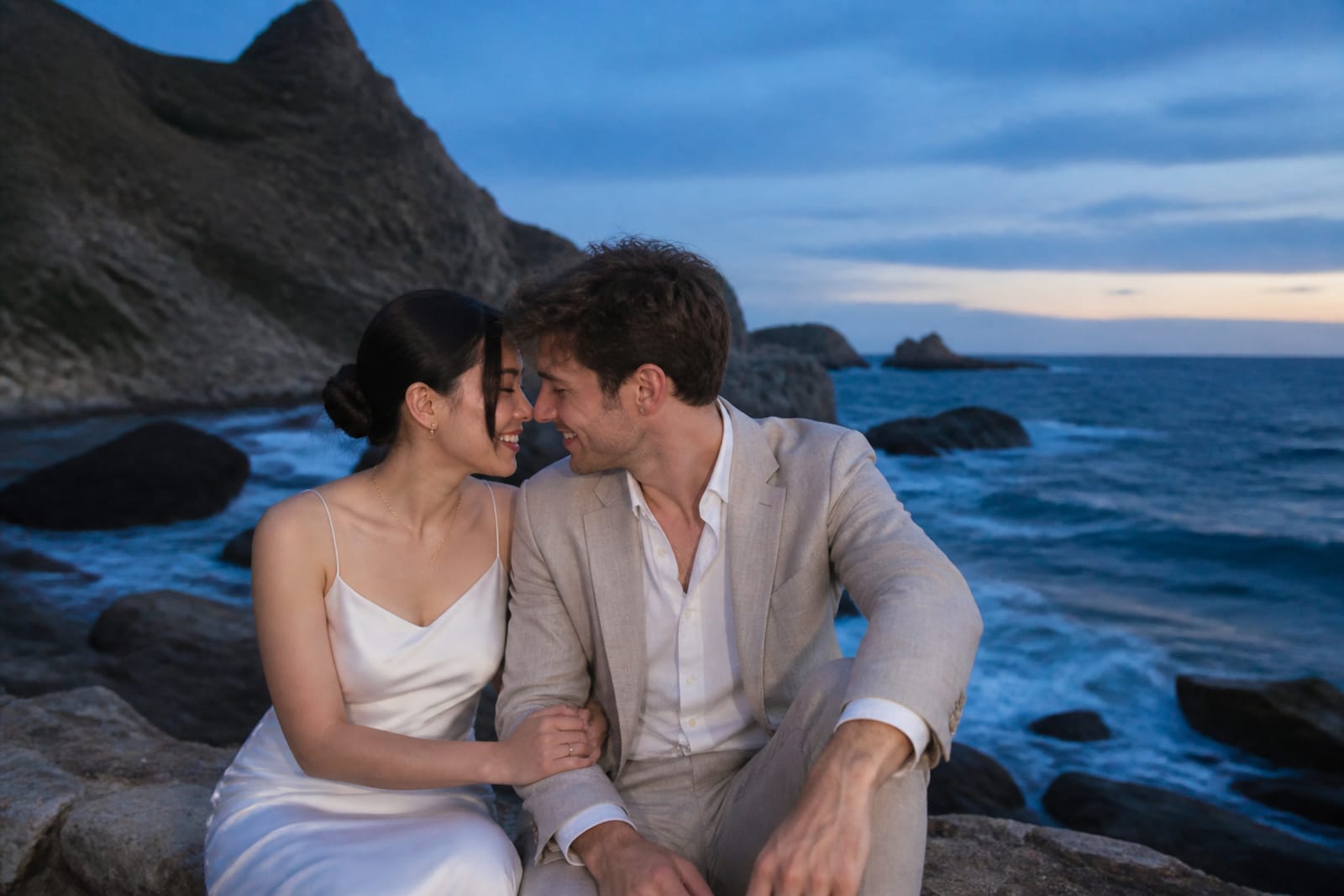
Golden hour (6:10–7:00 am or 5:20–6:15 pm) delivers soft, directional side light that sculpts the rock formations and keeps your faces shadow-free. Shoot wider shots first (you walking along the shoreline, sitting on a boulder), then medium frames (both of you, framed by the cove), then detail (hands, rings, sand between toes). Midday sun creates harsh shadows under eyes and cheekbones, flattens the water to grey-white and forces the photographer to underexpose (losing detail in your faces).
Quy Nhon's eastern coastline catches sunrise beautifully; if you're shooting a cove on the west side, plan sunset instead. Wind is strongest between 10 am–3 pm in dry season, so book early or late to protect makeup and keep fabric in place. Tides shift your safe shooting window — low tide (typically 6–8 hours after midnight) reveals sand bars and tide pools; high tide can cut you off from some rock formations. Ask your photographer to check the tide table and plan the shot list around it.
Conclusion: shoot before 7:30 am or after 5:00 pm, and plan the location scouting walk the day before so you know where the light falls.
Should you book a solo freelancer or a small team?
| Option | Best for | Why it works — or doesn't | Key risk |
|---|---|---|---|
| Solo photographer | Budget-conscious couples who pre-plan hair/makeup and outfits | One person, one vision, simpler logistics. | No backup if they're sick; makeup smudges in salt spray with no artist on set to fix. |
| Photographer + hair/makeup artist (two-person team) | Couples wanting one team but budget constraints mean fewer vendors. | Artist handles salt air, sweat and wind mid-shoot; photographer focuses on light. | Communication gaps if the two haven't worked together; longer setup time. |
| One integrated team (photographer, hair, makeup, styling) | Couples who want the best frames without reshoots. | One brief, one message, one art direction. Artist and photographer speak the same language; outfits chosen for the light, not the couple's closet. | Fewer teams operate this way; must book further ahead. |
Why it matters: salt spray, humidity and wind require a makeup artist on set. A solo photographer cannot retouch your base while shooting. You'll need reshoots, costing time and money.
💄 Makeup & hair services at your hotel
What do you check before hiring a Quy Nhon photographer?
Ask to see a portfolio of coastal shoots in similar light (golden hour, rocky coastline, turquoise water) — not indoor or heavily retouched images that don't reflect real conditions. Request references from at least two couples who shot in Quy Nhon between February–August (their experience will match yours). Confirm the photographer has a backup camera body, backup lenses and a weather-sealed bag for salt spray. Ask about their editing style: do they crush blacks (lose shadow detail), oversaturate blues (look artificial), or preserve skin tone and let the water be turquoise without forcing it?
Check the contract for revision policy — coastal light changes minute to minute; you need frames from multiple angles, not one "best" shot. Confirm delivery time: 48 hours is standard for edited digital files; albums or prints take longer. Ask about contingency: if weather forces a reschedule, do you pay the difference if a new date costs more (peak vs. off-season shift)? Request a shot list walkthrough — do they direct you to walk, sit and look at each other, or will they pose you stiffly in front of landmarks?
Final check: do they understand that one message (one outfit direction, one emotional arc) shoots faster and stronger than three outfit changes in one cove.
🌸 See how Cáo Studio approaches directed shoots
---
How do you avoid common location mistakes?
Avoid famous Instagram spots between 7:30 am–4:00 pm — tour groups flood Quy Nhon's main coves. Ask locals or your photographer for off-season alternatives: smaller northern coves (quieter, rockier light), inland salt marshes at dawn (graphic geometry, soft reflections), or sheltered beaches east of the town centre. Scout the location the day before to check safe footing, tidal access and whether the light hits the rocks as expected for your shoot time. Bring a tripod or rock to mark where the photographer will stand so you don't discover mid-shoot that the angle doesn't frame the backdrop as hoped.
Avoid shooting the same cove for multiple outfit changes — one location, one outfit, then move. You'll lose light waiting for changes and the frames will feel repetitive. If you want two or three locations, book a 4–5 hour window and plan tight transitions (no more than 15 minutes between shoots).
Conclusion: book a local who knows tides and timing, scout the day before, and limit yourself to two locations max to protect light quality.
---
What to check before you book a pre-wedding shoot in Quy Nhon
- Photographer experience: portfolio of golden-hour coastal shoots, at least two references from couples who shot Feb–Aug in Quy Nhon.
- Team composition: is it one person or a small team? Will a makeup artist be on set to manage salt spray and wind?
- Season & dates: confirm your dates fall in Feb–Aug (dry season); if not, ask for a backup indoor plan and shorter shooting window.
- Tides & timing: ask the photographer to check tide tables and confirm shoot time is before 7:30 am or after 5:00 pm.
- Outfit plan: discuss colour, silhouette and footwear; confirm how ao dai will be managed in salt water.
- Editing style: request samples of skin tone, water colour and shadow handling in their editing — not over-retouched images.
- Delivery & revisions: confirm turnaround time (48 hours is standard), revision policy (at least 3–5 location options per light window), and contingency if weather reschedules.
- Shot list: ask for a brief walkthrough — will they direct you to walk, sit and interact, or pose you?
---
If you're planning a pre-wedding shoot elsewhere in Vietnam — Hanoi, Ho Chi Minh City or Hoi An — Cáo Studio handles the full team (photographer, hair, makeup, styling) in one booking, with edited frames and a short film in 48 hours. For Quy Nhon, apply this framework to vet a local photographer and protect your shoot against common coastal pitfalls.
📸 Book a pre-wedding shoot in Hanoi, Saigon or Hoi An | 💍 See proposal & anniversary packages | 👰 Explore wedding day photography
---
FAQ
Is February–August really the only time to shoot in Quy Nhon?
Yes, the dry season (Feb–Aug) offers consistent early light and clear skies. The rainy season (Sep–Dec, worst Oct–Nov) brings typhoons and shorter shooting windows. If you must shoot Sep–Dec, plan for 6:30–7:30 am and 5:00–5:45 pm windows only, and book a backup indoor location.
Do I need to wear an ao dai or Western clothes for a Quy Nhon pre-wedding shoot?
Either works. Ao dai photographs beautifully in golden hour but requires planning for salt water (a silk slip dress under the tunic, or shooting indoors and changing to Western wear for the coast). Jewel-tone Western wear works equally well and offers more freedom in rocky terrain. Discuss outfit choices with your photographer two weeks before to allow rental or tailoring time.
What's the biggest risk of shooting at midday in Quy Nhon?
Harsh shadows under eyes and cheekbones, grey water (no turquoise), and blown-out sand. The photographer will underexpose to save the water, losing detail in your faces. Wind is also strongest midday, risking makeup smudges and loose fabric. Stick to golden hour (before 7:30 am or after 5:00 pm).
Should I book a solo photographer or a team for a coastal pre-wedding shoot?
A team (photographer + makeup artist) is safer. Salt spray, humidity and wind will smudge makeup within minutes; a solo photographer cannot retouch you mid-shoot. You'll need expensive reshoots. If budget is tight, at least book an artist for touchups every 30 minutes and choose a photographer experienced with coastal reshoots.
How far in advance should I book a Quy Nhon pre-wedding photographer?
Book 4–6 weeks ahead, earlier if you're shooting Feb–Apr or Jul–Aug (peak dry season). Ask the photographer to reserve a backup date in case weather forces a reschedule. Confirm the contingency cost if rescheduling shifts you from low to high season.
What happens if weather forces a reschedule on my shoot day?
Ask before booking: does the photographer charge extra if the new date falls in a pricier season? Do you get a full refund or a rescheduled session credit? Most professionals offer one free reschedule within 30 days, but confirm the contract.
FAQ
Is February–August really the only time to shoot in Quy Nhon?
Yes, the dry season (Feb–Aug) offers consistent early light and clear skies. The rainy season (Sep–Dec, worst Oct–Nov) brings typhoons and shorter shooting windows. If you must shoot Sep–Dec, plan for 6:30–7:30 am and 5:00–5:45 pm windows only, and book a backup indoor location.
Do I need to wear an ao dai or Western clothes for a Quy Nhon pre-wedding shoot?
Either works. Ao dai photographs beautifully in golden hour but requires planning for salt water (a silk slip dress under the tunic, or shooting indoors and changing to Western wear for the coast). Jewel-tone Western wear works equally well and offers more freedom in rocky terrain. Discuss outfit choices with your photographer two weeks before to allow rental or tailoring time.
What's the biggest risk of shooting at midday in Quy Nhon?
Harsh shadows under eyes and cheekbones, grey water (no turquoise), and blown-out sand. The photographer will underexpose to save the water, losing detail in your faces. Wind is also strongest midday, risking makeup smudges and loose fabric. Stick to golden hour (before 7:30 am or after 5:00 pm).
Should I book a solo photographer or a team for a coastal pre-wedding shoot?
A team (photographer + makeup artist) is safer. Salt spray, humidity and wind will smudge makeup within minutes; a solo photographer cannot retouch you mid-shoot. You'll need expensive reshoots. If budget is tight, at least book an artist for touchups every 30 minutes and choose a photographer experienced with coastal reshoots.
How far in advance should I book a Quy Nhon pre-wedding photographer?
Book 4–6 weeks ahead, earlier if you're shooting Feb–Apr or Jul–Aug (peak dry season). Ask the photographer to reserve a backup date in case weather forces a reschedule. Confirm the contingency cost if rescheduling shifts you from low to high season.
What happens if weather forces a reschedule on my shoot day?
Ask before booking: does the photographer charge extra if the new date falls in a pricier season? Do you get a full refund or a rescheduled session credit? Most professionals offer one free reschedule within 30 days, but confirm the contract.
Ao dai, makeup, hair and a local photographer in Hanoi or Saigon — one WhatsApp message.