/pre-wedding-photoshoot
Night pre-wedding photos in Hanoi: best spots & how to book
Night pre-wedding photoshoots in Hanoi are romantic shoots after sunset, typically 18:00–21:00, using street lights, neon, and added lighting to create mood. Hanoi's autumn (Oct–Nov) and cooler months (Dec–Feb) are best — longer darkness, softer air, and fewer mosquitoes. Cáo Studio – Makeup & Photoshoot runs night sessions across our three Hanoi branches, requiring in-advance booking to secure lighting gear and location permits. Shoots take 2–4 hours depending on outfit changes and travel between spots. Key challenges: slow shutter speeds risk blur (tripods and movement control matter), police stop street shooting without permits, and battery drain is fast. Winter drizzle and December–February overcast skies block available light, making autumn the safest bet. Choose a team that has shot night work before; ask to see a night portfolio before committing. --- Night pre-wedding shoots in Hanoi carry a romance that daylight cannot match — but they demand careful planning, the right season, and a photographer who knows how to work with low light and urban logistics. This guide walks you through the options, the real timings, where light actually exists at night, and what to confirm with your studio before booking.
What makes night pre-wedding shoots different from daytime?
Night shoots use available light — street lamps, neon signs, shop windows, car headlights — rather than sun. This means you control mood entirely through location choice and timing. Autumn (Oct–Nov) in Hanoi offers the sweetest window: darkness arrives by 18:30–19:00, air is cool (around 20–25°C), and the soft glow of illuminated streets feels intimate. Winter (Dec–Feb) is darker longer but often overcast and drizzly, which kills available light. Spring (Mar–Apr) brings humidity and haze. Summer (May–Sep) stays too bright until late (dusk lingers until 19:30+), and heat plus mosquitoes exhaust couples mid-shoot.
A night shoot is not simply a daytime shoot moved to evening — it demands a tripod, slower shutter speeds, image stabilization, and constant light metering. Your photographer must know how to expose for skin tones while keeping the city lit (underexposure is the most common mistake). If the studio promises to "add light in editing," walk away; night work requires in-camera lighting gear or flash bouncing, not post-production fixes.
📸 Book on WhatsApp — pre-wedding photoshoot | 💄 Makeup & hair at your hotel
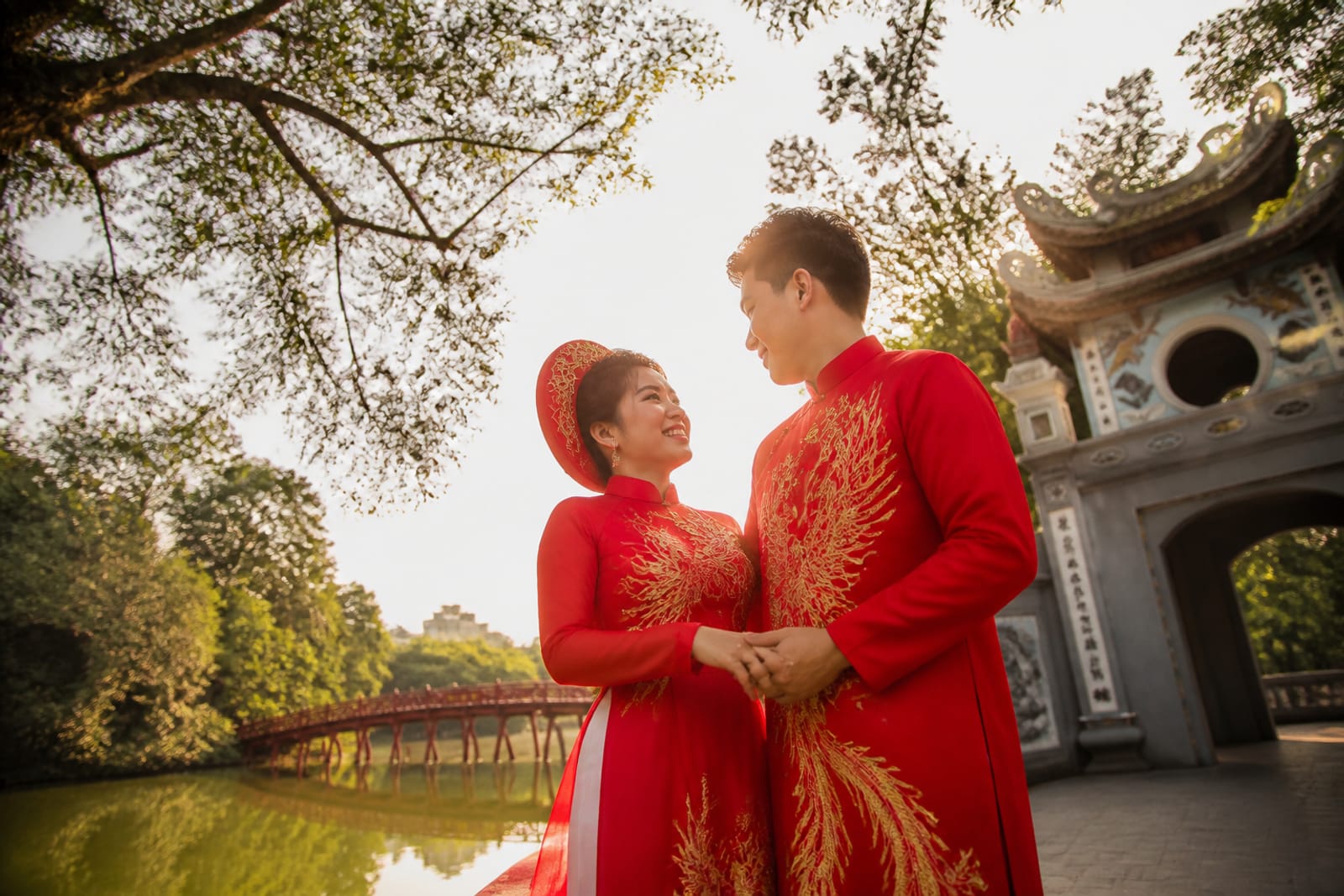
Which Hanoi neighborhoods photograph best at night?
Hoan Kiem Lake's eastern and western shores (Ngo Huong, Dinh Tien Hoang streets) glow with reflected light from buildings and water after dark — but the lakeside is pedestrian-only on Friday–Sunday evenings, closing traffic. Shoot Monday–Thursday for street access, or use weekend evenings if your team is comfortable with crowds and moving between quieter side paths.
Old Quarter (Hanoi's core, 36 streets between Hoan Kiem and Red River) has dense street lights, small neon signs (pharmacies, restaurants), and lanterns. Narrow lanes mean tight framing — expect close, intimate shots rather than wide vistas. October and November are busy with tourists; book early and plan for crowds.
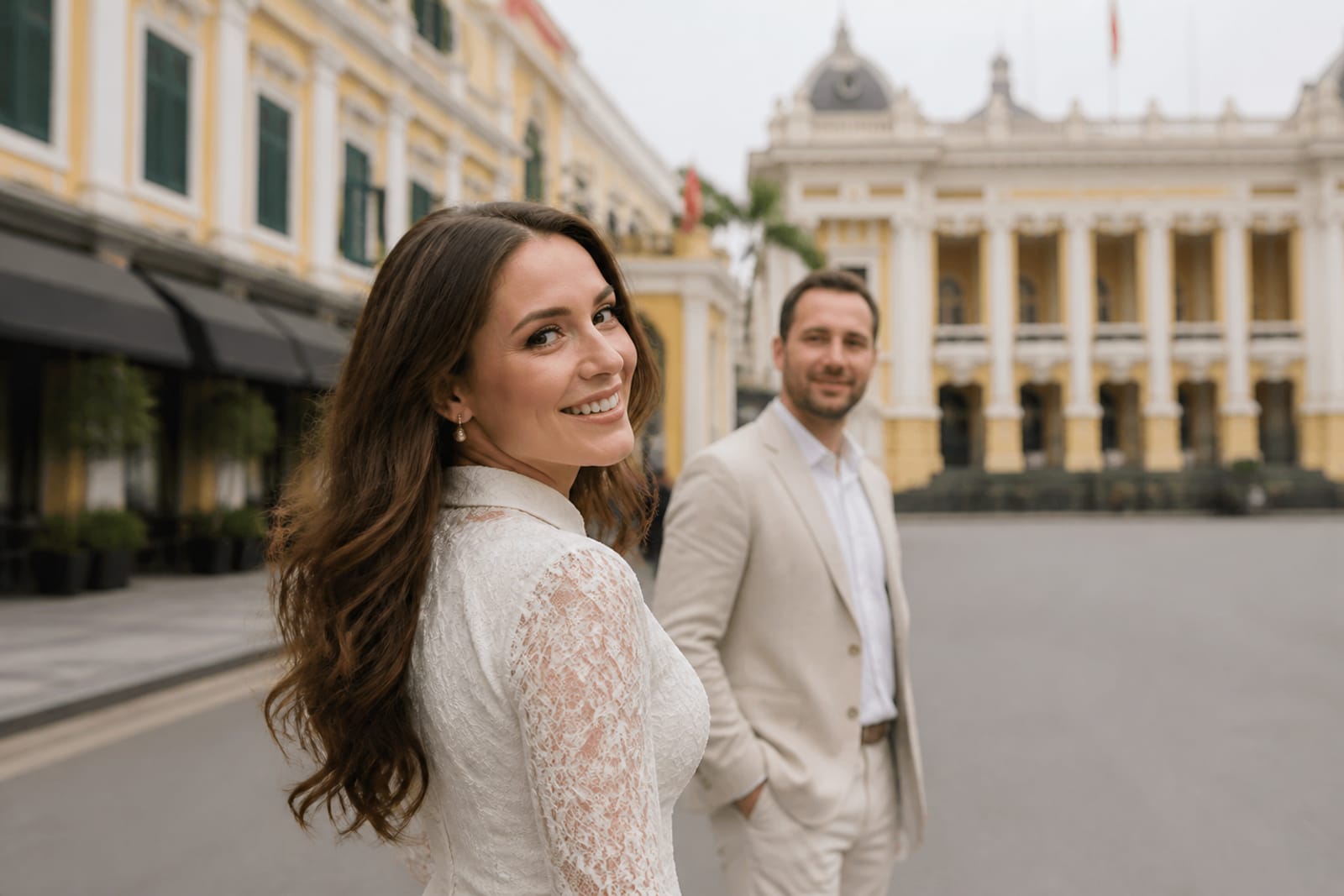
French Quarter (south of Hoan Kiem, around Trang Tien, Ly Thai To, Hang Buom) mixes colonial architecture, tree-lined sidewalks, and softer street-light spreads. Less crowded than Old Quarter, better for movement and outfit changes. Trees can block light — check sight lines with your photographer beforehand.
Tay Ho (West Lake, northwest) has fewer street lights than city center, so night work here relies more on shop signs and car light trails. The trade-off: calmer feel, fewer permits needed, and longer golden-hour window (dusk lingers longer over water). Not ideal for pure "night" mood but suits 17:00–19:00 "blue hour" shoots.
West Lake's northeast bank (Thanh Nien Road, near Yen Phu village) offers old houses, vintage scenery, and minimal street lighting — meaning you bring your own light. Rewarding for couples who want a quieter, moodier aesthetic, but it requires a skilled light technician on your team.
Train Street (Phan Tay Ho area) has become a tourist draw but faces periodic access restrictions from local authorities — never assume you can shoot there without current-day verification. Always ask your photographer to check access status 48 hours before your booking.
Comparison: night shoot locations
| Spot | Best for | Light availability | Why it works | Walking effort |
|---|---|---|---|---|
| Hoan Kiem Lake (pedestrian evening) | Romantic, iconic backdrop | Reflected water + building glow; soft | Recognizable, smooth pavement, photo-friendly hours | 1–2 km, flat |
| Old Quarter streets | Intimate, moody, local flavor | Neon + street lamps; dense, warm | Narrow lanes create close framing; authentically Hanoi | 0.5–1 km, stairs + uneven stones |
| French Quarter (Hang Buom, Trang Tien) | Elegant, less crowded | Tree-filtered street lights; softer | Wide sidewalks allow movement; architectural interest | 1–1.5 km, mostly flat |
| Tay Ho (dusk to early night) | Golden-hour transition, peaceful | Shop lights + water reflection | Water doubles light; fewer tourists | 2–3 km, some inclines |
| West Lake quieter banks (evening) | Moody, editorial aesthetic | Ambient + added lighting gear | Calm, creative control over mood | 3+ km, variable terrain |
---
What's the real timeline and what can go wrong?
A typical night shoot runs 2.5–4 hours. Timing: your makeup artist meets you 45–60 minutes before sunset (e.g., 17:00 for Oct shooting, 16:15 for Feb). Shoot begins around dusk (17:30–18:00 in autumn, 17:00–17:30 in winter), taking advantage of the "blue hour" (30–45 minutes of twilight). Full darkness follows; light quality becomes purely artificial. By 20:00, most street lights stabilize and mood peaks. By 21:00, energy drops; mosquitoes intensify (May–Sep); police foot patrols increase.
Common timing traps:
- Shoots booked for 19:00–21:00 (too late; you miss blue hour glow and warm early-night feel).
- Overconfidence in summer light: June–August darkness arrives after 19:30, meaning only 1–1.5 hours of usable night mood before deep fatigue sets in.
- Outfit changes in winter: cold fingers, small location bathrooms, and no indoor access slow changes dramatically. Plan fewer outfit swaps in Dec–Feb.
- Battery drain: night mode drains camera and light-gear batteries faster. A 4-hour shoot needs backup batteries; a lazy team forgets.
- Police stops: unless your photographer has permits from local wards, shooting on public streets can face ID checks and requests to stop. Hanoi tightened enforcement around popular spots (Hoan Kiem, Train Street, French Quarter) in 2025–2026. Always ask Cáo Studio whether permits are included in your package.
Moisture and condensation are underrated killers. Moving between air-conditioned venues and cool night air causes lens fogging in winter. If your location plan includes a café stop, allow 10 minutes for lens equilibrium. Better yet, avoid indoor breaks; stay outside the whole shoot.
Which season is genuinely best for night shoots?
October–November (autumn): Cool (18–24°C), dry, darkness by 18:30, soft street-light glow. Crowds at major landmarks peak on weekends. Best overall season; book 4–8 weeks ahead.
December–February (winter): Long darkness (dusk by 17:00), cool air, fewer tourists mid-week. Frequent light drizzle and overcast skies block available light — underexposure risk is high. Makeup and hair durability suffer with humidity changes. Not ideal unless you specifically want moody, rainy-night aesthetic.
March–April (spring): Mild, but morning haze persists into evening (light looks dull and flat). Humidity rises; mosquitoes emerge late month. OK as a second choice, not first.
May–September (summer): Too-bright dusk (lingers to 19:30+), heat exhaustion, heavy evening downpours (esp. June, Aug–Sep), typhoon-remnant risks. Mosquitoes severe. Avoid unless you have a very specific reason.
Autumn (Oct–Nov) is non-negotiable for night work in Hanoi if mood and image quality matter.
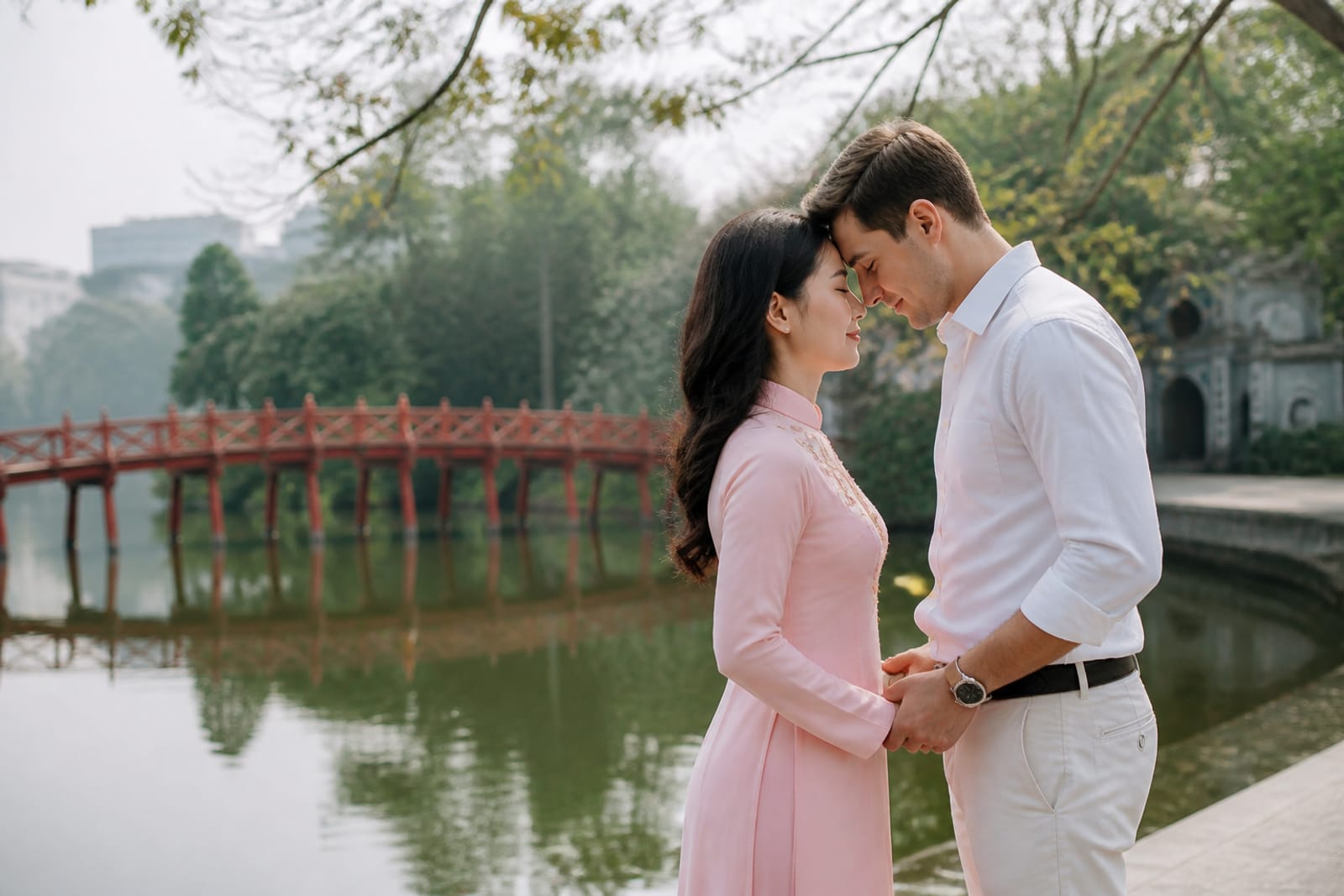
What should you wear, and how does makeup hold up?
Night shoots call for rich, saturated colors — deep reds, jewel tones, blacks — that photograph well under artificial light. Pastels and whites look washed out under street lamps. Ao dai (traditional silk tunic) works beautifully: the fabric catches neon and building light with natural sheen. Modern dress is fine too; just avoid very sheer fabrics (street lights silhouette them unflatteringly) and busy patterns (they strobe under flickering shop signs).
Makeup must be matte or semi-matte; glossy products reflect street lights in a way that reads as oily on camera. Your makeup artist should use long-wear formulas and set powders generously. Humidity in autumn Hanoi (often 60–75% even at night) will challenge lip color and eyeshadow blend by hour 3 — this is normal, not a failure. Bring blotting sheets and a powder compact for touch-ups between outfit changes.
Shoes matter: you will walk 1–3 km on pavement, stairs, and uneven Old Quarter stones. Heels are tempting for framing but painful after 90 minutes. Comfort heels (2–3 cm) or elegant flats are smarter. Test your shoes on concrete beforehand.
Hair: breezes and micro-humidity will cause some movement and frizz (especially for longer hair) — this can be charming, but if you want pin-perfect looks, discuss this with your makeup team before the shoot. Makeup & hair services at Cáo Studio include touch-ups; ask what's covered during your booking.
📸 Book on WhatsApp — couple photoshoot
How do you compare night shoots to daytime pre-wedding or other options?
Night shoots cost more than daytime work because lighting gear, permits, and longer team hours (darkness extends session length) add up. Daytime shoots (morning/golden hour) are faster, cheaper, and lighter on equipment — but you lose the romantic, urban-glow mood that night shooting offers. If budget is tight, a blue-hour shoot (dusk, 17:30–18:30) compromises: you get some night mood, shorter duration, and easier lighting than full darkness.
Couple & family sessions during daytime are ideal if you want a relaxed, bright, natural vibe — parks, lakes, casual framing. Night work suits couples who want cinematic, moody, dressed-up aesthetic. Ao dai photoshoots work exceptionally well at night: silk under street lights is radiant.
Some couples book both: daytime session for soft, romantic couple moments, then a night session in Old Quarter or by the lake for editorial, vibrant shots. Stagger them over two days to avoid fatigue.
Proposal & anniversary shoots are also available at night — the mood is built-in.
---
What to check before you book
- Ask for a night-shoot portfolio. Does the studio have real night work samples? Underexposed shots or blown-out street lights mean inexperience. A solid portfolio shows skin tones exposed correctly, ambient light used skillfully, and intentional composition — not just fast shutter + high ISO grain.
- Confirm location permits. Which spots are included? If you want Old Quarter or Hoan Kiem Lake access, does the package include permits, or will you face police stops?
- Lighting gear included? Night shoots require external flash, reflectors, or off-camera light. Is this included, or do you pay extra? Battery backup?
- Duration and outfit changes. How many outfits are realistic in your time slot? What happens if you want more changes — does it cost extra?
- Weather backup plan. Winter drizzle and summer downpours are common. What's the reschedule policy? Free rebooking within X months, or forfeit the fee?
- Makeup & hair durability. Is touch-up included during the shoot? Long-wear products assumed?
- Post-production timeline. How many days until you get edited files? Night work often requires more retouching (shadow detail, color balance) — expect a longer turnaround than daytime shoots.
- Edited file count and format. Do not assume "unlimited." Ask: how many fully edited images, what format (JPG, RAW, high-res print-ready), and can you request retakes if one outfit's light was poor?
Ask Cáo Studio all of these on WhatsApp 📸 Book on WhatsApp — night pre-wedding before committing. Quality studios welcome detailed questions.
---
FAQ
Is October or November better for night shoots in Hanoi?
Both are excellent. October is slightly warmer (20–24°C) and drier; November cools to 15–20°C and can be crisp. Choose based on your comfort — either works well. Book early; autumn is peak season.
Can you do a night shoot in June or July?
Technically yes, but not ideal. Dusk lasts until 19:30+, leaving only 1.5 hours of true night mood. Summer heat and evening downpours exhaust couples fast. October–February is far better.
What if it rains the night of my shoot?
Light drizzle is moody and manageable; heavy rain cancels most outdoor work. Hanoi's rainy season peaks Sep–Dec. Confirm your studio's weather reschedule policy before booking. Winter (Dec–Feb) has occasional drizzle — ask if your team shoots in light rain.
Do I need special makeup for night photography?
Yes. Use matte or semi-matte finishes; glossy products reflect street lights poorly. Waterproof, long-wear formulas hold better under humidity. Your makeup artist should understand night-light challenges — this is why asking for a portfolio matters.
How much more does a night shoot cost than daytime?
Costs vary by location, outfit changes, and team size. Lighting gear, permits, and longer hours add expense. Ask Cáo Studio for a quote tailored to your date, season, and location preference — send details on WhatsApp.
Can I combine night shoots with daytime couple sessions?
Yes. Many couples book both over two days or as separate sessions. Daytime is relaxed; night is cinematic. Double-session packages are common — inquire on WhatsApp about combinations.
What's the difference between a night pre-wedding shoot and a wedding day photographer?
Pre-wedding is a styled photoshoot before the wedding, for couple portraits and mood. A wedding-day photographer covers your actual ceremony, reception, and events. These are separate services. Cáo Studio offers both; ask which suits your timeline.
FAQ
Is October or November better for night shoots in Hanoi?
Both are excellent. October is slightly warmer (20–24°C) and drier; November cools to 15–20°C and can be crisp. Choose based on your comfort — either works well. Book early; autumn is peak season.
Can you do a night shoot in June or July?
Technically yes, but not ideal. Dusk lasts until 19:30+, leaving only 1.5 hours of true night mood. Summer heat and evening downpours exhaust couples fast. October–February is far better.
What if it rains the night of my shoot?
Light drizzle is moody and manageable; heavy rain cancels most outdoor work. Hanoi's rainy season peaks Sep–Dec. Confirm your studio's weather reschedule policy before booking. Winter (Dec–Feb) has occasional drizzle — ask if your team shoots in light rain.
Do I need special makeup for night photography?
Yes. Use matte or semi-matte finishes; glossy products reflect street lights poorly. Waterproof, long-wear formulas hold better under humidity. Your makeup artist should understand night-light challenges — this is why asking for a portfolio matters.
How much more does a night shoot cost than daytime?
Costs vary by location, outfit changes, and team size. Lighting gear, permits, and longer hours add expense. Ask Cáo Studio for a quote tailored to your date, season, and location preference — send details on WhatsApp.
Can I combine night shoots with daytime couple sessions?
Yes. Many couples book both over two days or as separate sessions. Daytime is relaxed; night is cinematic. Double-session packages are common — inquire on WhatsApp about combinations.
What's the difference between a night pre-wedding shoot and a [wedding day photographer](/wedding-photographer)?
Pre-wedding is a styled photoshoot before the wedding, for couple portraits and mood. A wedding-day photographer covers your actual ceremony, reception, and events. These are separate services. Cáo Studio offers both; ask which suits your timeline.
Ao dai, makeup, hair and a local photographer in Hanoi or Saigon — one WhatsApp message.