/pre-wedding-photoshoot
Planning a Phong Nha Pre-Wedding Shoot from Overseas
A Phong Nha pre-wedding shoot planned remotely hinges on three decisions: season (Feb–Aug is dry and bright; Sep–Dec brings heavy rain and flood risk), who directs the work (local Phong Nha team, or traveling photographers from Hanoi), and how far in advance you book. If you're overseas, you need a photographer who scouts locations for you, communicates light timing clearly, and handles the outfit—ao dai, Western dress, or both. Cáo Studio doesn't operate in Phong Nha, but we guide clients booking locally: ask your photographer for a shot list tied to sunrise/sunset times, confirm backup plans for rain, and arrange transport and hair/makeup on the ground. The biggest mistake is underestimating light quality in the karst landscape—soft side light at dawn beats harsh midday sun. Plan 4–8 weeks ahead so your team can book caves, boat access, and permits. 📸 Book on WhatsApp — ao dai photoshoot | 💄 Makeup & hair at your hotel | 🌸 See the lookbook ---
Why is season the first choice for a Phong Nha pre-wedding shoot?
Phong Nha sits in central Vietnam's driest belt Feb–Aug: skies are pale blue or soft white, caves are accessible, and river trips run reliably. Sep–Dec brings the tail of the southwest monsoon—daily afternoon downpours (often brief but heavy), flooding that closes Son Trach cave and boat routes, and a typhoon risk. October and November are the worst months. If you book Feb–Aug, you have predictable light and clear backup days; Sep–Dec requires extra flexibility and a willingness to reschedule. Choose your dates around your schedule, but know that February is coolest (easier for long outdoor sessions) and August is hottest (fast fatigue, more touch-ups needed for makeup). Your photographer should know how water reflections and cave interiors behave in each season—limestone absorbs and bounces light differently in humidity.
---
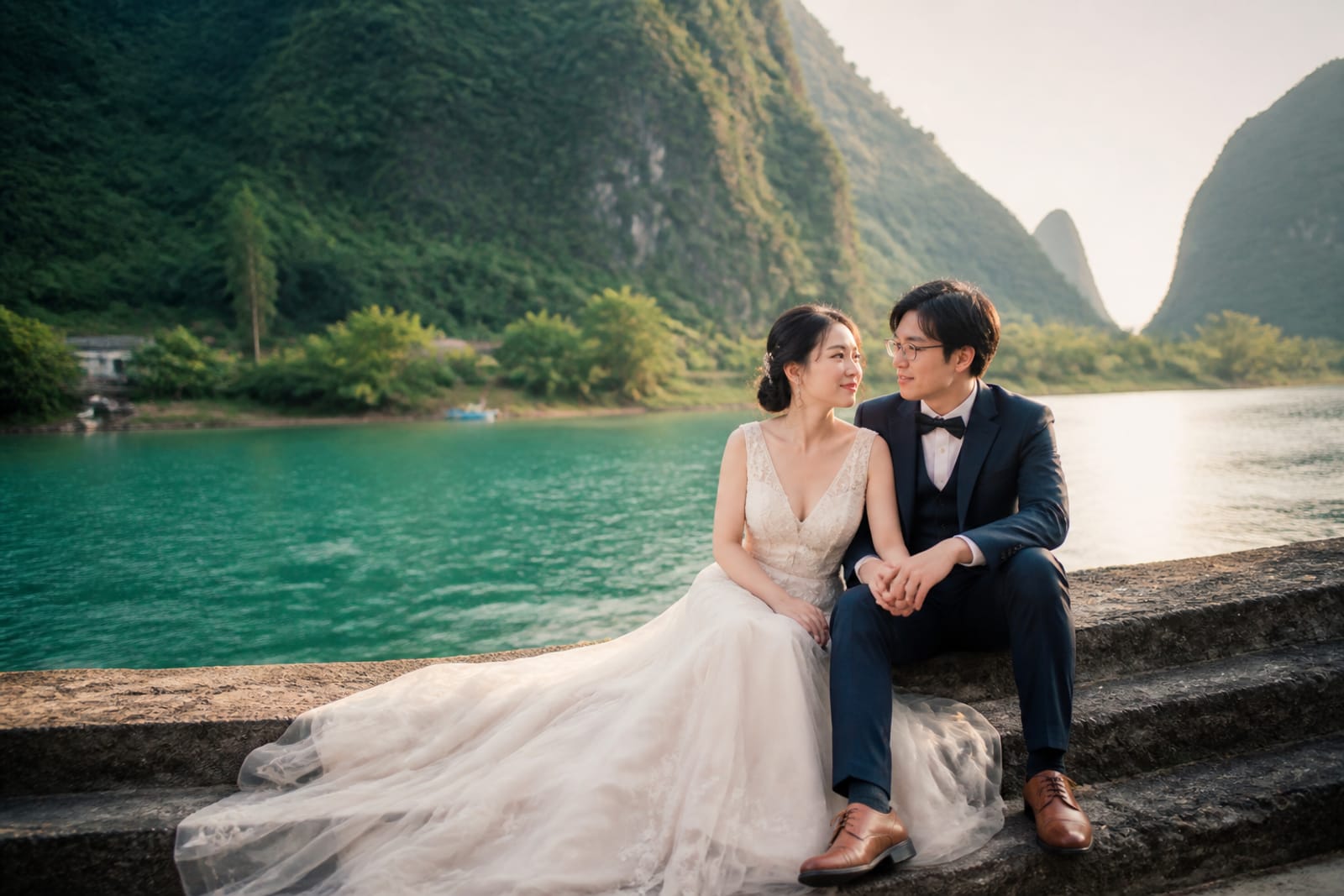
Can you hire a local Phong Nha photographer or should you travel with your own?
| Option | Best for | Light & Season | Why it works |
|---|---|---|---|
| Local Phong Nha team | Couples who land a few days early, want scouted locations, speak Vietnamese or have a guide | Feb–Aug; dawn/dusk only (no midday) | They know permit timings, boat schedules, and exactly where karst reflects light at 6 am |
| Hanoi-based traveling photographer | Couples wanting one team for outfit + hair + direction + editing | Feb–Aug; avoids rain weeks entirely | One person manages the narrative; no coordination between three vendors; turnaround is faster |
| Overseas photographer (you travel together) | Couples who want continuity with their own shooter | Any season if indoor-heavy (studio, hotel suite, cave interiors) | Familiar style; no language gaps; but high cost and risk if weather forces reschedule |
The trade-off: local teams know Phong Nha intimately but may not direct a story the way a traveling director does—you get the monument, not the moment. A Hanoi team travels to Phong Nha (takes 4 hours) and returns same-day or the next, costs more than a local, but treats your session like a film. If you hire local, ask their shot list: Do they have a video of dawn at Hang Son Doong? Do they scout the day before? Can they do hair and makeup on location, or do you arrange that separately?
🌸 See the lookbook | 💄 Makeup & hair at your hotel
---
What makes light work in Phong Nha's cave and river landscapes?
Phong Nha's UNESCO karst is dramatic but unforgiving: towering limestone faces shade valleys until late morning, and midday sun overhead is flat and ugly. Your best light windows are 5:45–7:15 am (before cave areas heat up, soft side-light on rock faces) and 4:45–6:15 pm (water reflections are warm, not harsh). Inside caves like Son Trach or Hang En, artificial light is banned or restricted—you rely on the single opening or small skylights. Experienced Phong Nha photographers know that Hang En works best at 7 am (light streams in from the cave mouth, models can walk through it); Son Trach is tighter and needs noon-ish light to avoid pitch darkness. River shots (Dragon River, Son Trach waterway) are best at dawn—water is calm, mist rises from limestone, and reflections are clear. Bring white or cream-colored ao dai for caves (bounces available light) and darker tones for river bank (contrast against water). Midday, ask your photographer to move to overhangs or jungle shade—the karst provides plenty. If rain occurs (afternoon storms), you lose light by up to 2 stops; your team should have an indoor contingency (hotel suite, homestay interiors, lantern corners in towns like Dong Hoi).
---
How far ahead should you book, and what permits or access do you need?
Book 6–8 weeks out if you want a specific date and good weather odds. Most caves (Son Trach, Hang En, Phong Nha Ke Bang caves) require entrance tickets (check the official Phong Nha Ke Bang National Park site for current prices and hours). If you shoot inside, the park may require a guide or an extra permit—your photographer should handle this; some do, some don't. Ask directly: "Do you include cave permits in your rate?" Boat trips on Son Trach River or Dragon River book through local operators (usually via your hotel or the photographer's network); they fill up Dec–Feb, so confirm dates early. Hair and makeup on the ground can be arranged through your hotel, your photographer, or a local salon—confirm credentials if the team isn't handling it themselves. Transport from Dong Hoi airport to shoot locations (30–45 min) can be arranged by your hotel or a local driver; your photographer should advise. The biggest delay: waiting for a clear weather window. If you build in 2–3 free days around your shoot date, you're insured against storms. Never book just one day—the karst swallows plans.
💄 Makeup & hair at your hotel | 🌸 See the lookbook
---
What's the difference between a Phong Nha pre-wedding shoot and a Hanoi or Ho Chi Minh City session?
Phong Nha is landscape-heavy: the story is you in the karst, not you in an urban grid. Light is softer (no concrete glare), but timing is stricter (narrow sunrise/sunset windows). Hanoi offers couple photoshoots in colonial streets, temples, and lakes—you can shoot mid-morning with reflected light from French architecture. Ho Chi Minh City (Saigon) has street energy and pagodas; the light is tropical and warm year-round, but you're often dodging traffic or crowds. Phong Nha requires patience: you arrive at one location at 5:50 am, wait for light, shoot for 45 minutes, and pack out. The reward is isolation—no tourists in the cave at dawn—and frames that feel cinematic rather than documentary. If you want on-the-day flexibility (multiple outfits, multiple spots, quick turnarounds), Hanoi or Saigon pre-wedding is easier. If you want one iconic narrative tied to geology and water, Phong Nha is worth the early starts. Both can include ao dai rental and makeup and hair on the ground.
---
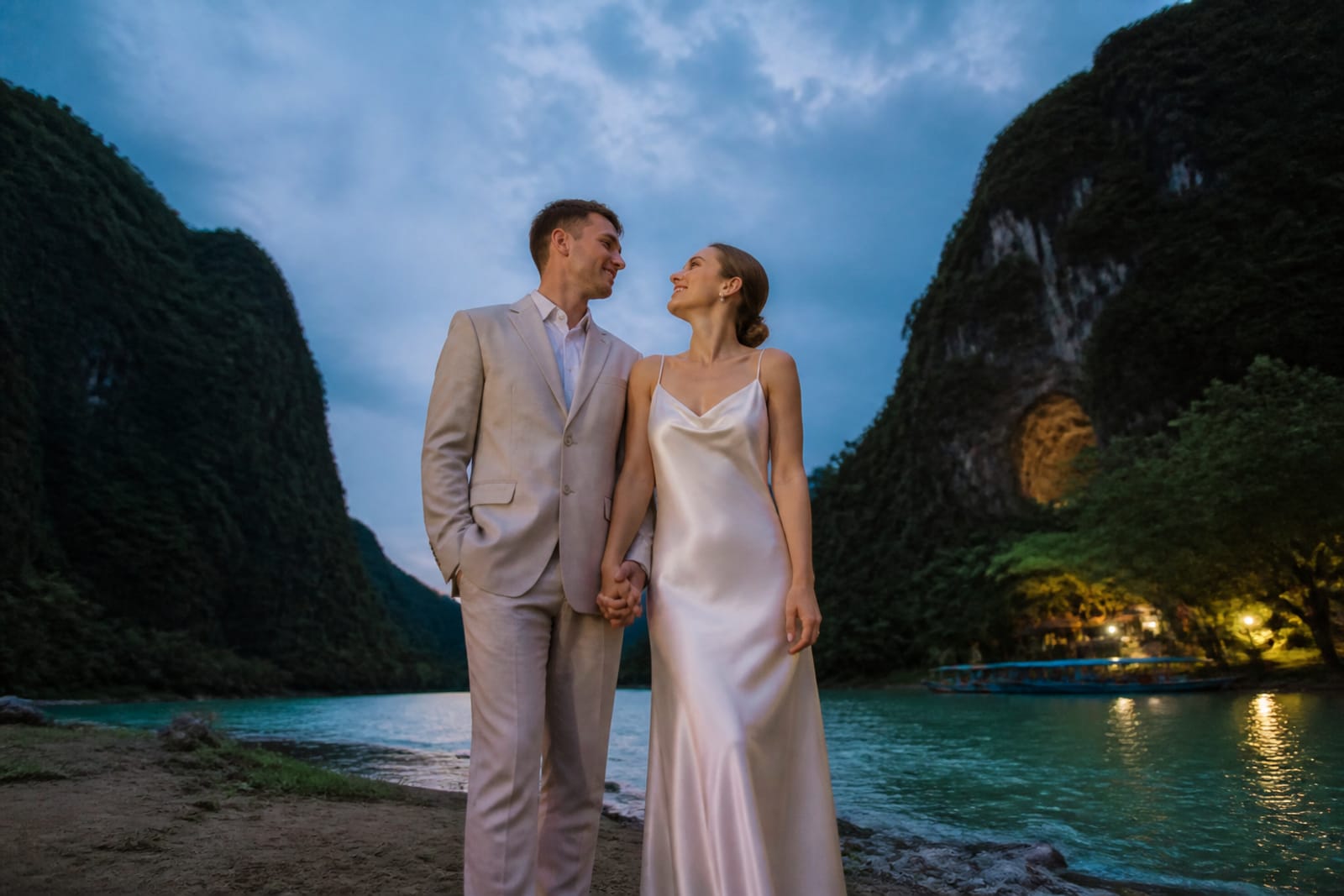
What should you check before booking a Phong Nha pre-wedding photographer?
Ask these questions before you commit:
- Shot list: Do they show you a list tied to specific times and light conditions? (e.g., "6:10 am at Hang En entrance for side light on you walking")
- Backup plan: What happens if it rains or light fails? Do they reshoot, or do you forfeit the session?
- Inclusions: Does their rate cover hair/makeup, ao dai or dress rental, cave permits, transport, editing, and delivery timeline?
- Solo or team: Is it one photographer, or do they bring a videographer or assistant? Do they direct (guide your movement and framing) or just shoot?
- Turnaround: When do you see edited files? A 48-hour delivery is rare in Phong Nha; expect 2–4 weeks if working with local teams.
- Language: Do they brief you in English, or do you need a translator?
- References: Ask for a portfolio of pre-wedding or couple shoots in Phong Nha—not just landscapes—so you see how they handle people.
If you're torn between options, Cáo Studio works with clients who want to shoot in Hanoi, Saigon, or Hoi An—places where our team controls the full narrative. For Phong Nha, we advise honestly: hire a local you trust, or route through a Hanoi studio that travels. Either way, arrive early, respect the weather, and expect to wake at 4:30 am. The frames are worth it.
📸 Book on WhatsApp — ao dai photoshoot | 🌸 See the lookbook | 💄 Makeup & hair at your hotel
---
What does a realistic pre-wedding timeline look like if you're booking from overseas?
Start 8 weeks out: shortlist photographers, message 3–4 options on WhatsApp or email, ask for portfolios and availability. After 1–2 weeks, you'll know who has your dates open and can discuss vision (caves only, or mix in town scenes; one outfit or two; video edit or stills only). Week 5–6: confirm the shot list, book transport and accommodation, arrange hair/makeup locally, and arrange any outfit rental. Week 3: final briefing—exact meet time, what to wear for the drive, where to meet, weather forecast, and backup dates. Week 1: final confirmation email with details. On arrival day, rest and hydrate. Shoot day: wake early, light breakfast, meet your photographer 45 min before the first light window. The shoot itself is 2–3 hours (shorter than urban shoots because you're chasing light). Editing takes 2–6 weeks depending on the photographer's backlog. Plan your wedding announcements or album for 6–8 weeks after the shoot to allow for final files.
---
Which outfits and fabrics work best in Phong Nha's humidity and light?
Ao dai: Choose white, cream, or pale pastels for cave interiors (they reflect available light) and jewel tones (emerald, sapphire, burgundy) for river shots (they sing against water and limestone). Silk wrinkles and clings in humidity; ask if the studio provides an iron or steamer on set. Bring a backup top in case the first absorbs cave moisture.
Western dress: A light, flowing fabric (chiffon, tulle, linen) breathes in heat and dries fast if you wade into the river. Avoid heavy satin or dense lace—they photograph dark in cave light and feel suffocating after two hours in 28°C humidity. Pale or neutral tones (white, blush, champagne, sage) work better than bold jewel tones indoors.
Grooming: Waterproof makeup is essential—you'll sweat. Dewy skin reads better than matte in cave light (it reflects the subtle illumination). Hair should be pinned or secured (wind at dawn, sweat mid-morning). Avoid heavy hairspray in humidity (it stiffens); a light hold is enough.
Coordinate with your photographer on outfit choices 2 weeks ahead. They'll tell you what they've seen work in their Phong Nha portfolio—pattern and color against limestone is an instinct you develop.
---
What makes a Phong Nha pre-wedding narrative different from a travel or couple shoot?
A couple shoot is a fleeting portrait session (30 min–2 hrs, one location, one outfit). A pre-wedding is a story: you arrive as strangers to a place, walk through it, interact with light and landscape, and leave changed. Phong Nha's geology makes this arc visual—you start small against the karst, move through caves, emerge onto water, and finish as part of the landscape rather than isolated in front of it. Experienced pre-wedding directors frame it this way: opening shot is wide (you two walking into Hang En's mouth, tiny against stone); middle is medium (water reflections, touching hands in a cave shaft); closing is detail (your ao dai hem trailing through mist, his arm guiding you across rocks). A travel shoot focuses on you discovering the place; a pre-wedding focuses on you as a couple discovering each other through the place. If you want frames for an album or announcement, a couple session or vacation photoshoot is enough. If you want a narrative arc that works as a film or a digital story, book a pre-wedding shoot with a director who understands the difference.
💄 Makeup & hair at your hotel | 📸 Book on WhatsApp — ao dai photoshoot
---
FAQ
Do I need both an ao dai and a Western dress for a Phong Nha pre-wedding?
No. One outfit works if it fits the light and season. Ao dai suits caves (reflects available light, tells a Vietnamese story). Western dress suits river and open sky. Most couples choose one, shoot it in 2–3 locations, and edit 40–60 final frames. Ask your photographer: "Do you recommend one outfit or two for Phong Nha's caves?"
What's the best time of day to shoot in Son Trach cave?
6:45–7:30 am. Light enters the cave mouth at a low angle, illuminating the interior and any water without harsh shadows. Midday light is overhead and useless; late afternoon caves are pitch-black. Your photographer should plan arrival for 6:15 am to set up.
Can we reshoot if the weather ruins the first date?
Only if your photographer's contract includes a free reshoot or a rescheduled date. Ask this explicitly before booking: "If heavy rain cancels the shoot, do I get a free reshoot date or a refund?" Most say yes, but confirm in writing.
How do we choose between hiring a local Phong Nha photographer and traveling with someone from Hanoi?
Local photographers are cheaper and know the caves intimately; Hanoi teams are more expensive but direct a stronger narrative and handle outfit/hair/makeup as one unit. If you want story-driven frames and can budget for travel, a Hanoi team is safer. If you're time-limited and on a tighter budget, vet a local's portfolio carefully—look for couple shots, not just landscapes.
Is February or August better for a Phong Nha pre-wedding?
February is cooler (less makeup touch-ups, easier endurance) and has slightly softer light; August is hotter but has fewer tourists. Both are dry and bright. February books faster because it's peak season; August has more flexibility for date changes. Either works if you avoid Sep–Nov.
Can we do the shoot in one day or do we need multiple days?
One full day (5 am–1 pm or 4 pm–dark) is standard. Most couples shoot one location at dawn, move to a second spot for mid-morning light, and finish. Multiple days are uncommon unless you're hiring a team to follow you for a multi-location wedding journey. Ask your photographer: "How many locations and hours does a typical session include?"
What happens if we book a Phong Nha photographer and they cancel last minute?
Check their cancellation policy before signing. Legitimate photographers have insurance or a reserve date clause; amateur operators may not. Ask: "If you become unavailable, do you refer me to a vetted backup, or do I get a refund?" Get the answer in writing (WhatsApp screenshot or email).
Should we hire a videographer separately or ask the photographer?
Many Phong Nha photographers offer video as an add-on; some are stills-only. Coordinate early. A photographer who also shoots video can maintain continuity (same narrative, same light moments framed twice). If you hire separately, brief both teams so they don't clash on location. Ask: "Can you shoot stills and a 2–3 min video edit in the same session?"
FAQ
Do I need both an ao dai and a Western dress for a Phong Nha pre-wedding?
No. One outfit works if it fits the light and season. Ao dai suits caves (reflects available light, tells a Vietnamese story). Western dress suits river and open sky. Most couples choose one, shoot it in 2–3 locations, and edit 40–60 final frames. Ask your photographer: "Do you recommend one outfit or two for Phong Nha's caves?"
What's the best time of day to shoot in Son Trach cave?
6:45–7:30 am. Light enters the cave mouth at a low angle, illuminating the interior and any water without harsh shadows. Midday light is overhead and useless; late afternoon caves are pitch-black. Your photographer should plan arrival for 6:15 am to set up.
Can we reshoot if the weather ruins the first date?
Only if your photographer's contract includes a free reshoot or a rescheduled date. Ask this explicitly before booking: "If heavy rain cancels the shoot, do I get a free reshoot date or a refund?" Most say yes, but confirm in writing.
How do we choose between hiring a local Phong Nha photographer and traveling with someone from Hanoi?
Local photographers are cheaper and know the caves intimately; Hanoi teams are more expensive but direct a stronger narrative and handle outfit/hair/makeup as one unit. If you want story-driven frames and can budget for travel, a Hanoi team is safer. If you're time-limited and on a tighter budget, vet a local's portfolio carefully—look for couple shots, not just landscapes.
Is February or August better for a Phong Nha pre-wedding?
February is cooler (less makeup touch-ups, easier endurance) and has slightly softer light; August is hotter but has fewer tourists. Both are dry and bright. February books faster because it's peak season; August has more flexibility for date changes. Either works if you avoid Sep–Nov.
Can we do the shoot in one day or do we need multiple days?
One full day (5 am–1 pm or 4 pm–dark) is standard. Most couples shoot one location at dawn, move to a second spot for mid-morning light, and finish. Multiple days are uncommon unless you're hiring a team to follow you for a multi-location wedding journey. Ask your photographer: "How many locations and hours does a typical session include?"
What happens if we book a Phong Nha photographer and they cancel last minute?
Check their cancellation policy before signing. Legitimate photographers have insurance or a reserve date clause; amateur operators may not. Ask: "If you become unavailable, do you refer me to a vetted backup, or do I get a refund?" Get the answer in writing (WhatsApp screenshot or email).
Should we hire a videographer separately or ask the photographer?
Many Phong Nha photographers offer video as an add-on; some are stills-only. Coordinate early. A photographer who also shoots video can maintain continuity (same narrative, same light moments framed twice). If you hire separately, brief both teams so they don't clash on location. Ask: "Can you shoot stills and a 2–3 min video edit in the same session?"
Ao dai, makeup, hair and a local photographer in Hanoi or Saigon — one WhatsApp message.