/pre-wedding-photoshoot
Pre-wedding photo ideas and poses at O Quy Ho pass
O Quy Ho (also spelled O Quy Hô) is a mountain pass at roughly 2,000 metres elevation on the road from Sa Pa downhill towards Lao Cai, in the far north of Vietnam. Pre-wedding couples shoot there for the wide, bare-ridge vistas, mist, and the dramatic stone marker. A session runs 2–4 hours depending on walk distance and outfit changes; the best light is early morning (6:30–8:00 am) before clouds thicken, or late afternoon (4:00–5:30 pm) as mist rolls in. You'll need a local photographer familiar with Sa Pa's roads, permits and rapid weather shifts — Cáo Studio does not operate in Sa Pa, so hire a Hanoi-based or Sa Pa-based photographer and plan outfits that layer under wind and cold. Avoid the mid-day flat light, rainy season (May–Sep) when passes close, and crowds on weekends around the marker stone. ---
What makes O Quy Ho special for pre-wedding frames?
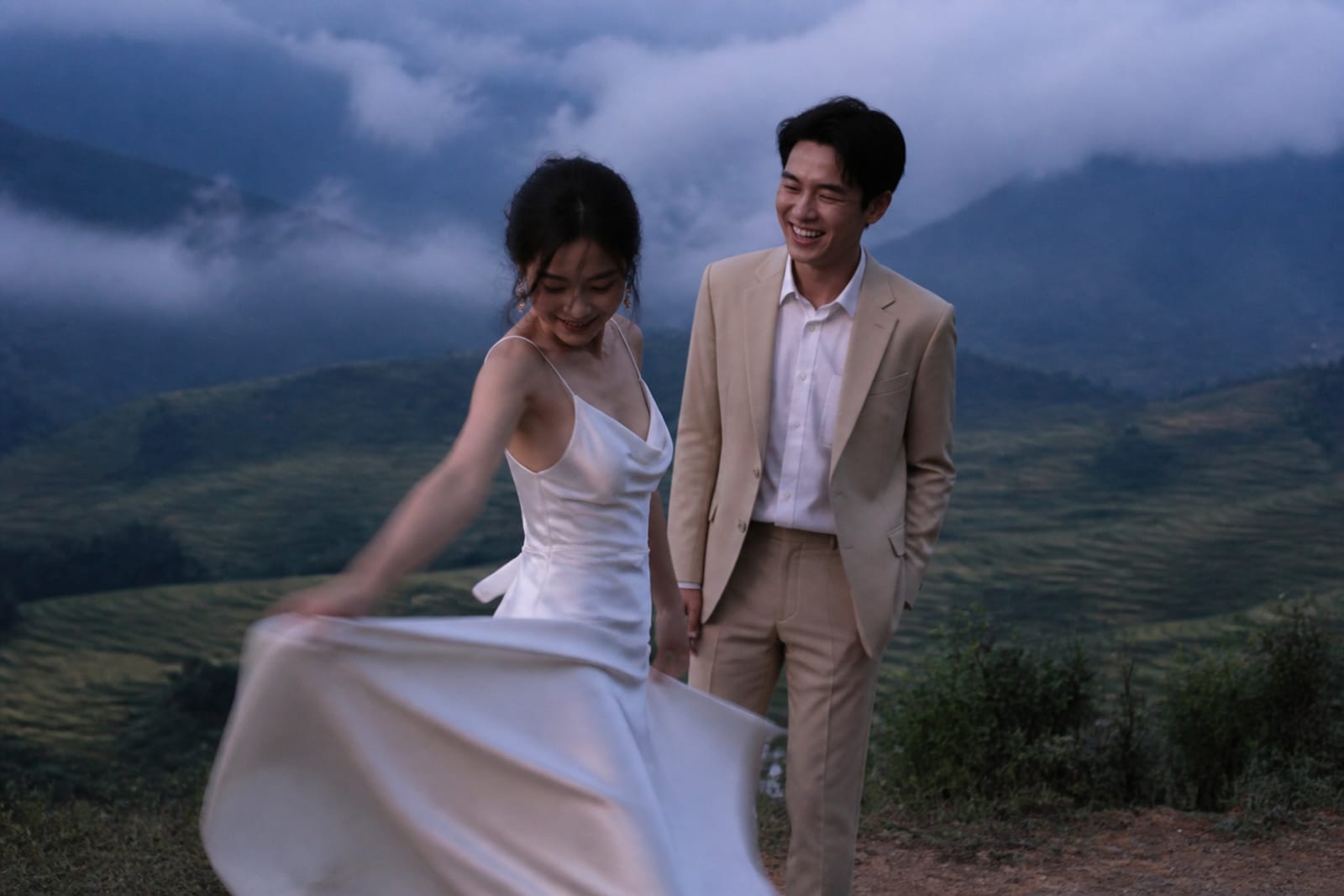
O Quy Ho is not a manicured resort: it's a working mountain pass where the landscape does the story. The ridge drops away on both sides; mist pools in valleys below; the iconic stone marker frames tight two-shots. Most couples shoot there for one reason — isolation and scale. A lowland studio cannot manufacture that. The trade-off is logistics: the pass is 1.5 hours' drive from Sa Pa town, weather changes in 20 minutes, and you cannot control foot traffic (domestic tours stop there). A skilled photographer uses that unpredictability — the couple walking into mist, a sudden cloud shadow, the light breaking through — instead of fighting it.
📸 Book on WhatsApp — pre-wedding photoshoot | 🌸 See the lookbook
When is the light and season right for shooting O Quy Ho?
Light windows at O Quy Ho are narrow. Early morning (6:30–8:00 am) gives soft, angled light across the ridge before clouds build; it also means you leave Sa Pa town by 5:30 am. Late afternoon (4:00–5:30 pm) brings warmer tones and mist rising from the valleys — often more dramatic, but you must be off the pass by dusk for safety. Mid-day (10 am–3 pm) is flat and harsh; avoid it. For season: March to May and September to early November have the clearest skies and stable mornings. December to February is cold (near or below 0°C at altitude), with fog that can obscure the view entirely — plan for grey, moody frames rather than clarity. June to August is rainy; passes often close due to visibility and landslide risk, and afternoon downpours cut shoots short. Tet (late January–mid February) brings crowds and road congestion. The sweet spot is late September to October (cool, dry, lowest mist) or April (pre-monsoon warmth, occasional clouds for contrast).
How do outfit and layering work at 2,000 metres elevation?
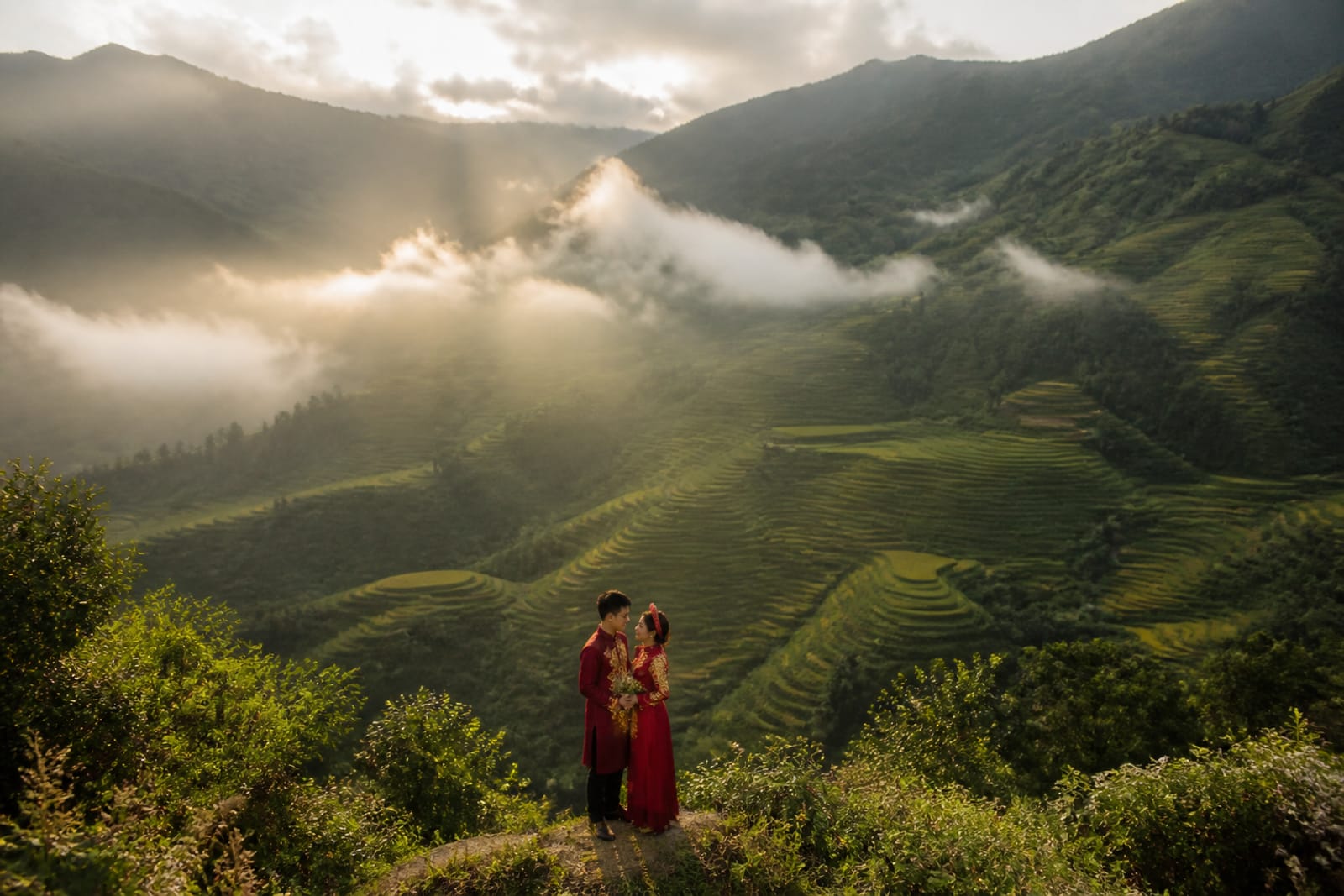
Wind at O Quy Ho is constant and cold, even in autumn. A flowing ao dai or wedding dress will catch it; the couple will be uncomfortable and the fabric won't photograph cleanly. Most couples wear a tailored wrap or shawl over the dress, or choose structured fabrics that don't billow. Underneath, thermal layers are not optional — the pass is 10–15°C cooler than Sa Pa town. Grooms wear a suit jacket or coat; bare arms or open shirts will read as discomfort in the frame. Shoes must grip: the stone marker area and ridge paths are uneven and sometimes slippery. Flat ballet flats or embellished heels will cause real problems; ask your photographer for terrain details before you choose footwear. Makeup: wind and cold dry skin fast. A makeup artist familiar with altitude (ideally one who comes with you from Sa Pa) can set makeup to last and carry touch-up powder. Hair should be pinned or braided; loose hair in mountain wind looks chaotic, not romantic. Plan two outfit changes maximum — more means more time exposed to cold, and the light window is short.
| Outfit option | Best for | Why it works | Trade-offs |
|---|---|---|---|
| Ao dai (traditional) with wrap | Couples wanting cultural frames in drama | Structured fabric moves elegantly in wind; wrap adds warmth and silhouette | Ao dai is high-maintenance on uneven terrain; requires a makeup artist who travels |
| Wedding dress with tailored coat | Western couples, formal aesthetic | Coat protects the dress and bride; layers read as intentional, not desperate | Coat hides the dress detail; heavy fabrics tire fast at altitude |
| Tailored trousers + structured top | Couples prioritizing comfort and movement | Easier to walk, sit on rocks, frame movement; lighter gear speeds up logistics | Less formal; fewer options for close-up detail shots |
| Casual/travel outfit (linen, knit) | Elopement or "real day" aesthetic | Authentic and practical; wind doesn't destroy the frame; fastest to change | No bridal formality; won't read as pre-wedding to most viewers |
What do you need to arrange before booking a photographer?
O Quy Ho shoots are not drop-in sessions. A month before, confirm: (1) weather forecast windows — if the forecast is rainy, reschedule rather than shoot in soup; (2) your photographer's Sa Pa access — do they have transport? Do they know the road safety protocols? Are they insured for mountain work?; (3) outfit details and layering plan — send photos of what you'll wear so the photographer can plan framing and warn you of issues; (4) permits — some local guides say a permit or guide is required for non-Vietnamese couples at the pass (rules vary); ask your photographer to confirm; (5) backup location — if mist is zero on shoot day, where will you pivot? A photographer who has shot Sa Pa before has a secondary pass or valley in mind. Cáo Studio is based in Hanoi and does not operate in Sa Pa, so you will hire a local Sa Pa photographer or a Hanoi-based photographer who travels north. Ask prospective photographers: How many shoots have you done at O Quy Ho? Show me a gallery. What happens if weather closes the pass on shoot day — do we reschedule free? How do you get us there? Do you have a backup plan? A photographer who hesitates on these is not ready for mountain work.
💄 Makeup & hair at your hotel | 📸 Book on WhatsApp
How does O Quy Ho compare to other northern Vietnam pre-wedding spots?
O Quy Ho is not the only alpine backdrop in the north. Here's how it stacks against similar options:
| Location | Elevation & vibe | Light & season | Accessibility | Poses & framing |
|---|---|---|---|---|
| O Quy Ho | ~2,000m; bare ridge, stone marker, mist | Early morning or late afternoon best; Sep–Oct peak | 1.5 hrs from Sa Pa town, uneven terrain, weather-dependent | Wide landscape + intimate two-shots; few crowds after 9 am |
| Fansipan (cable car) | 3,143m; summit, panorama, monument | Highly weather-dependent; often clouded; same seasons | Cable car + 30-min walk; regulated, crowded | Formal frames at monument; mist hides the view often |
| Silver Falls (Tram Ton Pass area) | ~2,000m; waterfall, forest, dramatic | Best May–Aug (water flow); rain-fed; misty Sep–Nov | 1.5 hrs from Sa Pa; less crowded; rockier terrain | Bridal splashing; intimate forest frames; water damage risk to outfits |
| Ta Phin Valley | ~1,500m; rice terraces, village, pastoral | Golden morning light; best Mar–May and Sep–Oct | 1 hr from Sa Pa; gentler walking; local guides available | Cultural frames; terraces scale couples small; domestic tourists frequent |
O Quy Ho wins on isolation and dramatic scale, but it demands early starts and stable weather. Fansipan is busier but guaranteed access (cable car). Silver Falls suits couples willing to get wet. Ta Phin suits cultural storytelling and easier logistics. If your priority is a unique, windswept frame far from crowds, O Quy Ho is worth the effort; if you need guaranteed clear photos and comfort, consider lower-elevation passes.
What should you check before committing to a photographer?
Before you book a photographer for O Quy Ho, verify:
- Portfolio at that specific location — ask for 3–5 galleries from O Quy Ho or similar passes. Edited photos mask many sins; ask for a RAW gallery or unedited selects so you see how they handle flat light and mist.
- Emergency and weather protocol — if the pass closes on shoot day, is rescheduling free? Who absorbs transport costs if you pivot to a backup location?
- Makeup and hair logistics — does the photographer coordinate with a makeup artist, or do you hire separately? Mountain makeup work is specialized; a lowland artist may not know how to set colour in wind and cold.
- Transport and timing — confirm the pickup point, departure time and eta at the pass. A photographer unfamiliar with Sa Pa roads may underestimate travel time and waste your light window in the car.
- Outfit and footwear advice — a good photographer will flag issues (heels on gravel, billowing fabrics in wind, inadequate layers). If they stay silent, they may not have shot mountain work before.
- Edited delivery and timeline — agree on the number of edited frames, delivery date and format (digital, album, prints). Mountain shoots often have lower usable frames due to weather; clarify expectations.
Ask your photographer to provide a detailed pre-shoot briefing — a call or WhatsApp exchange 2–3 days before the session. That conversation will reveal how prepared they are.
---
Since Cáo Studio operates in Hanoi, Ho Chi Minh City and Hoi An — not Sa Pa — we recommend hiring a local Sa Pa photographer or a Hanoi-based photographer experienced in mountain work. If you are planning a pre-wedding shoot in a lower-elevation destination, or if you'd like to combine a Sa Pa frame with a studio session in Hanoi before or after your mountain trip, we can help coordinate. Explore our couple photoshoot options, wedding video services, and wedding dress rental for the broader pre-wedding package.
For couples based in northern Vietnam or returning to Hanoi after Sa Pa, consider a follow-up shoot in the city to capture a second outfit or ao dai frame — Cáo Studio can arrange makeup and hair and an edited gallery within 48 hours.
🌸 Book on WhatsApp — pre-wedding photoshoot | 💄 Makeup & hair | 🎬 Wedding & pre-wedding video
---
FAQ
Do I need a permit to shoot at O Quy Ho pass?
Permit requirements for foreign couples vary by local authority. Ask your photographer to confirm current rules before booking. They should handle any paperwork or guide fees as part of their local knowledge.
What if the weather is bad on my shoot day?
A professional photographer will have a reschedule clause and a backup location (another pass or valley). Confirm this in writing before you pay the deposit. Mountain weather is unpredictable; flexibility is built into mountain shoots.
Can I wear a traditional áo dài at O Quy Ho?
Yes, but with caveats. Áo dài fabric is long and billows in wind; it can tangle on rocks or become muddy. Wear it with a tailored wrap or coat, and wear sturdy shoes underneath. A makeup artist should travel with you to handle touch-ups.
How far is O Quy Ho from Hanoi?
O Quy Ho is roughly 300 km (6–7 hours' drive) north-northwest of Hanoi, via Sa Pa town. Most couples base themselves in Sa Pa town the night before and wake early for the pass shoot. Cáo Studio is based in Hanoi and does not operate in Sa Pa; hire a local photographer.
What's the best time of year to shoot at O Quy Ho?
Late September to October offers the clearest skies and coolest, most stable mornings. April is also good (warm, occasional clouds for contrast). Avoid June–August (rainy, passes may close) and December–February (fog obscures views entirely, though grey light can be moody).
Can I combine an O Quy Ho shoot with a Hanoi pre-wedding session?
Yes. Many couples shoot at O Quy Ho, then travel to Hanoi a day or two later for a city outfit change or áo dài session. Cáo Studio in Hanoi can arrange makeup, hair and photography once you arrive. Coordinate the timeline so you don't exhaust yourselves.
FAQ
Do I need a permit to shoot at O Quy Ho pass?
Permit requirements for foreign couples vary by local authority. Ask your photographer to confirm current rules before booking. They should handle any paperwork or guide fees as part of their local knowledge.
What if the weather is bad on my shoot day?
A professional photographer will have a reschedule clause and a backup location (another pass or valley). Confirm this in writing before you pay the deposit. Mountain weather is unpredictable; flexibility is built into mountain shoots.
Can I wear a traditional áo dài at O Quy Ho?
Yes, but with caveats. Áo dài fabric is long and billows in wind; it can tangle on rocks or become muddy. Wear it with a tailored wrap or coat, and wear sturdy shoes underneath. A makeup artist should travel with you to handle touch-ups.
How far is O Quy Ho from Hanoi?
O Quy Ho is roughly 300 km (6–7 hours' drive) north-northwest of Hanoi, via Sa Pa town. Most couples base themselves in Sa Pa town the night before and wake early for the pass shoot. Cáo Studio is based in Hanoi and does not operate in Sa Pa; hire a local photographer.
What's the best time of year to shoot at O Quy Ho?
Late September to October offers the clearest skies and coolest, most stable mornings. April is also good (warm, occasional clouds for contrast). Avoid June–August (rainy, passes may close) and December–February (fog obscures views entirely, though grey light can be moody).
Can I combine an O Quy Ho shoot with a Hanoi pre-wedding session?
Yes. Many couples shoot at O Quy Ho, then travel to Hanoi a day or two later for a city outfit change or áo dài session. Cáo Studio in Hanoi can arrange makeup, hair and photography once you arrive. Coordinate the timeline so you don't exhaust yourselves.
Ao dai, makeup, hair and a local photographer in Hanoi or Saigon — one WhatsApp message.