/pre-wedding-photoshoot
Pre-wedding photo ideas and poses at Po Nagar Cham Towers
Po Nagar Cham Towers rises on a bluff north of Nha Trang, framing couples against weathered brick towers, sea view, and tree-lined steps. Best light arrives 16:30–18:15 (Oct–Mar clear; Apr–Sep after-rain humidity); shoot wide on the approach, medium walking the temple edge, detail on hands or jewelry against stone. Wear an ao dai (recommend rental locally or bring a flowing Western dress; avoid heavy, stiff fabrics). The climb is steep but brief (no permit needed, entry required—check current cost locally). Cáo Studio does not operate in Nha Trang; book a local photographer or request a directed shoot in Hanoi, Ho Chi Minh City, or Hoi An. Allow 2–3 hours including setup, travel, and changes. Avoid midday (harsh shadows, crowds) and rainy season peak (Oct–Nov). 📸 See pre-wedding shoots in Hoi An ---
What makes Po Nagar Cham Towers a strong pre-wedding frame?
The Towers sit 80 metres up with unbroken sea and valley horizon behind. Late light rakes across weathered Cham-era brick, throwing texture into sharp relief. A couple walking toward the main tower (not posed in front of it) reads as motion, discovery—the frame tells a story rather than marking a checkbox. Trees frame the upper edges, softening the sky. The approach itself—climbing past smaller stupas and stone shrines—offers layered compositions (foreground steps, middle couple, background towers). This three-depth stacking is rare at single-monument sites, which is why temple approaches often beat the main landmark.
Conclusion: Po Nagar works because the view extends and layers; you're not pressed against a single wall.
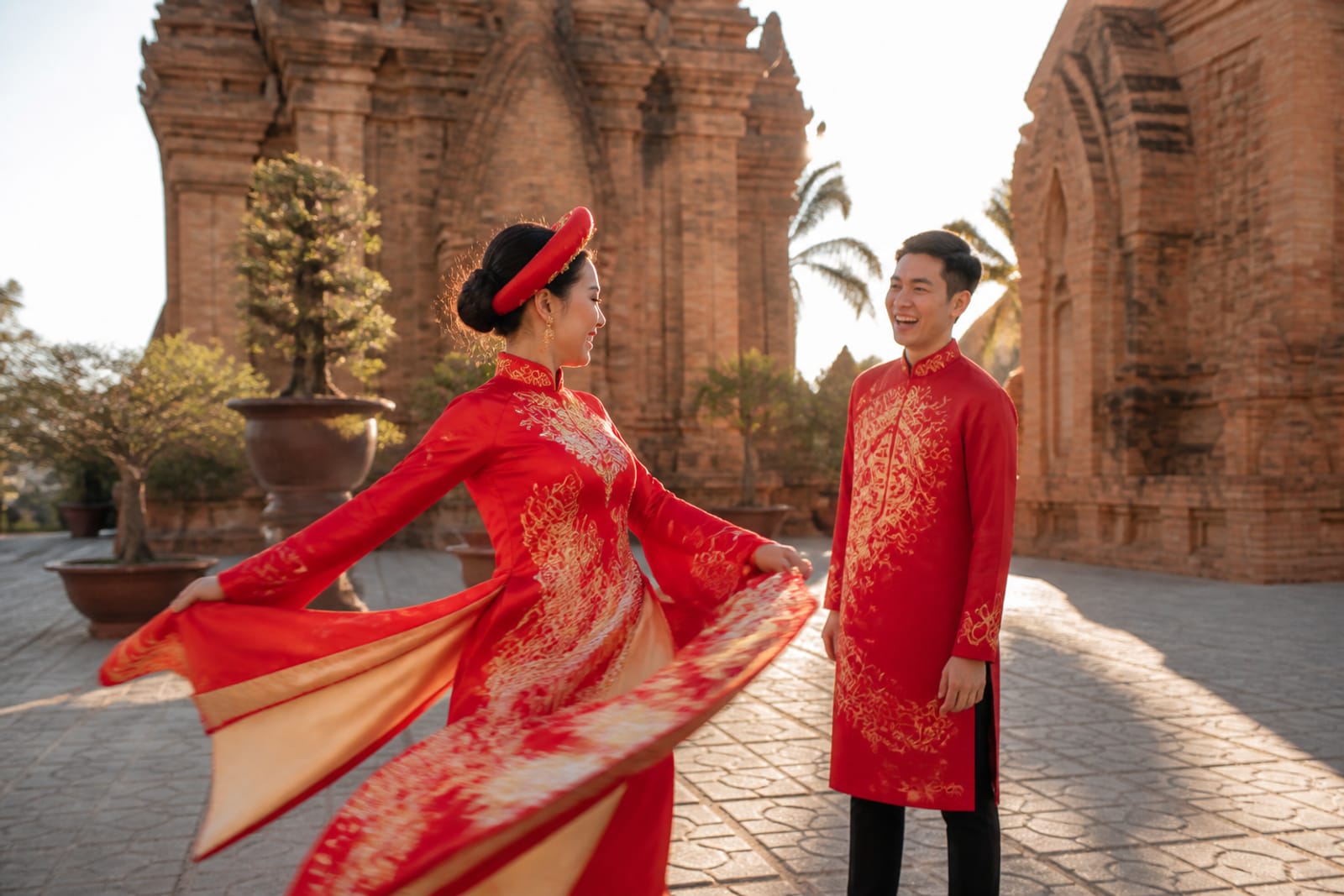
Should you shoot in ao dai or Western dress at the Towers?
An ao dai reads beautifully here—the vertical split of the tunic draws the eye upward (matching the towers), and the silk catches late light warmly. A white or cream ao dai against weathered brick is a classic contrast. Western dress works too if it's flowing (a gown, a silk slip dress, linen); anything fitted or stiff will fight the loose, ancient aesthetic of the site. If you're unsure, rent locally—Nha Trang has ao dai rental shops near the city center—or book a pre-wedding session in Hoi An, where ao dai rental and styling are part of the package. Layering (a shawl, a light wrap) protects skin at altitude and adds movement to frames.
Conclusion: Ao dai or flowing Western dress; stiff or tight fabrics undercut the site's mood.
Which time of year gives the clearest light at Po Nagar?
| Season | Light Quality | Crowds | Weather | Best Hours |
|---|---|---|---|---|
| Jan–Mar | Clear, sharp, cool | Low–moderate | Dry, 18–24°C | 16:45–18:00 |
| Apr–May | Warm, softer (haze) | Moderate | Pre-monsoon, 26–32°C | 17:00–18:15 |
| Jun–Sep | Soft, diffuse (humidity) | Low | Wet, afternoon rain likely | 16:30–17:45, after rain |
| Oct–Nov | Soft (cloud), risk of rain | Low | Typhoon/flood risk, grey | Avoid if possible |
| Dec | Clear, warm | Moderate–high | Dry, 22–26°C | 16:30–17:50 |
Jan–Mar is the clearest window—hard shadows are easy to manage, and the sea cuts deep blue. Apr–May introduces atmospheric haze (not necessarily bad for romance, but lines are softer). Jun–Sep humidity diffuses light evenly, reducing harsh contrast; if you shoot after a downpour, the towers and steps glisten. Oct–Nov (rainy season peak) poses a real risk—grey cloud, sudden rain, flash-flood hazard on the temple steps. Dec is solid, though crowds (holiday tourists) are heavier.
Conclusion: Jan–Mar or Dec deliver the sharpest light; Jun–Sep works if you embrace soft, diffuse frames.
How do you pose naturally without stiffness at an ancient monument?
The Towers invite movement, not stillness. Rather than "stand here and hold each other," try: walk up the final stone steps toward the main tower, looking at the view ahead (not the camera); sit on a lower plinth while your partner stands slightly back, hand on your shoulder (you both gaze out); cross the temple courtyard hand-in-hand, walking through the frame (the photographer is still and you move past). Details work too—close-up of your hands holding, fingers near a carved stone block, a ring catching light on weathered brick. Ask your photographer to shoot wide first (capturing the approach and landscape), then move closer for medium (you both in frame with tower behind), then pull tight for details. This sequence prevents stiffness because you're not re-posing; the camera is moving closer to a scene already happening. Avoid facing the camera directly at monuments—it locks you into "smiling at the camera," which dates fast.
Conclusion: Walk, sit, touch, look at each other or the view; let the camera follow the motion.
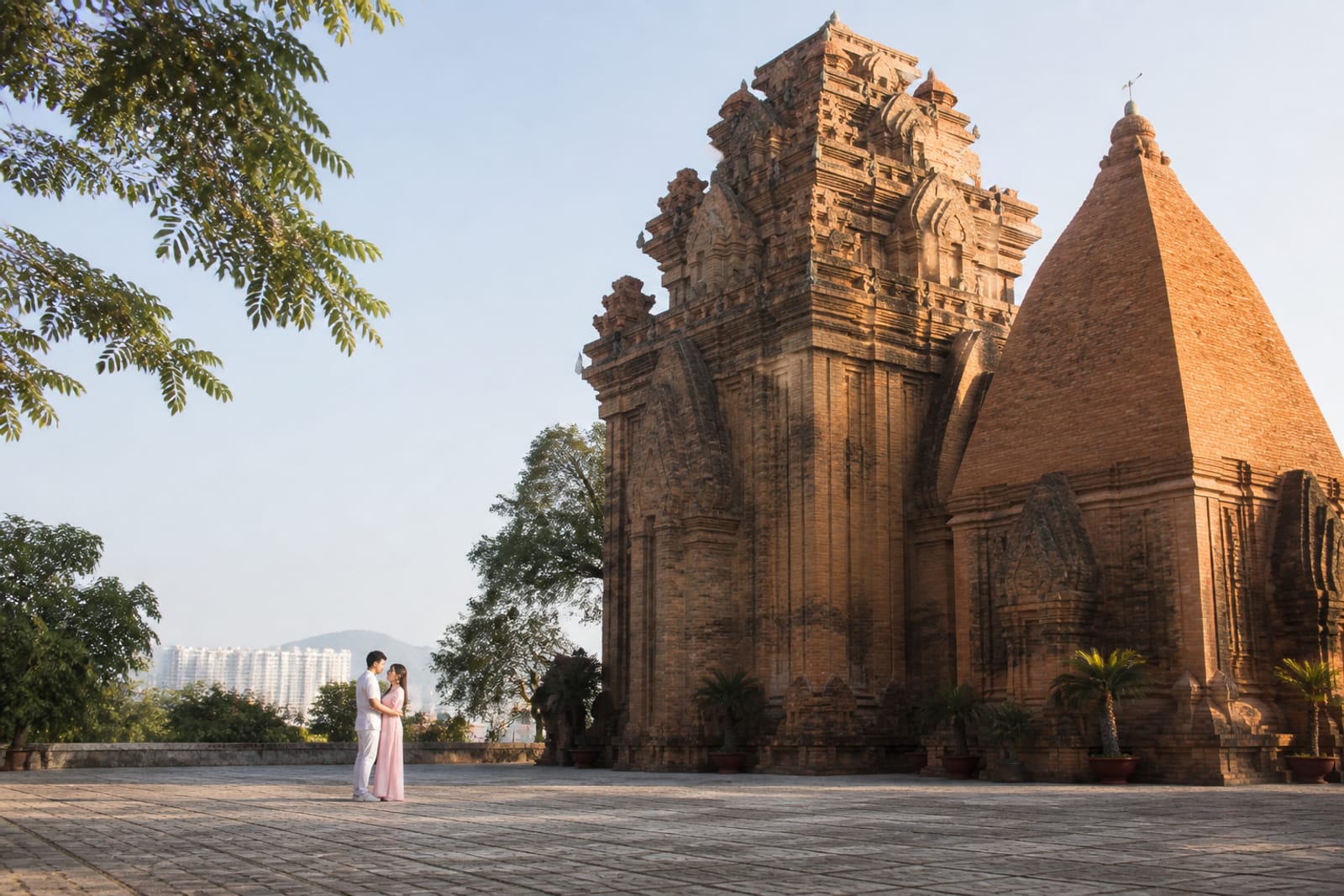
Should you hire a one-team shoot or assemble separate vendors?
| Option | Best For | Logistics | Coordination Load |
|---|---|---|---|
| One photographer + local makeup/hair | Budget-conscious, simple look | 2–3 vendors, timing gaps possible | Medium; you coordinate day-of |
| One-team studio (outfit, hair, makeup, photographer) | Couples wanting cohesive direction, stress-free | Single point of contact, pre-aligned brief | Low; studio owns the look and framing |
| Destination wedding planner + photographer | Multi-location pre-wedding, local logistics | 3+ vendors, heavy coordination | High; planner manages, but costs compound |
Cáo Studio does not operate in Nha Trang. If you're shooting there, the one-team model matters most at a complex site like Po Nagar—one director knows what light arrives at what time, how to dress you for that light, and frames the climb as a narrative (not discrete "couple photo," "detail shot," "location shot"). When you hire a photographer and then source hair separately, timing often drifts (hair takes 45 min, you start 15 min late, sunset light is gone). If you're in Hanoi, Ho Chi Minh City, or Hoi An, a pre-wedding shoot with makeup and hair included removes that friction. For Nha Trang, ask a local studio if they handle outfit, makeup, and photography in-house—that's the question to lead with.
Conclusion: One team avoids timing gaps and ensures styling matches light; coordination is simpler and the result more cohesive.
What to check before you book
- Climb and altitude: Po Nagar involves a steep stone staircase (no railing on some sections). Confirm your dress won't tangle, your shoes have grip, and you're comfortable with a 15-minute climb. If mobility is a concern, ask your photographer if they can shoot lower sections (still beautiful; the approach is often better than the summit).
- Entry and permits: Verify current entry requirements and cost on the official Nha Trang tourism site (no permits required for photography, but the site may change rules). Ask your photographer if they know the staff (sometimes they can arrange early or late access).
- Edited timeline: Local photographers often deliver 200–400 edited photos in 2–4 weeks. If you need images sooner (for a wedding website, invitations, announcements), discuss turnaround before booking.
- Backup location: Late-afternoon light depends on clear sky. Ask your photographer what secondary location (a waterfront, a garden, a street) they use if weather shifts. Inland, cloud can roll in fast.
- Outfit transport: If you're renting or bringing a dress, plan how to keep it clean on the climb. Bring a light tote and change on-site if possible.
- Lighting setup: Po Nagar has no shade structures or reflectors built in. A good photographer brings a small reflector or diffuser; ask if they do.
📸 See the lookbook | 💄 Book makeup & hair | 🌸 Pre-wedding shoots
---
A note on light direction at Po Nagar
The Towers face northwest. Late afternoon (16:30–18:15) brings side light from the southwest, raking across the front tower faces and casting deep shadows between them. This creates dimension—the weathered brick reads as texture, not a flat wall. If you shoot earlier (15:00–16:30), light is flatter and warmer (good for skin tone, less dramatic). The sea behind catches golden light and turns a deep amber around 17:30–18:00. If you're shooting toward the sunset (sea in background, towers in profile), you're backlit, which means your faces are underexposed unless your photographer uses a reflector or fill flash—ask about this. The best sequence is: shoot with towers behind you (side-lit by direct sun), transition to the edge looking seaward (now silhouetted, atmospheric), then finish as light fades (golden, soft, no harsh shadows). This arc takes 45–60 minutes and uses the site's natural light journey, not a single "best moment."
For comparison, ao dai photoshoots at other Hanoi temples (Quan Su, Tran Quoc) offer similar late-light advantage, though fewer crowds and stairs.
---
FAQ
Can I shoot at Po Nagar early morning instead of late afternoon?
Sunrise faces east (sea behind); the towers are backlit and dark. Morning light suits other Nha Trang spots (beach, street markets) but not the Towers' brick texture. Late afternoon (16:30–18:15) is non-negotiable here.
Do I need a permit to photograph at Po Nagar Cham Towers?
No photography permit is required, but entry to the site is required. Check the current cost on the official Nha Trang tourism site, as fees and rules can change.
What if it rains on my shoot day at Po Nagar?
The site has limited shelter. Most photographers in Nha Trang reschedule or pivot to an indoor/covered backup (a hotel, a restaurant, a colonial building). Confirm your photographer's rain policy before booking.
Should I book a Nha Trang photographer or fly Cáo Studio in from Hanoi/Saigon?
A local Nha Trang photographer knows the site intimately and costs less (no travel time added). Cáo Studio does not operate in Nha Trang, but we shoot pre-wedding in Hoi An, Hanoi, and Ho Chi Minh City. If Nha Trang is part of a longer trip, ask us on WhatsApp about other destinations.
How many outfit changes should I plan for Po Nagar?
One ao dai or flowing dress is ideal for 90–120 minutes. Two changes (ao dai, then Western dress) stretch the session to 2–2.5 hours and require on-site changing space. Confirm with your photographer what's realistic for the site's facilities.
What's the difference between a pre-wedding shoot and a wedding day photographer?
Pre-wedding is styled, directed, and unhurried (2–4 hours, one or two locations, outfit and hair planned). Wedding day is fast, reactive, and covers ceremony and reception in 8–12 hours with minimal setup. Most couples do both.
FAQ
Can I shoot at Po Nagar early morning instead of late afternoon?
Sunrise faces east (sea behind); the towers are backlit and dark. Morning light suits other Nha Trang spots (beach, street markets) but not the Towers' brick texture. Late afternoon (16:30–18:15) is non-negotiable here.
Do I need a permit to photograph at Po Nagar Cham Towers?
No photography permit is required, but entry to the site is required. Check the current cost on the official Nha Trang tourism site, as fees and rules can change.
What if it rains on my shoot day at Po Nagar?
The site has limited shelter. Most photographers in Nha Trang reschedule or pivot to an indoor/covered backup (a hotel, a restaurant, a colonial building). Confirm your photographer's rain policy before booking.
Should I book a Nha Trang photographer or fly Cáo Studio in from Hanoi/Saigon?
A local Nha Trang photographer knows the site intimately and costs less (no travel time added). Cáo Studio does not operate in Nha Trang, but we [shoot pre-wedding in Hoi An](/hoi-an), [Hanoi](/hanoi), and [Ho Chi Minh City](/saigon). If Nha Trang is part of a longer trip, ask us on WhatsApp about other destinations.
How many outfit changes should I plan for Po Nagar?
One ao dai or flowing dress is ideal for 90–120 minutes. Two changes (ao dai, then Western dress) stretch the session to 2–2.5 hours and require on-site changing space. Confirm with your photographer what's realistic for the site's facilities.
What's the difference between a pre-wedding shoot and a [wedding day photographer](/wedding-photographer)?
Pre-wedding is styled, directed, and unhurried (2–4 hours, one or two locations, outfit and hair planned). Wedding day is fast, reactive, and covers ceremony and reception in 8–12 hours with minimal setup. Most couples do both.
Ao dai, makeup, hair and a local photographer in Hanoi or Saigon — one WhatsApp message.