/pre-wedding-photoshoot
Pre-wedding photoshoot in Ha Giang: complete guide for couples abroad
A Ha Giang pre-wedding shoot is a multi-day trip into Vietnam's northernmost mountains, featuring golden terraces, buckwheat blooms (Oct–Nov), and winding roads where light and weather shift hourly. Couples typically spend 2–4 days on location; a single shoot day with travel accounts for 8+ hours of driving from Hanoi. You can hire a Hanoi-based studio like Cáo Studio – Makeup & Photoshoot, which travels to Ha Giang by appointment, or source a local Ha Giang photographer and coordinate logistics yourself. Pre-wedding shoots here work best Feb–Mar (cool, stable light) and Oct–Nov (buckwheat flowers), avoiding Dec–Feb cold snaps and June–Sep monsoon rains and landslides. Outfits—áo dài, Western dress, casual wear—must account for temperature swings (mountain mornings are cold); undergarments should be minimal and sweat-resistant. Budget for vehicle rental, fuel, driver or guide, meals, and accommodation as cost factors; ask studios on WhatsApp for their travel quote and what they include in the session price. --- Ha Giang is not a day trip. If you are considering a pre-wedding shoot there, you are committing to a journey: 3–5 hours each way from Hanoi on narrow, winding roads through high terrain. The payoff is landscape that changes every 30 minutes—misty valleys, switchbacks, terraced slopes of gold or green depending on harvest season, and buckwheat fields that bloom white and pink in late autumn. But every advantage comes with a trade-off: isolation means weather can trap you, poor roads mean long travel days, and cold high-altitude mornings are hard on makeup and exposed skin. This guide covers the full picture: where to shoot, when light works best, how to dress for mountains without ruining your áo dài, how to vet a photographer, and what a Hanoi-based studio's travel process actually looks like versus hiring locally.
Why do couples choose Ha Giang for pre-wedding shoots?
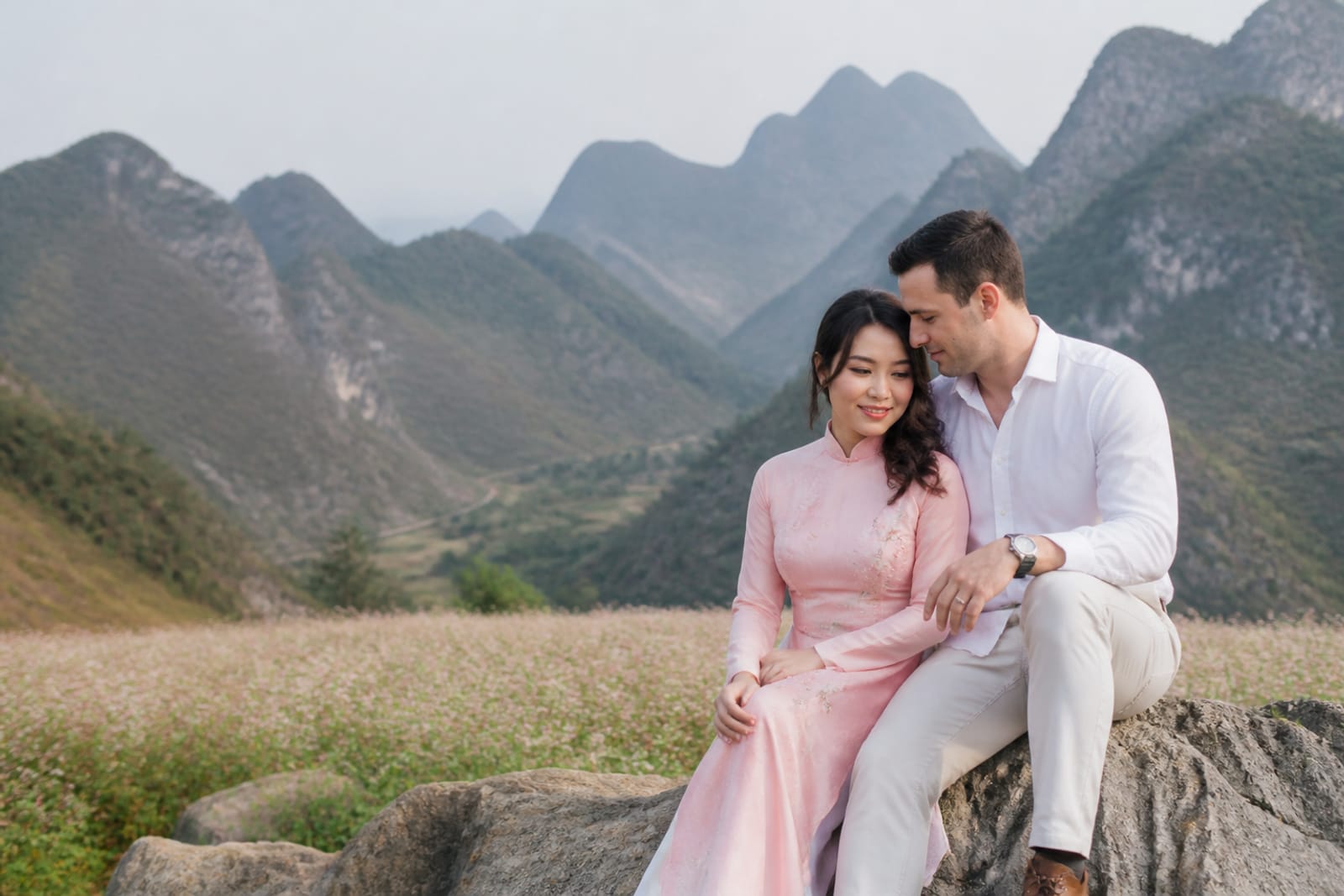
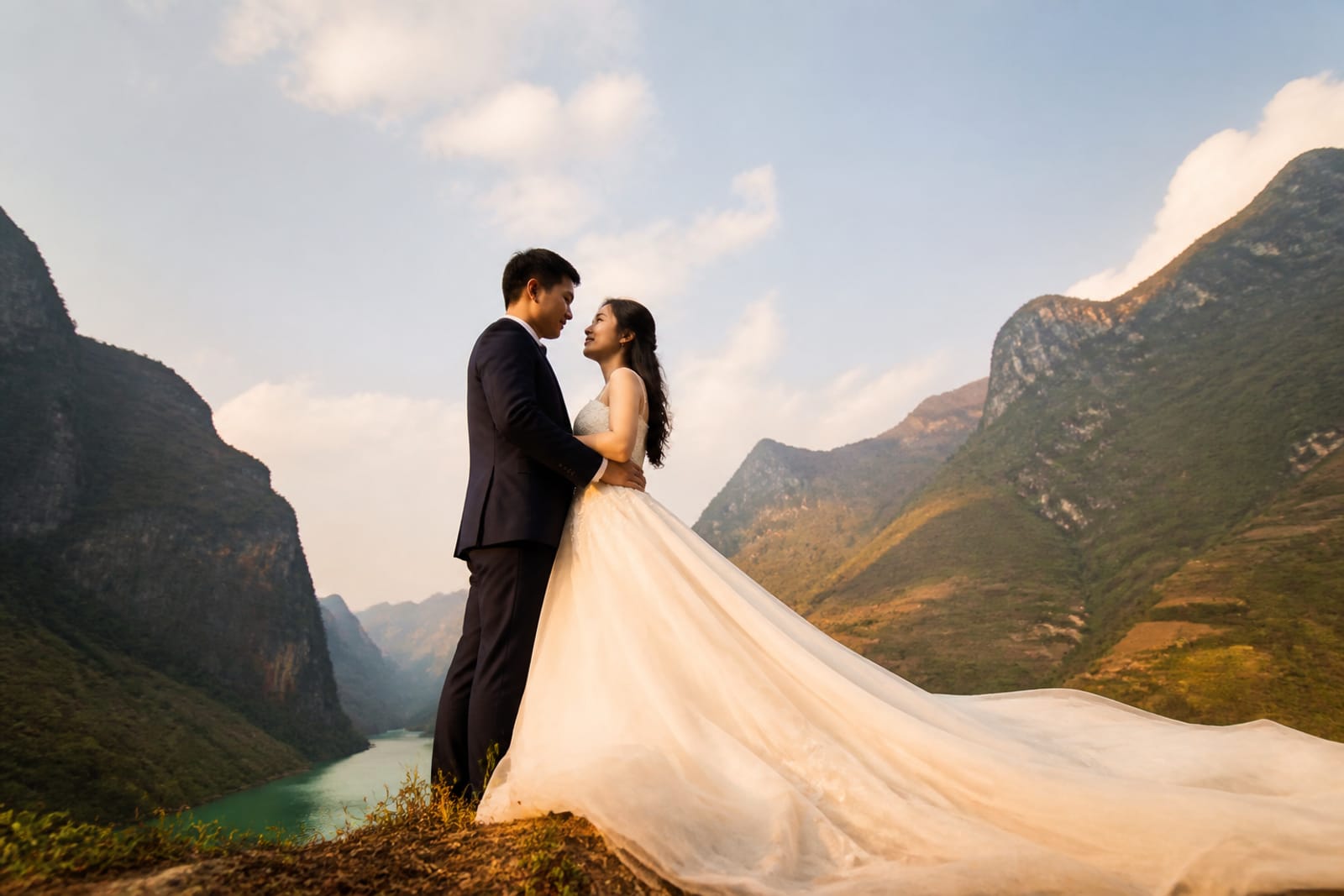
Ha Giang's appeal is genuine: no other destination in Vietnam offers these landscapes at this scale. The Hoang Su Phi rice terraces, cut into mountainsides in amphitheater curves, photograph as cinematic backdrop—especially early morning when mist clings to the slopes. Buckwheat flowers (late Oct–Nov) create a white-pink carpet across high plateaus. The roads themselves—switchbacks hewn into cliffs—become part of the narrative. The light, filtered through mountain haze, is soft and diffused: no harsh midday shadows, gentle on skin, flattering for áo dài colors.
The trade-off is logistics. There are no hair-and-makeup studios in Ha Giang town; you must travel with pre-arranged professionals or book a Hanoi team who brings equipment uphill. Village roads near shoot locations are unmade; you may walk 20+ minutes in heels or áo dài trains over rough ground. Accommodation is basic. And the season window is tight: 6 weeks in Oct–Nov for flowers, 6 weeks in Feb–Mar for stable light. Book outside these months and you negotiate cold drizzle, sudden afternoon rains, or landslide warnings on mountain passes.
When is the light and season right for Ha Giang shoots?
Ha Giang's best shooting windows are Feb–Mar and Oct–Nov. Here's why each works differently:
| Timing | Light quality | Landscape | Temperature | Best for |
|---|---|---|---|---|
| Oct–Nov | Soft, clear; dry after monsoon | Buckwheat blooms; golden harvest terraces | 15–20°C mornings; cool by noon | Flower blooms, dramatic color contrast |
| Feb–Mar | Hazy, diffused; stable & cool | Terraces fallow or early green; misty valleys | 12–18°C; crisp mornings | Soft-focus romance, fewer tourists |
| Dec–Jan | Clear but cold; early fog burns slow | Fallow terraces; brown tones; frost possible | 5–12°C; freezing at dawn | Moody, minimal, only if cold-hardy |
| Apr–Sep | Monsoon rains, landslide risk; limited options | Lush green but heavy cloud cover | 20–30°C; humidity high | Not recommended |
Feb–Mar gives you stable, cool light and fewer crowds, but the landscape is muted: terraces are preparing for spring planting, and you rely on mist and texture rather than color. Morning haze is your asset—it softens edges and creates mood. A 6 a.m. start in Feb means shooting in near-darkness until 7:30 a.m.; light becomes usable by 8 a.m. and stays even until noon.
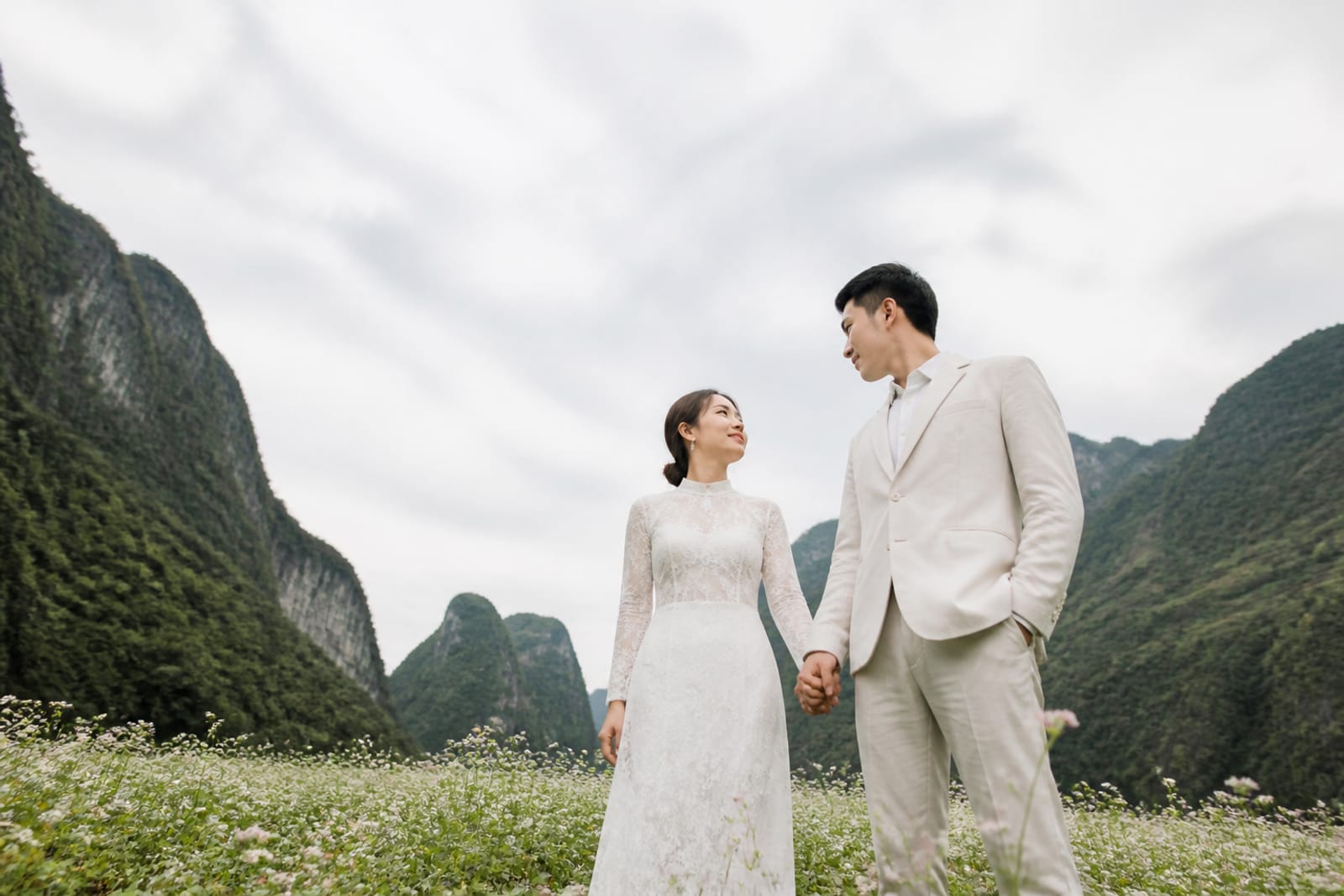
Oct–Nov is the showstopper season but also the busiest. Buckwheat flowers peak mid-late Oct; by Nov they're turning to seed and drying. Harvest terraces glow golden-brown under clear autumn light. Mornings (5:30–8 a.m.) are cold and require layers; by 9 a.m., temperature rises 10°C. Afternoon light (3–5 p.m.) is warm and angled; you can shoot until 5:30 p.m. before the sun dips fast behind peaks.
Never shoot June–Sep. Monsoon rains can close mountain roads without warning, landslides block passes, and mist is so thick you see 50 meters ahead. Afternoon thunderstorms strand teams for hours.
📸 Book on WhatsApp — pre-wedding photoshoot | 🌸 See the lookbook
What do you actually wear under an áo dài on a mountain shoot?
Áo dài—the traditional silk tunic—is stunning in photographs but logistically tricky in Ha Giang. The garment is long, narrow, and unforgiving: a step wrong on a rocky path, and the train snags or tears. Undergarments matter because you will sweat, climb, and sit on damp ground.
Wear:
- Thin, high-waisted slip shorts or cycling shorts (tight, non-slip, white or nude). Do not wear regular underwear; visible panty lines show under thin silk, and loose fabric bunches.
- A lightweight camisole under the áo dài, not a bra strap across bare shoulders. The camisole wicks sweat, prevents chafing, and looks clean in close-ups.
- Warm layers you remove: fleece jacket, cardigan, or shawl for the 5 a.m. wait and mountain breeze. Remove 20 minutes before the shoot so makeup isn't messed by pulling fabric over your head.
- Flat or low-heel shoes for walking. Heels sink into soft ground and catch on roots. Wear them for final posed shots only; walk in flat sandals or shoes between locations.
Avoid:
- Anything that sweats through: cotton underwear, heavy foundation on décolletage.
- Perfume or body oil. Ha Giang's humidity and exertion will smell strong; keep skin clean.
- New áo dài. Rent or borrow a worn one; new silk is stiff and photographs artificially.
If you're booking with Cáo Studio – Makeup & Photoshoot, ask on WhatsApp about their áo dài rental options and whether your team brings steamer or pressing tools. A local photographer may not, and wrinkled silk shows in every frame.
Couples who book a couple & family photoshoot package in Hanoi first often test their áo dài fit and movement before committing to Ha Giang's logistics. It's a practical dry run.
Should you hire a Hanoi studio to travel or find a Ha Giang photographer?
Two routes exist; each suits different couples.
Route 1: Hanoi-based studio (e.g., Cáo Studio – Makeup & Photoshoot) travels to Ha Giang
Pros:
- Professional makeup and hair done on-site (not improvised in a hotel bathroom).
- Team familiar with international couples' communication and expectations.
- Consistent editing and post-processing; you know the style.
- Makeup & hair at your hotel coordination included—they know timing and gear.
- Backup equipment and contingency plans built in.
Cons:
- Travel cost is factored into the session quote; ask on WhatsApp for their all-in rate.
- 6+ hour drive each way means the team may leave Hanoi very early, shoot one day, return next day. You pay for two travel days.
- Less flexibility on location scouting; the Hanoi team has a set itinerary.
- Weather delays cost you and the team equally—no refund negotiation leverage.
How it works: Contact Cáo Studio on WhatsApp and ask about Ha Giang availability and dates. Confirm dates (they travel by appointment; not every weekend). Provide location preferences and outfit ideas. They will quote you a travel fee + session fee. You book a separate vehicle for yourself or they recommend a driver. Makeup happens early morning at your accommodation (6–7 a.m.), and the team departs Hanoi the evening before to arrive on schedule.
Route 2: Hire a local Ha Giang photographer
Pros:
- Lower cost (no Hanoi-to-Ha-Giang travel premium).
- Local photographer knows hidden locations, best light angles on specific roads, seasonal timing intimately.
- Flexible scheduling; they live there and can shoot early morning or wait out weather.
- Can recommend nearby guides, accommodation, and logistics.
Cons:
- You source hair-and-makeup separately (often poor quality in rural Ha Giang; fly in a Hanoi MUA or do it yourself).
- Communication may be spotty; fewer English-fluent photographers outside Hanoi.
- Portfolio may be limited or unedited; hard to judge final quality until delivery.
- No backup team; if the photographer is sick, no shoot happens.
- Post-processing style is unvetted; you may receive undercooked or over-saturated edits.
How to vet a local photographer: Search "Ha Giang photographer" or "Ha Giang pre-wedding" on Instagram and check for 5–10 portfolios with consistent quality. Look for sharp focus, balanced color, and at least 3 couples' shoots (not just landscape snaps). Ask for references in English or Vietnamese and phone/WhatsApp calls to discuss day-of logistics. Request a test shoot or lower-cost session first if budget allows. Agree in writing (even simple WhatsApp messages) on outfit changes, number of locations, and delivery timeline.
💄 Makeup & hair at your hotel | 🌸 See the lookbook
For international couples, we recommend Route 1 (hiring a Hanoi-based team) unless you speak Vietnamese and have time for detailed planning. The upfront cost is higher, but the coordination is seamless and the backup is real.
What's the full itinerary and timeline for a Ha Giang shoot day?
A single pre-wedding shoot in Ha Giang spans 2–3 calendar days (not continuous shooting—most time is travel and rest).
Day 1 (the day before shoot):
- Depart Hanoi 3–5 p.m. (depending on team arrival time and your accommodation pickup).
- Drive 3–4 hours to Ha Giang town or a village near Hoang Su Phi (e.g., Yen Minh, Dong Van).
- Arrive ~7–8 p.m. Check into accommodation, brief scout of location if daylight remains, early night (5 a.m. call time is brutal without sleep).
Day 2 (shoot day):
- 5:30–6 a.m.: Wake, light breakfast, prepare skin.
- 6:30–7:30 a.m.: Makeup and hair (1 hour, done at your hotel or a quiet spot).
- 7:45–8 a.m.: Depart to first location (15–40 min drive depending on distance).
- 8 a.m.–12 p.m.: Shoot at 2–3 locations (light is ideal, landscape is sharp, colors pop). Each location = 1–1.5 hours (setup, outfit change, 50–100 frames).
- 12–1 p.m.: Lunch break (often a local restaurant or packed meals in the van).
- 1–4 p.m.: Second shoot block if light permits, or travel to evening location.
- 4–5:30 p.m.: Golden-hour shoot (last location, warm side light, dramatic shadows). This is prime time; do not miss it.
- 5:30–7 p.m.: Drive back to accommodation, dinner.
Day 3 (departure):
- Check out, breakfast.
- Optional: sunrise shoot at a location near town (bonus if you have energy).
- 10 a.m.–1 p.m.: Drive back to Hanoi, arrive early evening.
Total active shoot time: ~6 hours spread over two calendar days. Actual driving and waiting: 8+ hours. Fatigue is real by 4 p.m.; plan easier locations or low-demand poses late in the day.
What should you check before booking a Ha Giang pre-wedding shoot?
Before committing, confirm these with your photographer or studio:
- Dates and weather backup: Are specific dates guaranteed, or is the shoot rescheduled if rain/landslides occur? What's the refund or rebook policy?
- Travel cost structure: Is travel included in the session quote, or billed separately? (Ask on WhatsApp; prices vary widely.)
- Outfits and changes: How many outfit changes are included? (Áo dài + Western dress = 2 changes; add casual wear for a 3rd.) Do you provide áo dài, or does the photographer/studio source it? If rented, who pays?
- Hair, makeup, and crew: Is a professional MUA included, or just the photographer and possibly an assistant? If your Hanoi studio provides makeup, confirm they arrive early enough (6:30 a.m. for a 7:30 a.m. first shot).
- Edited files and delivery: How many edited images do you receive, and when? (Standard ranges 50–150 edited; delivery is 2–8 weeks post-shoot.)
- Location scouting: Does the photographer choose locations, or can you request specifics (e.g., "Buckwheat field near Yen Minh")? Are you paying for scouting time, or is it part of the shoot day?
- Equipment and insurance: Does the photographer carry backup batteries, lenses, hard drives? (Ha Giang has no tech shops; lost equipment is lost for good.)
- Accommodation and meals: Who books your hotel? Is the photographer's accommodation and meals your responsibility, or theirs? (Clarify now to avoid surprise bills.)
- Assistant or videographer: Is a videographer included? (Many couples also book wedding & pre-wedding video for Ha Giang shoots; the journey is cinematic.)
- Cancellation terms: If you cancel 1 week before, what's your loss? (Non-refundable vs. partial refund—common in remote shoots.)
For Cáo Studio – Makeup & Photoshoot, all exact inclusions are confirmed on WhatsApp once you inquire. Ask directly; do not assume.
What to pack for a Ha Giang pre-wedding shoot trip?
Beyond outfits, bring:
- Skincare: Cleanser, toner, sunscreen, hydrating mask. Mountain sun + wind = dehydrated skin. Reapply sunscreen every 2 hours between shoots.
- Hair tools: Bobby pins, hair spray, dry shampoo (if oily hair; sweat accumulates fast). MUA may forget these.
- Comfort items: Blister pads (rough terrain), pain relief (long walks in heels), water (3+ liters per day).
- Weather layers: Fleece jacket, rain shell, scarf. Don't rely on the forecast; mountains change in minutes.
- Footwear backup: Flat sandals or hiking shoes for walking; heels only for posed shots.
- Medications: Anything personal (headache, stomach, altitude adjustment). No pharmacy in remote areas.
- Portable charger: For phone and camera backup.
- Snacks: Nuts, energy bars, fruit. Meals in villages may be unpredictable or delayed.
---
What's the best way to use Ha Giang pre-wedding photos?
Most couples frame 1–3 large prints of peak moments (e.g., embracing in a buckwheat field at sunrise). Ask Cáo Studio about photo prints & frames or wedding photo album options when you confirm your shoot. A bound album of Ha Giang's landscape and intimate moments works beautifully as a keepsake or guest book.
Some couples commission a wedding video alongside the shoot; the drive through mountains, sunrise in mist, and light-to-landscape interplay are cinematic gold.
📸 Book on WhatsApp — pre-wedding photoshoot
---
FAQ
Can we shoot in Ha Giang as a quick Hanoi day trip?
No. Ha Giang is 3–4 hours each way from Hanoi on winding mountain roads. A day trip means 6+ hours driving and 4–5 hours usable shoot time—exhausting and inefficient. Book 2–3 calendar days: one travel day, one full shoot day, one return. Ask Cáo Studio on WhatsApp about their multi-day Ha Giang packages.
What month has the best light for photos?
Oct–Nov (buckwheat blooms, golden terraces, clear skies) and Feb–Mar (stable, soft light, fewer crowds) are ideal. Oct–Nov is busier but more visually dramatic. Feb–Mar is quieter and better for soft-focus romance. Avoid June–Sep entirely due to monsoon rains and landslide risk.
Do we need a guide or driver, or can we self-drive?
Self-driving is possible if you're comfortable on narrow mountain roads with no guardrails and steep drop-offs. Most couples hire a driver (included or recommended by their photographer). The driver knows routes, waits during shoots, and handles vehicle logistics. Ask your studio or photographer to recommend one.
How much will a Ha Giang pre-wedding shoot cost?
Costs depend on studio/photographer fees, vehicle rental, fuel, accommodation, meals, and outfit sourcing. Instead of a fixed price, consider cost factors: Hanoi-based studio travel (adds significantly), number of outfit changes, meal planning, and accommodation type. Contact Cáo Studio on WhatsApp for a personalized quote.
Can we hire a Hanoi MUA to travel with us instead of using the photographer's team?
Yes. You can arrange independent makeup and hair if you find a Hanoi-based MUA willing to travel. Confirm they have a kit suited to outdoor mountain conditions (long-wear, sweat-proof formulas, touch-up supplies) and can wake at 5 a.m. Coordinate timing directly with your photographer to avoid overlap or miscommunication.
What happens if weather cancels the shoot?
If bad weather (heavy rain, landslides warning) closes roads, your shoot is rescheduled to the next available date or refunded per the contract. Always clarify cancellation terms before booking. A Hanoi studio and a local photographer may have different policies; ask in writing on WhatsApp.
FAQ
Can we shoot in Ha Giang as a quick Hanoi day trip?
No. Ha Giang is 3–4 hours each way from Hanoi on winding mountain roads. A day trip means 6+ hours driving and 4–5 hours usable shoot time—exhausting and inefficient. Book 2–3 calendar days: one travel day, one full shoot day, one return. Ask Cáo Studio on WhatsApp about their multi-day Ha Giang packages.
What month has the best light for photos?
Oct–Nov (buckwheat blooms, golden terraces, clear skies) and Feb–Mar (stable, soft light, fewer crowds) are ideal. Oct–Nov is busier but more visually dramatic. Feb–Mar is quieter and better for soft-focus romance. Avoid June–Sep entirely due to monsoon rains and landslide risk.
Do we need a guide or driver, or can we self-drive?
Self-driving is possible if you're comfortable on narrow mountain roads with no guardrails and steep drop-offs. Most couples hire a driver (included or recommended by their photographer). The driver knows routes, waits during shoots, and handles vehicle logistics. Ask your studio or photographer to recommend one.
How much will a Ha Giang pre-wedding shoot cost?
Costs depend on studio/photographer fees, vehicle rental, fuel, accommodation, meals, and outfit sourcing. Instead of a fixed price, consider cost factors: Hanoi-based studio travel (adds significantly), number of outfit changes, meal planning, and accommodation type. Contact Cáo Studio on WhatsApp for a personalized quote.
Can we hire a Hanoi MUA to travel with us instead of using the photographer's team?
Yes. You can arrange independent makeup and hair if you find a Hanoi-based MUA willing to travel. Confirm they have a kit suited to outdoor mountain conditions (long-wear, sweat-proof formulas, touch-up supplies) and can wake at 5 a.m. Coordinate timing directly with your photographer to avoid overlap or miscommunication.
What happens if weather cancels the shoot?
If bad weather (heavy rain, landslides warning) closes roads, your shoot is rescheduled to the next available date or refunded per the contract. Always clarify cancellation terms before booking. A Hanoi studio and a local photographer may have different policies; ask in writing on WhatsApp.
Ao dai, makeup, hair and a local photographer in Hanoi or Saigon — one WhatsApp message.