/pre-wedding-photoshoot
Pre-wedding photoshoot in Mu Cang Chai: November weather and light gui
Pre-wedding shoots in Mu Cang Chai in November work best on clear mornings (5:30–8 am) on the terrace roads north of town, before cloud builds. November sits between rainy season and full dry season: you'll see golden, directional light on water-filled paddies and villages, but cloud can roll in by 10 am or persist all day if a system stalls. The drive from Hanoi takes 5+ hours over mountain switchbacks—plan arrival the day before, scout light and outfit fit (terraces are muddy; avoid heavy fabrics) the evening of arrival, and shoot early. Cáo Studio does not operate in Mu Cang Chai; you'll need to hire a local photographer who knows the roads, guides access to private terraces, and can move fast if weather shifts. This guide covers season timing, logistics, outfit choices and how to vet a photographer for a remote pre-wedding session. 📸 Book on WhatsApp — pre-wedding photoshoot in Hanoi | 💄 Makeup & hair at your hotel ---
Why does November light differ from other months at Mu Cang Chai?
November falls in the dry-season transition: monsoon moisture has cleared, so the sky is crisp and light travels cleanly across valleys. By contrast, September–October air is still humid and hazy; December–January can be overcast for days. The sun at 6 am in November creates a warm, low-angle glow on east-facing slopes—exactly what pre-wedding frames need. Cloud does appear by mid-morning, especially if a cold front pushes south from China; if it stalls overhead, you lose directional light and gain flat, grey tones. The terraces flood between July and October; by November, water levels drop as harvest begins, so you see a mix of flooded (reflective, silver-toned) and harvested (golden, textured) paddies—each tells a different story.
Conclusion: November offers reliable dawn light on varied terrain, but cloud timing is unpredictable and requires early wake-ups and fast shooting.
What do you wear for a Mu Cang Chai pre-wedding shoot in November?
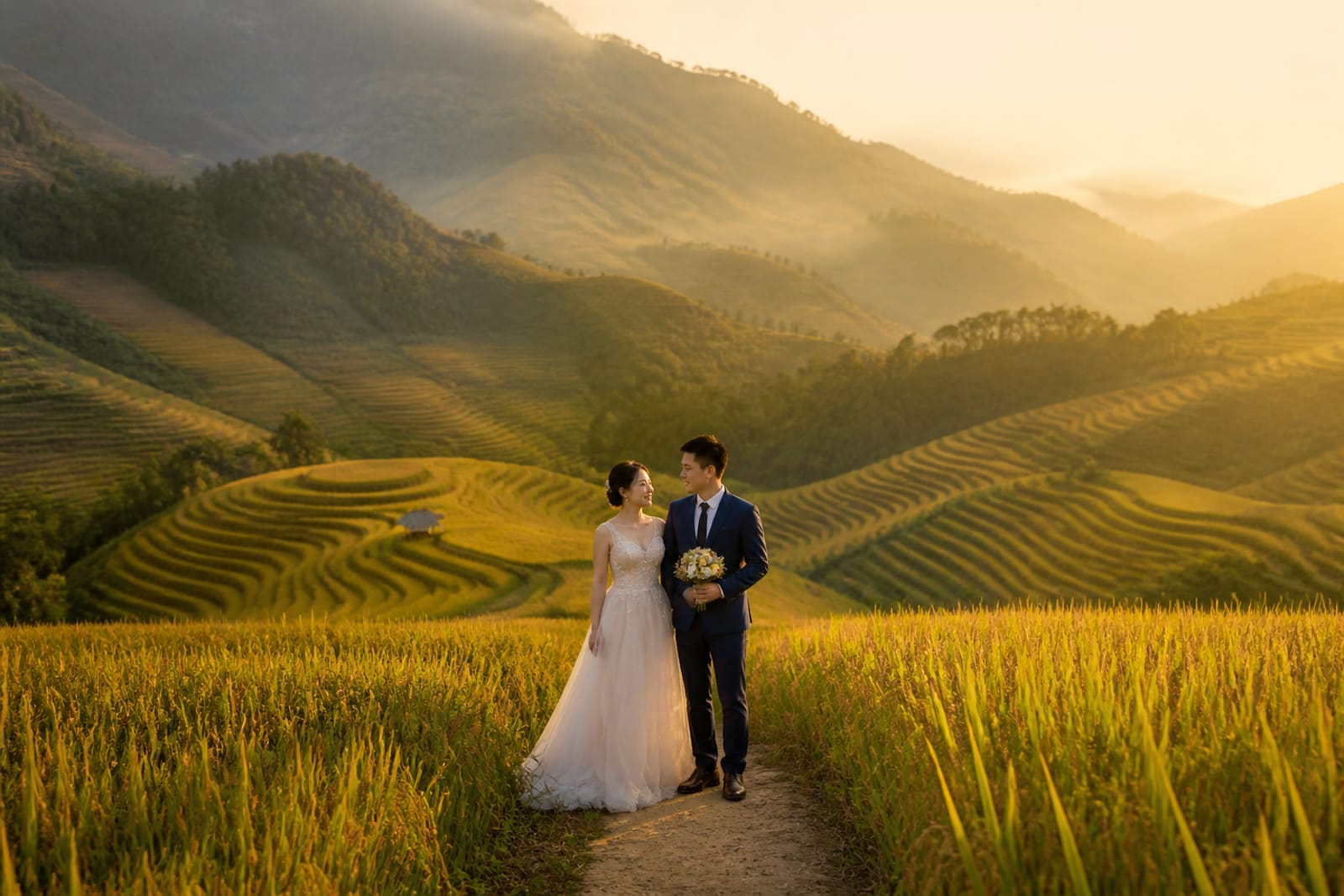
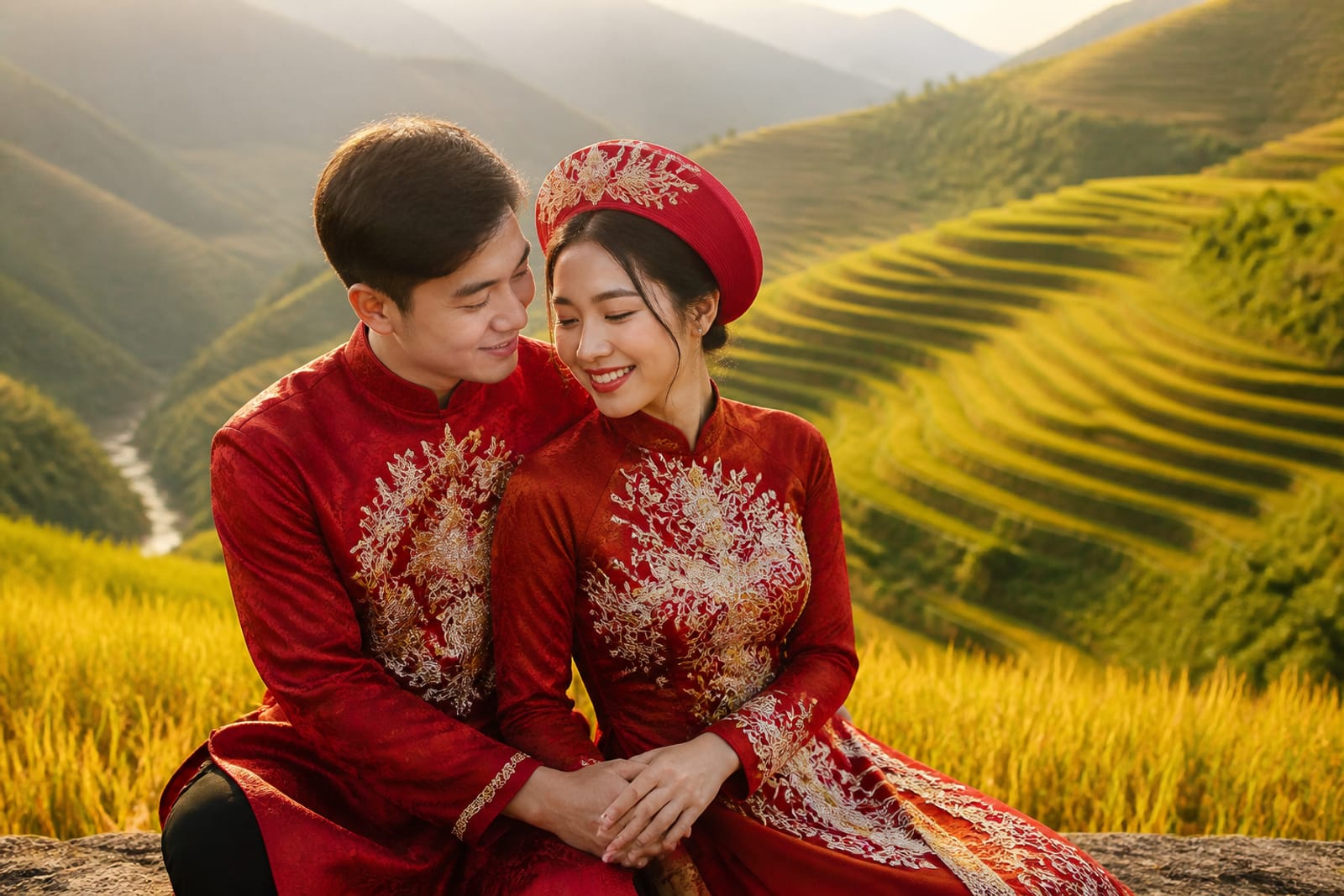
Terraces are working farmland with mud, water channels and narrow walking paths. Avoid silk ao dai (water stains and mud cling; drying takes hours), voluminous Western wedding gowns (they drag and catch on terrace walls), and anything requiring hours of steaming. November temperatures range from cool (13–18°C) at dawn to warm (22–25°C) by 9 am, so layers work: a fitted, water-resistant modern ao dai or a linen rehearsal dress over leggings; a light jacket or wrap for the drive. Men wear tailored trousers and a linen or cotton shirt (the tie or vest can wait for scenes shot on flat ground back in Hanoi). Wear closed, grip-soled shoes or hiking boots for the paths. Bring a second, simpler outfit (jeans and a plain tee, or a casual modern ao dai) for the descent or for shots in the village itself—the best pre-wedding frames often happen in transition, not posed on the ridge. A scarf or shawl doubles as wind control and a colour accent without adding bulk.
Conclusion: Practical fabrics, layers, and a back-up outfit beat bridal drama on steep, wet terrain.
How do you plan light timing when cloud is unpredictable?
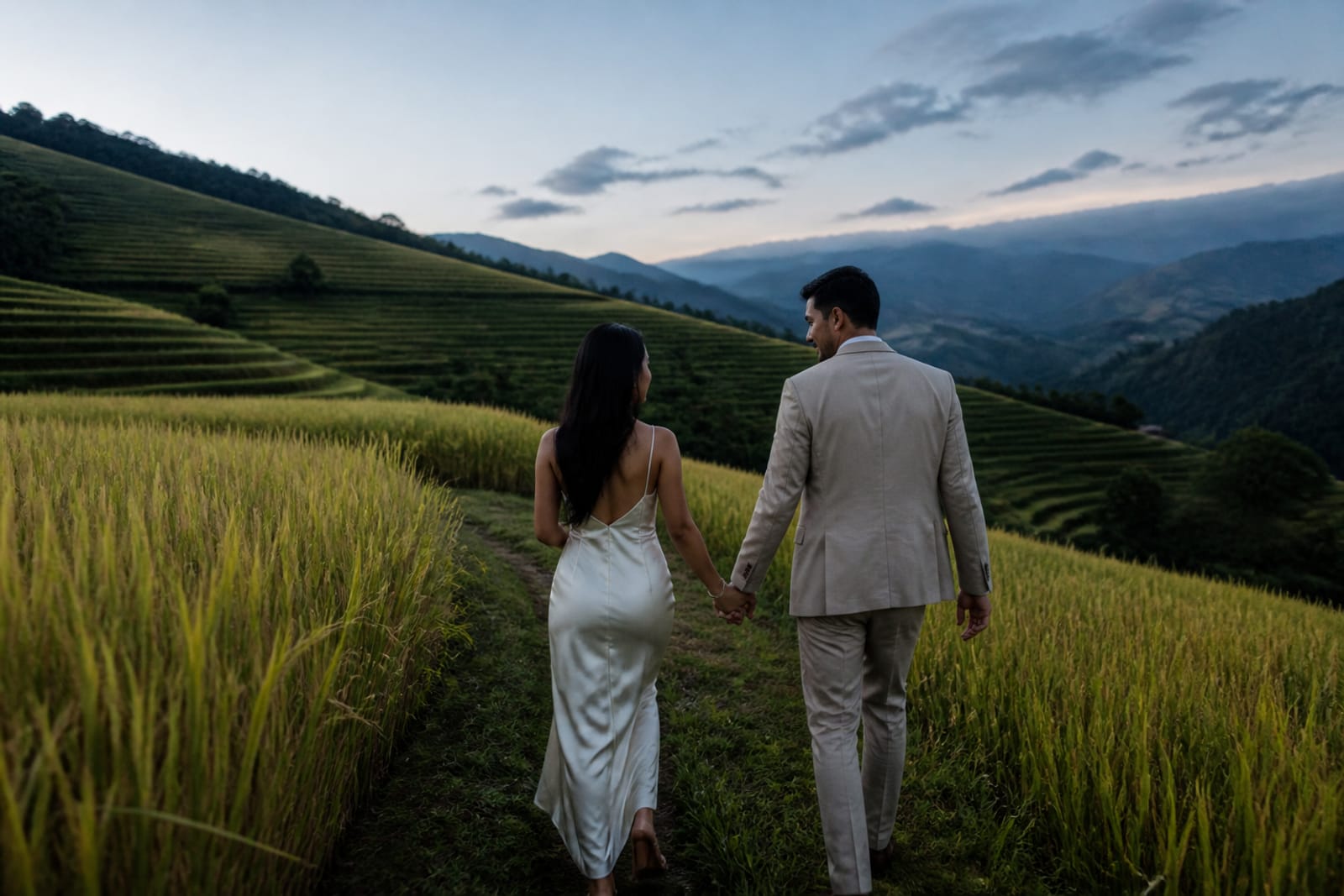
The photographer should scout the shoot location 12–24 hours before and confirm sunrise time for the shoot date (it shifts 1–2 minutes daily). Arrive in Mu Cang Chai the day before, eat dinner locally, and wake at 4:30 am to drive to the terrace location by 5:45 am—this gives 30 minutes to settle, check light direction, and frame wide shots before the couple enters. If cloud is present at 6 am, the photographer has three moves: wait (cloud can break in 10–15 minutes if a system is moving fast), reframe toward a lower angle where direct light hits water or village roofs below the clouds, or shoot black-and-white frames (cloud becomes texture, not a liability). By 8 am, if cloud persists, the shoot shifts to the village or to a reservoir spot (lower, often clearer) a 20-minute walk away. If cloud lifts by 9 am, steal one more series of terrace frames before leaving by 10:30 am—lingering after that risks afternoon haze and the road getting busy with locals.
Conclusion: Flexible timing, an alternative location, and monochrome fallback frames keep the shoot alive when cloud appears.
What is the difference between shooting in Mu Cang Chai versus Hanoi or Hoi An?
| Aspect | Mu Cang Chai | Hanoi | Hoi An |
|---|---|---|---|
| Light quality | Sharp, golden dawn on water; pastoral, high-altitude clarity | Soft urban light; pagodas, lakes, old town symmetry; streetscape detail | Warm riverside tone; lanterns at dusk; narrow lanes reflect light differently |
| Logistics | 5–6 hour drive one way; overnight stay; weather scouting required; no backup indoor location | 30–60 min drive from central hotels; multiple spots in one morning; rain covered by arcaded streets | 3 hours from Da Nang; smaller, walkable scale; ancient town closes to vehicles in evening |
| Season (Nov) | Cloud risk, early wake-up, one optimal 2-hour window | Crisp, cool mornings; consistent light all morning; crowds thin out after 8 am | Warm, dry, wind possible; light shifts steeply between riverside and inland streets |
| Best for | Couples wanting isolation, terraced landscape framing, story of the landscape itself | Pre-wedding frames that feel contemporary and urban; mix of tradition and modernity | Romantic, intimate moments; heritage and culture in the frame; hotel pickup/dropoff ease |
| Outfit fit | Hiking-ready fabrics; high heels not feasible; casual elegance needed | Ao dai works beautifully; heels manageable on streets; full bridal wear is an option | Ao dai required for temples; heels on old-town stones risky; Western dresses work for riverside |
| Photographer type | Must know terrain, local access, rapid logistics; often works solo with a driver/local guide | Can work with a hair/makeup team same-day; urban photography experience typical | Smaller teams; guide or fixer often included; cultural sensitivity for temple shots |
Conclusion: Mu Cang Chai demands outdoors skill and early logistics; Hanoi offers urban variety and convenience; Hoi An balances romance with cultural context and road comfort.
🌸 See the lookbook — pre-wedding frames
How do you find and vet a local photographer for Mu Cang Chai?
Ask for recommendations through your Hanoi hotel or travel company (many have shooter contacts). Request three examples: one on a clear morning, one in overcast conditions, one as backup from another season. Look for: sharp focus on faces even in low dawn light, evidence of composition beyond "pose and shoot" (the couple moving, laughing, walking out of frame), and a shot or two from the village or a secondary location (showing they can adapt if the main spot disappoints). Ask the photographer if they have a driver for the 5+ hour mountain drive and if they know which terrace roads allow non-resident access (some areas require local guide fees or have restricted hours). Confirm they edit on-location or have a fast turnaround (same-day preview is rare; 3–5 business days is standard). Avoid photographers offering "unlimited hours" or "all 1000+ photos unedited"—pre-wedding framing is curated, not volume.
Conclusion: Local knowledge of terrain, road access, and early-light logistics is non-negotiable for a remote November shoot.
What should you check before you commit to a Mu Cang Chai pre-wedding date?
- Weather window: Check the 10-day forecast 4 days before your shoot date. If rain or cloud cover is predicted for 3+ consecutive days, reschedule; a single overnight rain can leave terraces waterlogged and paths unsafe.
- Travel contingency: Book accommodation that allows a 24–48-hour flexible check-in. If you must be back in Hanoi on a specific day, a Mu Cang Chai shoot becomes high-risk.
- Outfit trials: Have your ao dai or dress professionally fitted 2 weeks before travel. Test the shoes and layers on a hill or stairs to confirm comfort and grip.
- Photographer contract: Confirm in writing: shoot start and end times, number of final edited images (not raw files), delivery format (digital and/or prints), and what happens if weather is poor (reschedule free, or partial edit set). Ask if they deliver a short vertical video clip (many now do as standard).
- Local guides: If hiring a fixer or local guide, confirm they speak English (or that the photographer translates), know the terrace access rules, and carry basic first aid (it's remote).
- Backup plan: Know the photographer's second-choice location if Mu Cang Chai is unsafe (usually a rice-terrace valley lower down or a reservoir; confirm this beforehand).
Conclusion: Documented terms, contingency planning, and outfit trials reduce surprises on the day.
---
If you're considering a pre-wedding shoot in Vietnam and want the convenience of a team handling outfit, hair, makeup and direction in one booking, Cáo Studio operates in Hanoi, Ho Chi Minh City and Hoi An. We direct from real light and edit in 48 hours—no separate vendors, no day-of chaos. For shoots outside our service area like Mu Cang Chai, this guide helps you plan and vet a local photographer yourself. Either way, the best frames come from early light, practical clothing and a team that moves fast.
📸 Book on WhatsApp — pre-wedding photoshoot | 🎬 See wedding video examples | 💄 Makeup & hair at your hotel
---
FAQ
Is November better than October for Mu Cang Chai terraces?
October has higher humidity and lingering cloud from monsoon tail; November air is clearer and light is sharper. October terraces are often still flooding; November shows more varied texture (flooded and harvested). November is the stronger choice, but weather remains variable.
Can we shoot in the afternoon at Mu Cang Chai if we miss dawn light?
No. Afternoon light becomes flat and hazy by 11 am; the sun behind you or overhead produces tourist-snapshot tones, not pre-wedding frames. Evening light is soft but backlit scenes require skill and often fall flat on film. Dawn is the only reliable window.
How much does a local Mu Cang Chai photographer charge?
Pricing varies by photographer experience, travel distance, team size, and whether a guide or vehicle is included. Ask photographers directly for a quote. Budget for overnight accommodation and fuel as separate costs—ask us on WhatsApp for reference if you need guidance.
Should we hire a guide in Mu Cang Chai in addition to a photographer?
If your photographer is unfamiliar with terrace access rights and local customs, a guide is invaluable—they know which areas allow casual shooting versus which require fees, and they manage relationships with residents. Many photographers work with their own local fixer; ask upfront.
What happens to our pre-wedding shoot if it rains all day in Mu Cang Chai?
Rain at altitude is dangerous (slippery terrain, visibility drops, paths flood). Reputable photographers will reschedule or offer a partial refund; read the contract before booking. If you're short on time, ask the photographer about shooting in a sheltered village or indoor location as a fallback, though this changes the aesthetic entirely.
Can we do part of our pre-wedding shoot in Mu Cang Chai and part in Hanoi?
Yes. Couple shoots often split: one day in Mu Cang Chai for landscape frames, another in Hanoi or Hoi An for urban/traditional elements. This adds logistics but gives you range. Cáo Studio can shoot your Hanoi or Hoi An portion if you're returning to our service areas.
FAQ
Is November better than October for Mu Cang Chai terraces?
October has higher humidity and lingering cloud from monsoon tail; November air is clearer and light is sharper. October terraces are often still flooding; November shows more varied texture (flooded and harvested). November is the stronger choice, but weather remains variable.
Can we shoot in the afternoon at Mu Cang Chai if we miss dawn light?
No. Afternoon light becomes flat and hazy by 11 am; the sun behind you or overhead produces tourist-snapshot tones, not pre-wedding frames. Evening light is soft but backlit scenes require skill and often fall flat on film. Dawn is the only reliable window.
How much does a local Mu Cang Chai photographer charge?
Pricing varies by photographer experience, travel distance, team size, and whether a guide or vehicle is included. Ask photographers directly for a quote. Budget for overnight accommodation and fuel as separate costs—ask us on WhatsApp for reference if you need guidance.
Should we hire a guide in Mu Cang Chai in addition to a photographer?
If your photographer is unfamiliar with terrace access rights and local customs, a guide is invaluable—they know which areas allow casual shooting versus which require fees, and they manage relationships with residents. Many photographers work with their own local fixer; ask upfront.
What happens to our pre-wedding shoot if it rains all day in Mu Cang Chai?
Rain at altitude is dangerous (slippery terrain, visibility drops, paths flood). Reputable photographers will reschedule or offer a partial refund; read the contract before booking. If you're short on time, ask the photographer about shooting in a sheltered village or indoor location as a fallback, though this changes the aesthetic entirely.
Can we do part of our pre-wedding shoot in Mu Cang Chai and part in Hanoi?
Yes. Couple shoots often split: one day in Mu Cang Chai for landscape frames, another in Hanoi or Hoi An for urban/traditional elements. This adds logistics but gives you range. [Cáo Studio can shoot your Hanoi or Hoi An portion](/pre-wedding-photoshoot) if you're returning to our service areas.
Ao dai, makeup, hair and a local photographer in Hanoi or Saigon — one WhatsApp message.