/proposal-and-anniversary
Proposal at Tra Que village with photographer: what to book
Tra Que vegetable village (about 3 km north of Hoi An Ancient Town) is a working organic farm where you can propose among raised beds, water channels and farm workers during morning or late-afternoon shoots. A photographer typically spends 1–2 hours capturing candid proposal moments, couples' portraits in the fields, and detail shots of lanterns or rings. The village is quietest and lit best before 9 a.m. or after 3 p.m.; midday sun is harsh and the site draws tour groups. Cáo Studio – Makeup & Photoshoot sends a team from Hanoi or books a Hoi An-based photographer (ask on WhatsApp for Hoi An dates and partner photographers); costs depend on travel time, crew size, outfit changes and whether makeup/hair is included. What to avoid: booking on weekends or Tet without early morning slots, arriving without checking current farm access rules, or expecting the farm to close for your proposal. 📸 Book on WhatsApp — proposal & anniversary | 🌸 See the lookbook ---
Why do couples choose Tra Que for proposals?
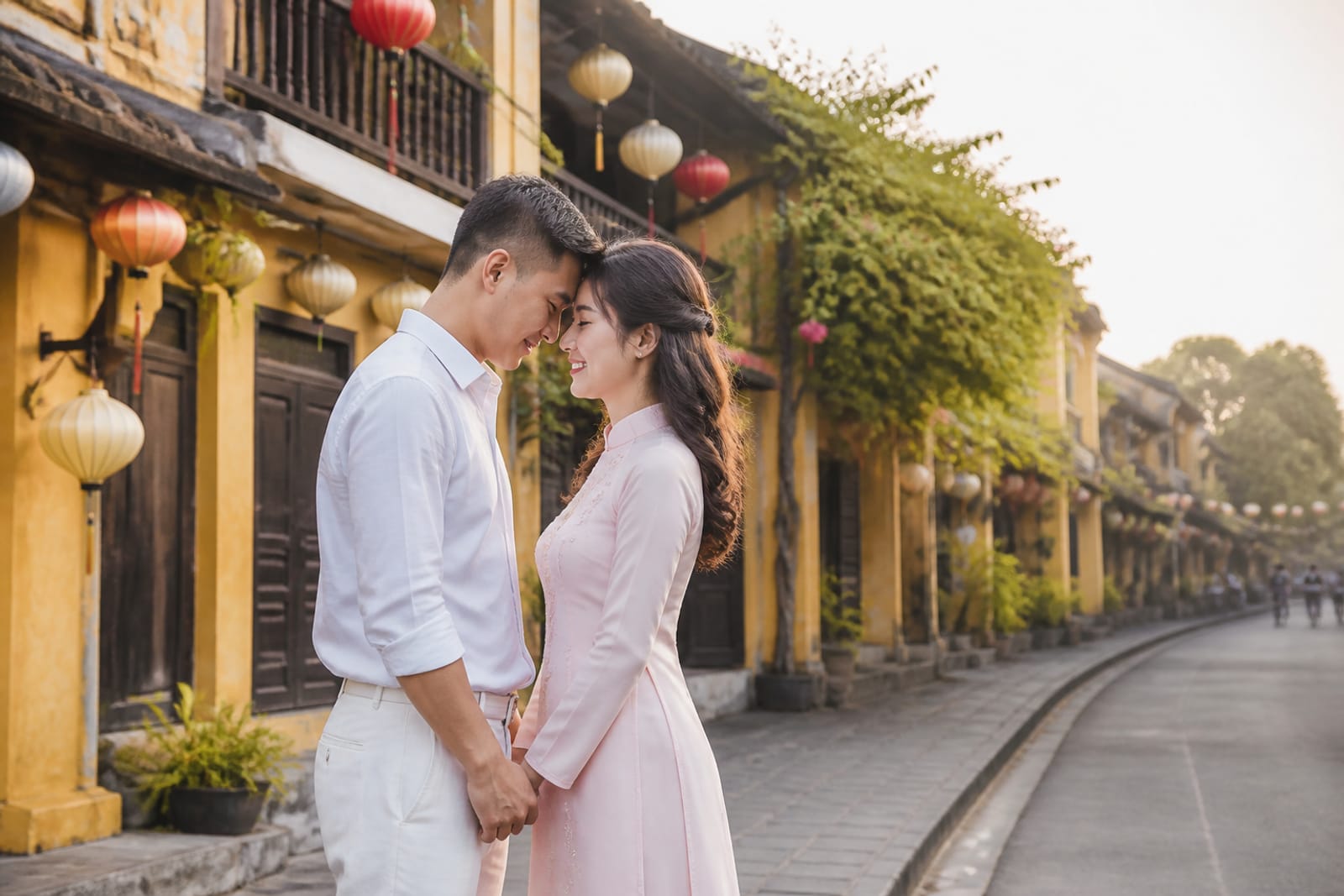
Tra Que offers authentic rural backdrop without leaving Hoi An — green, photogenic, and emotionally resonant because it's a real place where locals work, not a staged set. The light is naturally soft in early morning and golden at dusk, making emotion-first portraits possible. Rows of vegetables, water buffalo, traditional Vietnamese dress in the fields, and the absence of tourist crowds (if you time it right) create an intimate moment that photographs as both grand landscape and close personal story. A proposal here reads as genuine discovery, not rental-site performance — and that authenticity often matters more to couples than manicured gardens or resort backdrops.
What's the best time of year to shoot at Tra Que?
Tra Que is best February–April: cool, dry weather, mild midday heat, and fields are green after wet season. May–August is dry but extremely hot (often 35°C+), making midday shoots uncomfortable and outdoor makeup harder to set. September–December is Hoi An's rainy season; October–November brings typhoons and flooding in low-lying areas near the Ancient Town, which can affect farm access. December–January is cool and drizzly, sometimes limiting light and farm activity. For proposal timing, book Feb–April when you can shoot 6–9 a.m. or 3–6 p.m. without wilting, or May–August if you commit to a 5:30–7 a.m. start.
Do you need a local Hoi An photographer or can Cáo Studio come from Hanoi?
| Option | Best for | Lead time | Why it works |
|---|---|---|---|
| Cáo Studio team travel from Hanoi | Pre-wedding couples, multiple outfits, on-site makeup | 2–3 weeks | Full creative control, consistent style, ao dai rental + makeup included |
| Local Hoi An photographer | Quick bookings, daytrip proposals, budget-conscious | 1 week | No travel fee, knows village light, fast turnaround |
| Hybrid: Hoi An local for shoot + Hanoi team for editing | Best of both | 2 weeks | Local access + Cáo Studio's post-production |
Cáo Studio travels to Hoi An by appointment (ask on WhatsApp for current availability). A local Hoi An photographer knows Tra Que light and farmer relationships but may not have the ao dai styling or multi-day pre-wedding vision that Cáo Studio offers. Choose Cáo Studio if you want makeup, outfit coordination and a cohesive proposal-to-pre-wedding story; choose local if you're proposing on a tight timeline or visiting only Hoi An.
What logistics matter most before you book?
Farm access and timing: Tra Que is busiest 9 a.m.–3 p.m. when tour buses arrive. A professional shoot needs a 5:30–7 a.m. or 3:30–6 p.m. slot; confirm the farm allows photo groups on your date (some farming periods restrict access).
Makeup and outfit: On-site makeup at Tra Que is tricky (no mirror, uneven ground, dust, farm activity). If you're wearing traditional ao dai or formal dress, book makeup & hair at your hotel 30–45 minutes before the shoot, then travel to the village. Cáo Studio can arrange this; ask on WhatsApp.
Transportation: You need private transport (taxi or guide car) to reach Tra Que and move between field sections. Budget extra time for vehicle coordination.
Light and weather: Overcast mornings in Dec–Jan reduce contrast; May–Aug early starts are non-negotiable to avoid harsh midday glare. Check the forecast 3 days before and have a backup light time.
Crew size and cost factors: A single photographer is faster and cheaper than a two-person team; one outfit change is simpler than three. Wedding videography adds a second crew member. Makeup/hair on-site adds time and logistics. None of these details lock a price, but they shape feasibility and timeline.
How does a Tra Que shoot day actually run?
Before dawn (5:15–6 a.m.): Makeup and hair at your hotel if booked; photographer and you meet at the farm entrance or a designated point nearby.
First light (6–7:30 a.m.): Walk the fields as they're opening; farmers are present but used to photo groups. Capture proposal or couple's portraits with morning mist and soft gold light on the eastern rows. No crowds, no competing shadow lines.
Mid-morning (7:30–9 a.m.): Light hardens; move to shaded paths or the family's traditional house area if access is permitted. Detail shots (hands, rings, lanterns). Photographer suggests location changes based on real-time light.
Wrap by 9 a.m.: Farm tour groups and buses arrive; light becomes flat. Photographer and team leave; you can stay to explore or have breakfast nearby if you wish.
Post-shoot (editing, albums, prints): Cáo Studio delivers edited photos and albums weeks after the shoot (exact timeline confirmed on WhatsApp). A local Hoi An photographer typically turns around selects within 1–2 weeks.
| Phase | Duration | Mood | Light quality |
|---|---|---|---|
| Pre-dawn setup | 15 min | Quiet, private | Not yet bright |
| First light portraits | 60–90 min | Intimate, emotional | Soft, directional gold |
| Mid-morning details | 30–45 min | Reflective, slower | Transition to harsh |
| Wind-down & departure | 15 min | Casual, relief | Bright, flat |
What to check before you book a Tra Que proposal shoot
1. Photographer's Hoi An experience: Ask if they've shot Tra Que before (or at least rural Hoi An). Light and farm access are learned, not intuitive. If booking Cáo Studio, confirm they're sending a team that's worked in Hoi An; if booking local, ask to see a portfolio of morning farm shoots.
2. Farm access and permissions: No formal permit is needed, but farms can restrict access on harvest or festival days. Ask your photographer to confirm with the village on your specific date.
3. Outfit fit and practicality: Hiking wedding dresses through fields damages fabric and hems; ao dai are better suited to walking narrow farm paths. If wearing a Western formal dress, ask the photographer if it's realistic and whether backup outfits should be packed.
4. Makeup durability: Early-morning humidity and farm dust mean makeup needs to be set properly. If booking on-site makeup at your hotel, mention the Tra Que location so the makeup artist chooses sweat- and humidity-resistant products.
5. Timeline and transport: Confirm the photographer will be at the farm no later than 6 a.m., and that you have reliable transport from your hotel. A 20-minute taxi delay can cost you the best light.
6. Weather backup: Overcast mornings are fine; heavy rain cancels the shoot. Ask the photographer's rescheduling policy if weather forces a change.
7. Deliverables and editing: Check exactly what you're getting — digital files, printed album, online gallery — and when. Cáo Studio confirms packages on WhatsApp; local photographers vary widely.
What to avoid: Don't propose at Tra Que on a weekend morning (tour buses start at 7 a.m.). Don't skip makeup if you want close-up portraits (dust and early-morning skin look tired in unretouched morning light). Don't wear fragile dress fabrics if you're not prepared to replace them. Don't book without checking the farm's calendar for closures or harvest periods.
---
Should you add an ao dai outfit change?
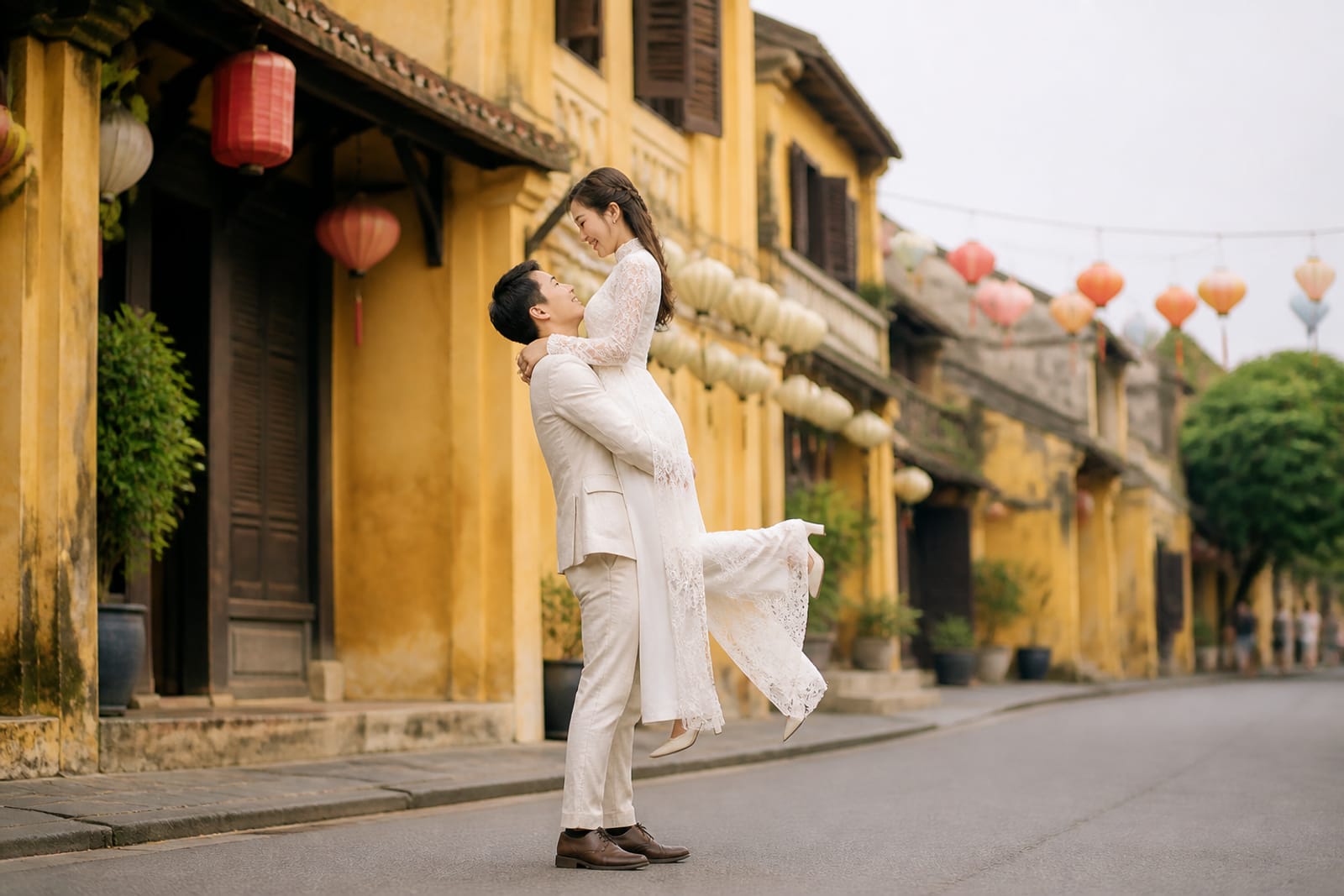
An ao dai reinforces the Hoi An setting and photographs beautifully against green fields. Cáo Studio can arrange rental and styling; a local photographer can point you to a rental shop in town. A single ao dai outfit adds 20–30 minutes to the shoot (changing in a nearby house or vehicle) and includes tailoring if the fit isn't perfect. If you're also doing a pre-wedding photoshoot in Hoi An later, a single ao dai in the Tra Que proposal connects both sessions visually. If this is your only Hoi An shoot, an ao dai is optional but strongly enhances the narrative of the place.
Compare: Tra Que vs. other Hoi An proposal backdrops
| Location | Vibe | Light & timing | Logistics | Best for |
|---|---|---|---|---|
| Tra Que village | Rural, intimate, authentic | Morning or late afternoon (6–9 a.m., 3–6 p.m.) | Early start, private transport needed | Couples wanting green fields & real place |
| Hoi An Ancient Town | Historic, walkable, lantern-lit | Sunrise (5:30–6:30 a.m.) or dusk for lanterns (6 p.m.+) | Entrance ticket required, crowded after 8 a.m. | Tradition-focused, lantern nostalgia |
| Japanese Bridge area | Iconic, framed backdrop | Early morning to avoid crowds | Inside Ancient Town, congested midday | Photo-first proposals, recognizable setting |
| Rice fields near Hoi An | Expansive, seasonal | Golden hour (4–6 p.m.) | Longer commute, muddy in wet season | Large-scale landscape feel |
| Beach near Hoi An | Coastal, romantic | Sunrise (5:30 a.m.) or golden hour | Sand affects camera, salt wind | Beach-lover couples |
Tra Que wins if you want authenticity and green intimacy without feeling staged. Ancient Town wins for historical resonance and walkable ease. Rice fields win if you want scale and isolation. Pick based on how the setting should feel in your story, not just how it photographs.
---
Next steps: booking your Tra Que proposal shoot
If you're interested in Cáo Studio: Message +84 338 762 340 on WhatsApp with your proposal date, preferred time, outfit ideas (ao dai, Western formal, casual), and whether you want on-site makeup. Mention this article so the team knows you're planning Tra Que specifically. They'll confirm Hoi An availability, send a quote based on travel, crew size, and deliverables, and walk you through the full timeline.
If you're looking for a local Hoi An photographer: Ask your hotel concierge for referrals, check Instagram for recent Tra Que shoots, and message potential photographers asking for their farm shoot portfolio, earliest available time slot, and editing turnaround. Many will quote within 24 hours.
If you want to combine Tra Que with ao dai photoshoot or a pre-wedding session: Book Cáo Studio for a multi-day Hoi An package. One proposal at Tra Que can anchor a bigger creative story — engagement to wedding — with consistent styling and photography. Ask on WhatsApp.
For makeup & hair: Don't skip this. Book makeup & hair at your hotel for 30–45 minutes the morning of your shoot, then travel to Tra Que with the photographer. It keeps you comfortable and ensures your face is camera-ready in soft morning light.
📸 Book on WhatsApp — proposal & anniversary
---
FAQ
Can we propose at Tra Que without hiring a professional photographer?
Yes, many couples use a friend's camera or phone. But Tra Que's best light (5:30–7:30 a.m.) requires expertise to expose correctly and compose in real-time while you're emotional. A professional photographer anticipates the proposal moment and captures candid reactions — something a friend focusing on the camera will miss. If budget is tight, hire a 1-hour local Hoi An photographer instead of a full team; costs scale down with shorter sessions.
How many photos will we get from a Tra Que proposal shoot?
Depends on the package. Cáo Studio's exact inclusions (number of edited images, albums, files) are confirmed on WhatsApp when you book. A typical 2-hour farm shoot yields 200–400 raw frames; edited selections are usually 40–100 polished photos. A 1-hour local shoot may deliver 30–60. Ask your photographer upfront what "edited delivery" means — gallery, USB files, prints, album — to avoid surprises.
What if it rains on proposal day?
Light overcast is fine for morning shoots; it softens shadows and reduces glare. Heavy rain cancels outdoor photography. Most photographers offer a rain date within 7 days or a refund/reschedule option. Book in Feb–April (dry season) to minimize rain risk. Check the forecast 3 days before and have a backup date in mind.
Can we do the proposal and a full photoshoot on the same morning?
Yes, if you start early (5:30–6 a.m.) and allow 2–3 hours. The proposal itself takes 30 minutes of shooting; couple's portraits and outfit changes fill the rest. By 9 a.m., Tra Que fills with tour groups and light hardens. A longer session means arriving even earlier or splitting into two mornings (proposal day + a couple photoshoot the next day). Ask your photographer if they offer multi-hour packages.
Do we need permits to propose at Tra Que?
No formal permit is required. The village is open to visitors and photographers. However, farms may have restricted access during harvest or festivals. Your photographer should check with the village before your date. If you're organizing independently, visit a day ahead or contact a local guide to confirm access.
Should we hire a videographer too?
Video captures emotion in a way still photos can't (your voice, reaction, laughter). If you want wedding & pre-wedding video, book a video team with the photographer or separately. A 2–3 hour morning shoot with both photographer and videographer requires coordinated logistics but is logistically feasible. Video adds to cost and crew size; it's optional but deeply meaningful for many couples.
FAQ
Can we propose at Tra Que without hiring a professional photographer?
Yes, many couples use a friend's camera or phone. But Tra Que's best light (5:30–7:30 a.m.) requires expertise to expose correctly and compose in real-time while you're emotional. A professional photographer anticipates the proposal moment and captures candid reactions — something a friend focusing on the camera will miss. If budget is tight, hire a 1-hour local Hoi An photographer instead of a full team; costs scale down with shorter sessions.
How many photos will we get from a Tra Que proposal shoot?
Depends on the package. Cáo Studio's exact inclusions (number of edited images, albums, files) are confirmed on WhatsApp when you book. A typical 2-hour farm shoot yields 200–400 raw frames; edited selections are usually 40–100 polished photos. A 1-hour local shoot may deliver 30–60. Ask your photographer upfront what "edited delivery" means — gallery, USB files, prints, album — to avoid surprises.
What if it rains on proposal day?
Light overcast is fine for morning shoots; it softens shadows and reduces glare. Heavy rain cancels outdoor photography. Most photographers offer a rain date within 7 days or a refund/reschedule option. Book in Feb–April (dry season) to minimize rain risk. Check the forecast 3 days before and have a backup date in mind.
Can we do the proposal and a full photoshoot on the same morning?
Yes, if you start early (5:30–6 a.m.) and allow 2–3 hours. The proposal itself takes 30 minutes of shooting; couple's portraits and outfit changes fill the rest. By 9 a.m., Tra Que fills with tour groups and light hardens. A longer session means arriving even earlier or splitting into two mornings (proposal day + a [couple photoshoot](/couple-photoshoot) the next day). Ask your photographer if they offer multi-hour packages.
Do we need permits to propose at Tra Que?
No formal permit is required. The village is open to visitors and photographers. However, farms may have restricted access during harvest or festivals. Your photographer should check with the village before your date. If you're organizing independently, visit a day ahead or contact a local guide to confirm access.
Should we hire a videographer too?
Video captures emotion in a way still photos can't (your voice, reaction, laughter). If you want [wedding & pre-wedding video](/wedding-video), book a video team with the photographer or separately. A 2–3 hour morning shoot with both photographer and videographer requires coordinated logistics but is logistically feasible. Video adds to cost and crew size; it's optional but deeply meaningful for many couples.
Ao dai, makeup, hair and a local photographer in Hanoi or Saigon — one WhatsApp message.