/pre-wedding-photoshoot
Timeline of a pre-wedding photoshoot day in Ha Long Bay
A pre-wedding photoshoot day in Ha Long Bay typically runs 5–8 hours, starting before dawn at a boat dock in Ha Long City and ending as light fades over the water. The timeline hinges on tide, weather, and how many outfit changes you plan: early light (5:30–7:30 AM) works best on deck and at quiet anchorages; midday (9 AM–noon) suits wide karst panoramas but creates harsh shadows; late afternoon (3–6 PM) gives soft, golden tones for intimate couple shots. Travel time between locations—boat motoring, walking ashore, climbing—typically adds 2–3 hours to the shoot day. Cáo Studio – Makeup & Photoshoot has worked Ha Long sessions for international couples; the studio coordinates timing with your boat operator, confirms weather windows on WhatsApp, and briefs you on what to wear under ao dai in salt spray and humidity. Most couples book a full-day charter or join a private-group boat to maximize flexible positioning; half-day shoots compress the timeline and limit location variety. Key variables: season (March–May and September–November are driest), whether makeup/hair happens on the boat or ashore, and how many outfit changes you'll do. 📸 Book on WhatsApp — pre-wedding photoshoot ---
Why Ha Long Bay timing matters more than you think
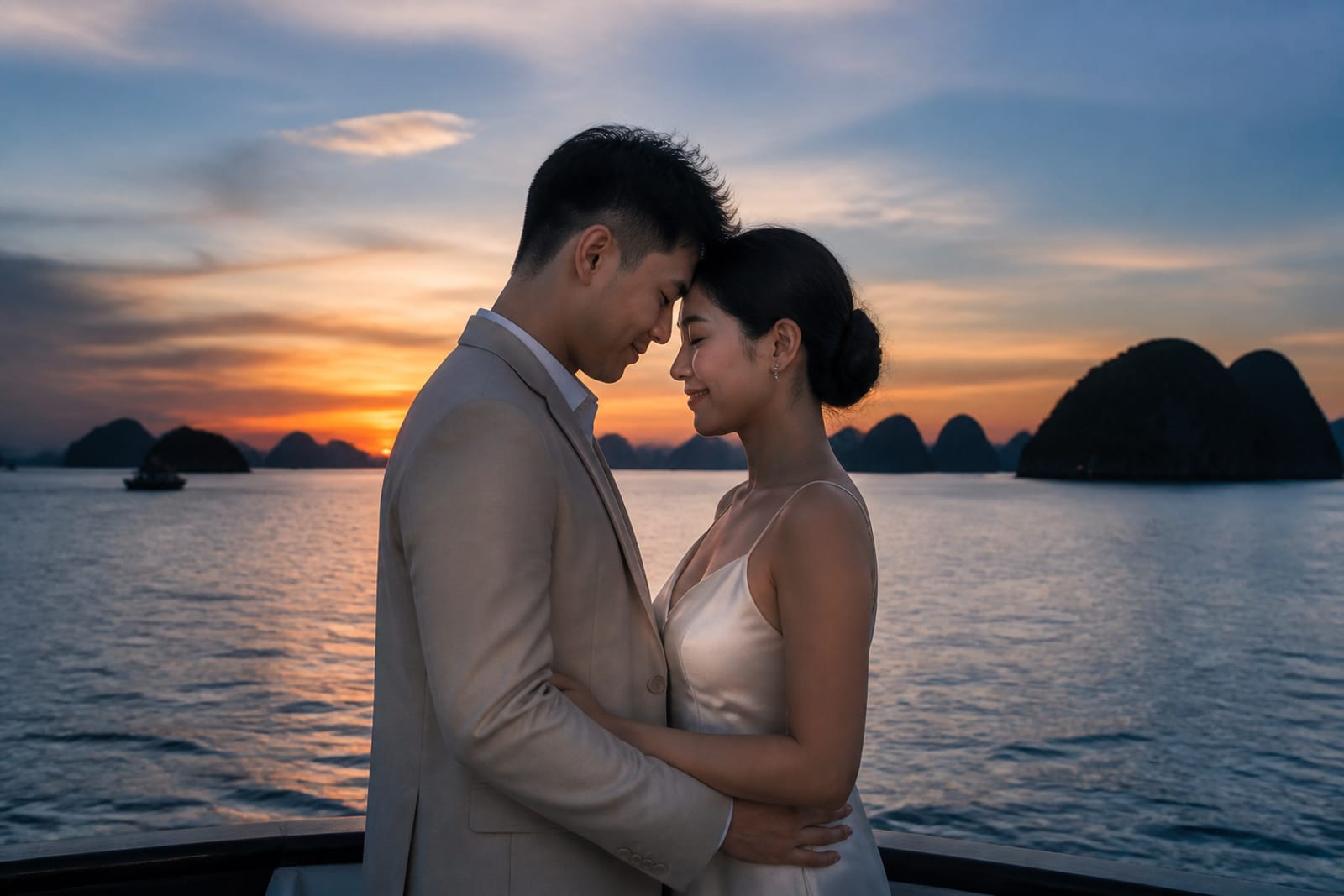
Sunrise and sunset are non-negotiable for limestone karst photography—the rock faces glow warm, water reflects gold, and the tourist crowds haven't arrived. Between these windows, light bounces harshly off the limestone and sea, flattening color and creating unflattering shadows on faces. A 5 AM start means you dock your boat by 6 AM, which sounds early until you see the first light hit the karst without a single other vessel in frame. By 7:30 AM, nearby boats begin their morning cruises and crowds grow; by 9 AM, the bay fills with dozens of tour groups. If you delay your shoot to mid-morning "to sleep in," you're shooting in flat, blue-cast light and competing for clear angles around anchored boats. The tradeoff: early starts demand pre-dawn hotel pickups, hair and makeup done by 4:30 AM (typically at your hotel or boat cabin), and energy management through a long day.
How many hours should you actually book?
| Duration | Best for | Light coverage | Reality check |
|---|---|---|---|
| Half-day (4–5 hours) | Budget-conscious couples; limited outfits | Early light only, or late afternoon only | Boat travel + one outfit change = ~2 hours shoots max. No flexibility for weather delays or location changes. |
| Full-day (7–8 hours) | Multiple outfits; sunrise + golden hour; buffer time | Early light, midday wide shots, late-afternoon intimates | Covers two best light windows. Allows makeup touch-ups, outfit swaps, and repositioning if weather shifts. Most popular. |
| Extended (9+ hours) | Perfectionist couples; additional video, outfit tripling | Sunrise through twilight + blue hour | Fatigue sets in by hour 7. Extra hours often yield diminishing returns unless you're also booking wedding video. |
Full-day bookings suit most couples because they absorb travel delays (a boat engine issue, a tide-locked beach) without losing light windows. Half-day shoots work if you're comfortable with one strong lighting period and want to keep logistics simple; they cost less but offer no backup if conditions shift mid-morning.
Actual schedule: what happens when
4:00–4:30 AM: Hotel pickup (if not staying on boat). Hair and makeup in your hotel room or boat cabin—humidity and salt air are real; a makeup artist experienced with waterfront conditions will use long-wear formulas and set spray. You'll change into your first outfit (often ao dai or bridal gown) and pack a second look in a dry bag.
5:00–5:45 AM: Transfer to boat dock. Photographer and assistant are already onboard doing light checks. You board; the boat leaves while the world is still dark.
6:00–7:30 AM: First shoot location—usually a quiet anchorage or the boat's upper deck as light arrives. Golden hour frames your first outfit. Photographer positions you against the karst, adjusts for boat sway, and shoots for 60–90 minutes.
7:45–9:00 AM: Outfit change in a boat cabin or beach shelter (bring a privacy screen or use the cabin). Hair touch-up, makeup refresh. Boat repositions to a second location—a quieter beach, a cave entrance, or a rock formation with fewer boats. The light is still warm but getting brighter.
9:15–11:00 AM: Second outfit shots. By 10 AM, light begins to flatten; by 11 AM, shadows under the karst deepen. Photographer may shoot wider landscapes, detail shots of your dress, or walk-through moments to use this light efficiently.
11:15 AM–1:00 PM: Lunch break on the boat. This sounds like downtime, but it's critical: you rest, eat, rehydrate. Makeup artist does a full touch-up—waterproof mascara, lip color, powder for the humidity. Photographer reviews images, scouts the afternoon location on maps, and briefs you on what to expect.
1:30–3:00 PM: Optional third outfit (if booked) or return to an earlier location for additional shots. Midday light is harsh; this slot often captures couple activities—walking on deck, holding hands, looking out at the view—rather than posed portraits. Some photographers skip this window and rest the team; others use it for video content or wedding video sequences.
3:30–5:30 PM: Late-afternoon repositioning. The boat moves to a location chosen for sunset direction. You may change back into outfit two or add a fourth look (casual clothes, swimwear for a couple's moment in a cave). As the sun lowers, light softens and turns golden again—this is the second-best window of the day.
5:45–6:30 PM: Golden hour couple session. Final shots, intimate portraits, silhouettes against the water. Photographer works fast; light changes every 5–10 minutes.
6:30–7:00 PM: Wrap. Light fades to blue hour; most couples are too tired for further shooting. You return to your hotel by 7:30–8:00 PM, depending on boat speed and traffic.
Weather and season: the variables that reshape your plan
Ha Long Bay's best light windows fall in March–May and September–November, when the sky is often clear and humidity is lower. Winter (December–February) brings misty, cool conditions—beautiful for moody, atmospheric shots, but sunrise light is softer and more diffused; you'll shoot longer to gather the same amount of usable frames. Summer (June–August) and autumn transition (September–early November) carry typhoon risk; the boat operator may cancel or reschedule if winds exceed safe limits. Rain doesn't always cancel a shoot—soft drizzle can add mood to limestone shots—but heavy downpour limits visibility and makes deck work unsafe.
When you book, confirm the weather forecast 5–7 days before your shoot date and again 2 days prior. Cáo Studio coordinates with your boat operator to decide whether to proceed, postpone, or shift locations based on wind and water conditions. Always have a backup date in mind; rebooking is easier than recovering from a cancelled shoot.
What to wear and pack: logistics that avoid regret
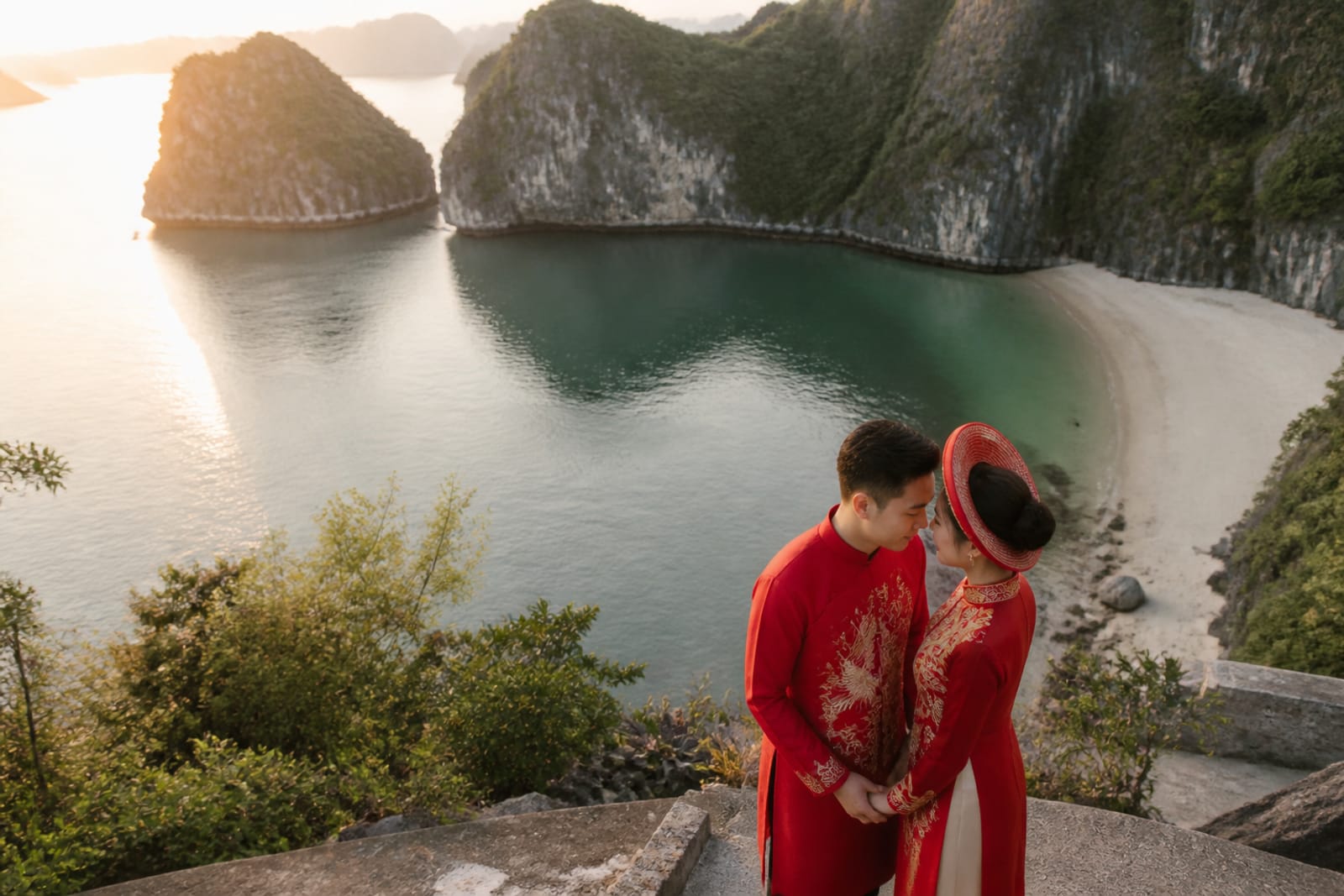
Wear what flatters you, but layer for the boat environment. An ao dai over slip pants works beautifully and moves in the wind; a bridal gown looks ethereal but needs careful movement on wet decks—bring water shoes and a robe. Pack a dry bag with a second outfit, swimwear (if planning in-water shots), undergarments, a light cardigan for early-morning chill, and a small first-aid kit (saltwater stings). The boat will have a cabin with a mirror and basic facilities; bring your own makeup touch-up kit (blotting papers, powder, lip color) and a hand towel. Shoes: wear non-slip soles on deck; bring backup flats for after outfit changes.
Salt spray and humidity degrade hair and makeup faster than on land. Plan for a makeup artist to be onboard or meet you at the dock; DIY touch-ups mid-day are rarely effective. A professional knows how to refresh a full face in 15 minutes on a boat.
Comparing booking options: charter boat vs. group boat vs. shore-based shoots
Some couples book a private boat charter (you're the only group aboard), while others join a pre-arranged group photoshoot where 2–3 couples share the vessel and take turns at different locations. A few couples opt for a half-day shoot based at a beach or island, skipping the boat entirely.
Private charter: You control the itinerary, timing, and which locations you visit. The photographer and crew focus only on you. Costs more (charter boat prices vary by season and operator), but timing is maximally flexible—you can shoot a sunrise without leaving before midnight. Ideal if you want multiple outfit changes, long couple moments, or a cinematic wedding video.
Shared-boat group shoot: You share the boat with 1–2 other couples, shooting in different bays or at different times. Cheaper than a private charter, and Cáo Studio can coordinate logistics across couples. The tradeoff: you're anchored around other tour boats, and timing is fixed by the group's schedule. Works well for budget-conscious couples who don't mind sharing the boat's captain and crew.
Shore-based half-day: You stay on a beach or island (Monkey Island, Ti Top, Cat Ba) and shoot there without boat travel. Simpler logistics, no seasickness risk, and lower cost. Downside: fewer unique angles, more tourist crowds during daytime, and you miss the sunrise/sunset light out on the water.
Ask yourself: How important is exclusive access? How many outfit changes do you want? Do you get seasick? Your answer shapes which option fits your priorities and budget factors.
Before you book: the checklist that saves heartbreak
☐ Confirm boat operator and vessel type — Is it a private junk, speedboat, or tour-boat retrofit? Does it have a cabin with good light for outfit changes? Ask Cáo Studio for operator contacts so you can verify directly.
☐ Lock in your dates and backup dates — Ha Long's weather is unpredictable Sep–Nov. Book with a flexible rescheduling clause (confirm terms on WhatsApp).
☐ Arrange hair and makeup — Will Cáo Studio coordinate a makeup artist to travel with you, meet you at the dock, or work at your hotel before departure? Waterproof formulas and experienced hands are non-negotiable.
☐ Plan outfit changes — How many outfits do you want? Each adds 15–20 minutes of boat time and rest. Discuss with your photographer how many are realistic within your booked hours.
☐ Clarify what's included — Photographer hours, assistant coverage, number of edited photos, delivery timeline—these vary by package. Get the exact terms on WhatsApp before you commit.
☐ Verify movement and safety protocols — Does the boat operator allow photography on certain decks? Are there railings and non-slip surfaces? Ask the operator directly; your photographer can't override boat safety rules.
☐ Budget for transportation and permits — Entry to Lan Ha Bay (if shooting there instead of Ha Long) may require permits; boat charter costs, hotel pickups, and guide fees all add up. None of these are Cáo Studio's fee, but they're part of your total spend. Ask the operator for a full breakdown.
---
FAQ
Do I really need to start at 5 AM?
Early light (5:30–7:30 AM) is the best window for limestone karst photography—soft, warm, and crowd-free. If you sleep in, you're shooting in flat midday light or competing with dozens of tour boats. Most couples find the early wake-up worth the image quality.
Can we shoot a full day without staying overnight on the boat?
Yes. You can do a hotel-to-dock pickup at 4–5 AM, board the boat, and return by evening. This adds travel time but works if you prefer sleeping in your own room. Coordinate timing with Cáo Studio on WhatsApp.
What happens if weather cancels our shoot?
The boat operator and Cáo Studio decide 1–2 days before whether to proceed, reschedule, or shift to a backup location. You'll have a rescheduling date agreed in advance. Confirm cancellation and rebook policies when you book.
Can we bring family or a second photographer?
Yes, but space is limited on smaller boats. Extra passengers (family members, videographer) may require a larger vessel and affect pricing. Discuss with Cáo Studio and the boat operator on WhatsApp.
How many edited photos do we get from a full-day shoot?
The number and delivery timeline depend on your package. Confirm the exact count and editing turnaround on WhatsApp before you book—it varies widely.
Is an ao dai practical for a boat, or should we wear a bridal gown?
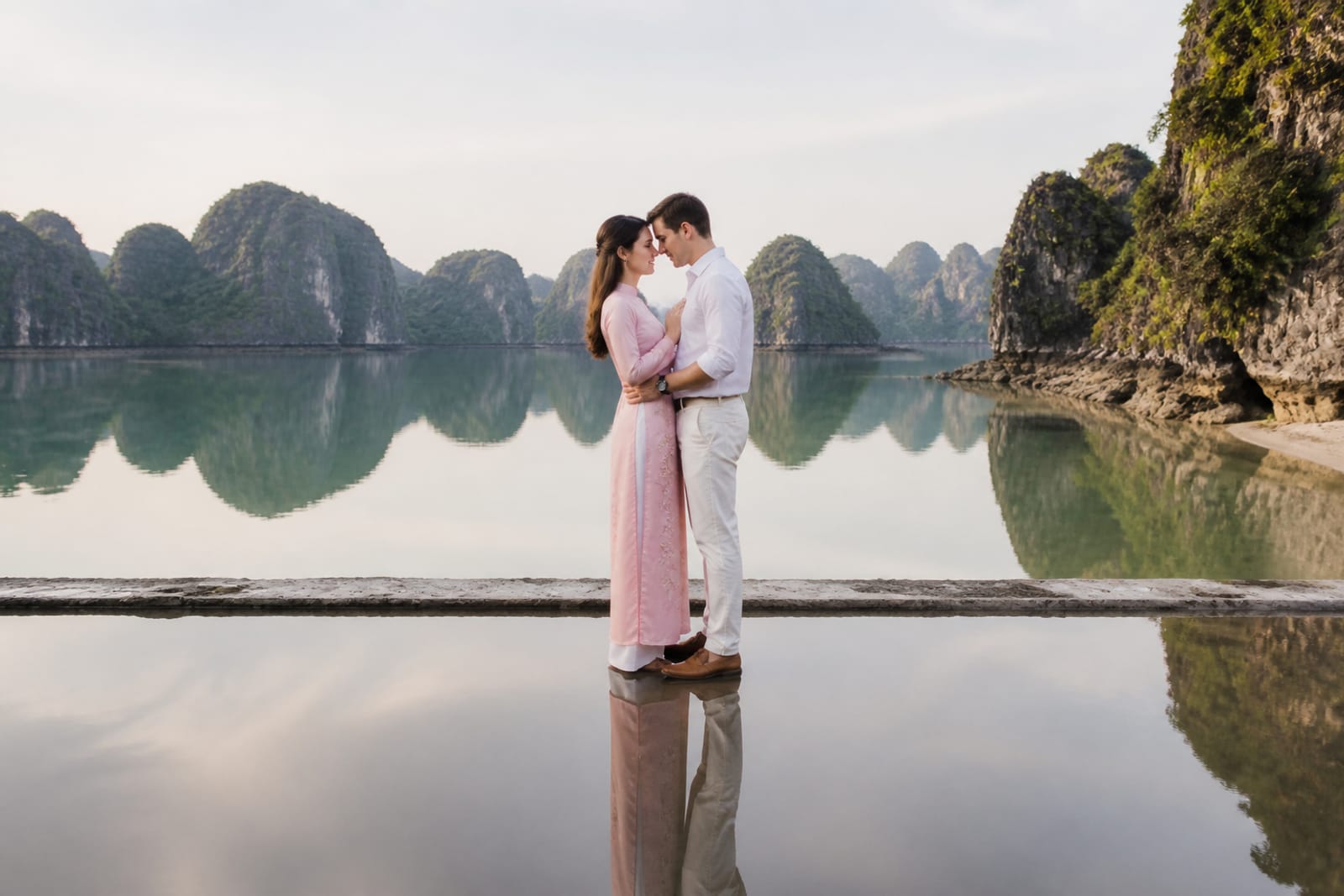
Both work. An ao dai moves beautifully in the wind and doesn't drag in salt spray; a gown photographs dramatically but needs careful footing on wet decks. Many couples wear ao dai for the boat and a gown for a beach moment or cave shots.
Can we book Cáo Studio for a Ha Long shoot if we live abroad?
Yes. Cáo Studio coordinates pre-wedding shoots in Ha Long, Hanoi, Hoi An, and Ho Chi Minh City for international travelers. Message on WhatsApp with your dates, and the studio will brief you on boat logistics, weather, and what to prepare. --- 📸 Book on WhatsApp — pre-wedding photoshoot | 🌸 Visit Cáo Studio Hanoi | 💒 See more couple sessions
FAQ
Do I really need to start at 5 AM?
Early light (5:30–7:30 AM) is the best window for limestone karst photography—soft, warm, and crowd-free. If you sleep in, you're shooting in flat midday light or competing with dozens of tour boats. Most couples find the early wake-up worth the image quality.
Can we shoot a full day without staying overnight on the boat?
Yes. You can do a hotel-to-dock pickup at 4–5 AM, board the boat, and return by evening. This adds travel time but works if you prefer sleeping in your own room. Coordinate timing with Cáo Studio on WhatsApp.
What happens if weather cancels our shoot?
The boat operator and Cáo Studio decide 1–2 days before whether to proceed, reschedule, or shift to a backup location. You'll have a rescheduling date agreed in advance. Confirm cancellation and rebook policies when you book.
Can we bring family or a second photographer?
Yes, but space is limited on smaller boats. Extra passengers (family members, videographer) may require a larger vessel and affect pricing. Discuss with Cáo Studio and the boat operator on WhatsApp.
How many edited photos do we get from a full-day shoot?
The number and delivery timeline depend on your package. Confirm the exact count and editing turnaround on WhatsApp before you book—it varies widely.
Is an ao dai practical for a boat, or should we wear a bridal gown?
Both work. An ao dai moves beautifully in the wind and doesn't drag in salt spray; a gown photographs dramatically but needs careful footing on wet decks. Many couples wear ao dai for the boat and a gown for a beach moment or cave shots.
Can we book Cáo Studio for a Ha Long shoot if we live abroad?
Yes. Cáo Studio coordinates pre-wedding shoots in Ha Long, Hanoi, Hoi An, and Ho Chi Minh City for international travelers. Message on WhatsApp with your dates, and the studio will brief you on boat logistics, weather, and what to prepare. --- [📸 Book on WhatsApp — pre-wedding photoshoot](/pre-wedding-photoshoot) | [🌸 Visit Cáo Studio Hanoi](/hanoi) | [💒 See more couple sessions](/couple-photoshoot)
Ao dai, makeup, hair and a local photographer in Hanoi or Saigon — one WhatsApp message.