/wedding-photographer
Vietnamese tea ceremony photos: what to capture at le an hoi
The lễ ăn hỏi (tea ceremony) is a formal ritual where the bride and groom serve tea to elders, kneeling and receiving blessings—typically 3–5 minutes per family group, sometimes 15–30 minutes total across both sides. It happens indoors at home, a hotel banquet room, or a restaurant private space, usually midday or early evening. Key shots: the couple's approach on knees, the tea pouring (hands, cup angle, guest faces), ring exchanges, and the elder's response (a smile, a nod, a red envelope or gift handed back). Avoid shooting from directly behind the couple or into backlighting; position yourself to one side, pre-focus on the tea cup, and expect dim ambient light—a fast lens (f/2.8 or wider) and high ISO work better than flash, which breaks the quiet reverence. Cáo Studio – Makeup & Photoshoot frames these moments as the emotional heart of your wedding day, not a secondary ritual. ---
Why is the tea ceremony the soul of a Vietnamese wedding?
The lễ ăn hỏi isn't a photo op—it's where two families formally unite and the couple asks permission to marry. Guests watch in silence; the ritual carries centuries of respect, gratitude, and blessing. A photographer who understands this shoots for stillness and sincerity, not speed or drama. The ceremony's power lies in restraint: a trembling hand pouring tea, an elder's eyes tearing up, a younger sibling covering their mouth in emotion. These moments vanish in seconds. Capturing them requires anticipation, not intervention. Many Western photographers miss this entirely because they treat it like any other event moment—staged, loud, fast. Vietnamese families remember the tea ceremony for decades; your images will anchor that memory forever.
📸 Book on WhatsApp — pre-wedding photoshoot
What camera positions work best during the ceremony?
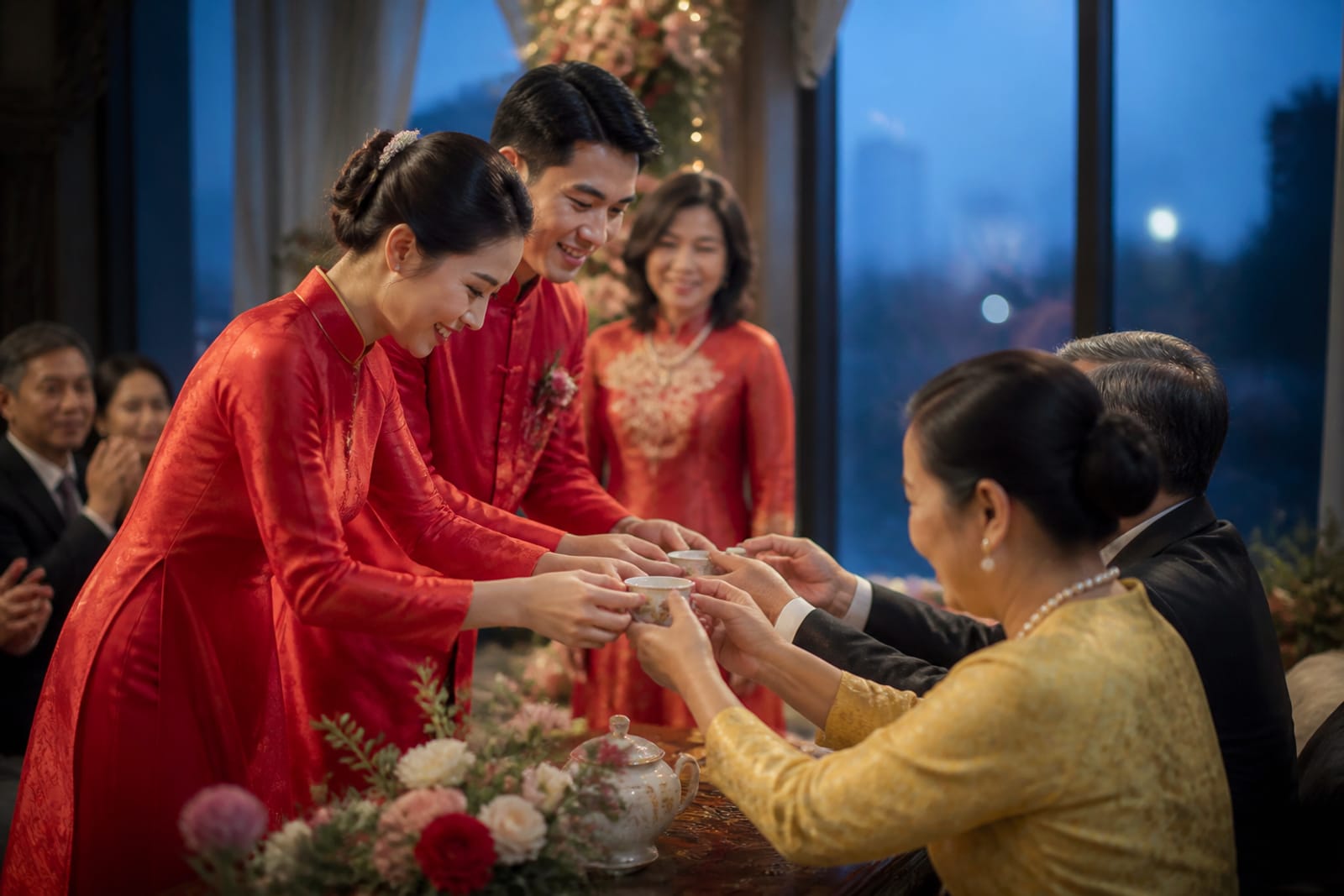
Position yourself at a 45-degree angle to the couple's side, roughly 6–8 feet away, so you see their faces, the tea cup, and the elder's reaction in the same frame. Avoid shooting straight-on (hides the pouring motion) or from behind (obscures emotion). Sit or kneel if the floor is low; standing above the couple looks hierarchical and distorts the moment's intimacy. Scout the location beforehand—check ceiling height, window placement, and ambient light direction. In a hotel banquet room with recessed ceiling lights, position yourself so light falls on the couple's faces, not your lens (which creates lens flare). If the space is dim, move slightly toward a window or ask the family if a single table lamp can be angled onto the tea table. Never use a flash; it startles the family and ruins the reverent tone. A second camera angle (your second shooter, if you have one) captures the family's faces from across the room—their silent reactions are as vital as the couple's actions.
What lighting setup captures emotion without disrupting the ritual?
Shoot at f/2.8 or f/4, ISO 1600–3200, and shutter speed 1/200–1/500 (depending on motion). Available light is non-negotiable; flash breaks the ceremony's contemplative mood. If the room has warm tungsten lights (typical in Vietnamese homes and older hotels), shoot in Kelvin mode (around 3200–4500K) or auto white balance and correct in post—tungsten light actually flatters skin and creates an intimate, honeyed warmth that feels appropriate. Window light is ideal if the ceremony runs mid-morning or afternoon; position yourself so side light grazes the couple's profiles and the tea cup. Overcast outdoor ceremonies (rare but possible in gardens) are forgiving—no harsh shadows, no blown highlights. In truly dim spaces, prioritize a fast prime lens (50mm f/1.8, 85mm f/1.4) over zoom; primes gather more light and focus faster. Bring a small reflector (silver side) to bounce ambient light onto the couple's faces if the elder's position blocks direct light—but have a family member or assistant hold it unobtrusively, out of frame.
How do you anticipate the key moments before they happen?
Study the ceremony flow with the family or wedding planner beforehand. Typical sequence: couple enters, kneels, pours tea (one cup per elder, left to right), receives a response (words, a gift, a blessing), bows, and moves to the next family group. The most powerful frames occur during the pour (watch their hands, the guest's eyes) and the exchange (the moment the elder accepts the cup or hands back a gift). Pre-focus on the tea table and adjust aperture to include both the couple and the elder in sharpness; f/4–f/5.6 often works better than ultra-wide apertures in dim light because it lets you breathe slightly with focus. Anticipate the bow—it happens fast and reveals a vulnerability that static moments don't. Watch the crowd for candid reactions: a grandmother wiping her eyes, a sibling mouthing encouragement, the couple's parents' faces. These aren't part of the ritual itself, but they complete the story. Shoot constantly during the 5–30 minutes; you'll capture 200–400 frames, and only 5–8 will be exceptional. That's normal and necessary.
What cultural details strengthen your tea ceremony photos?
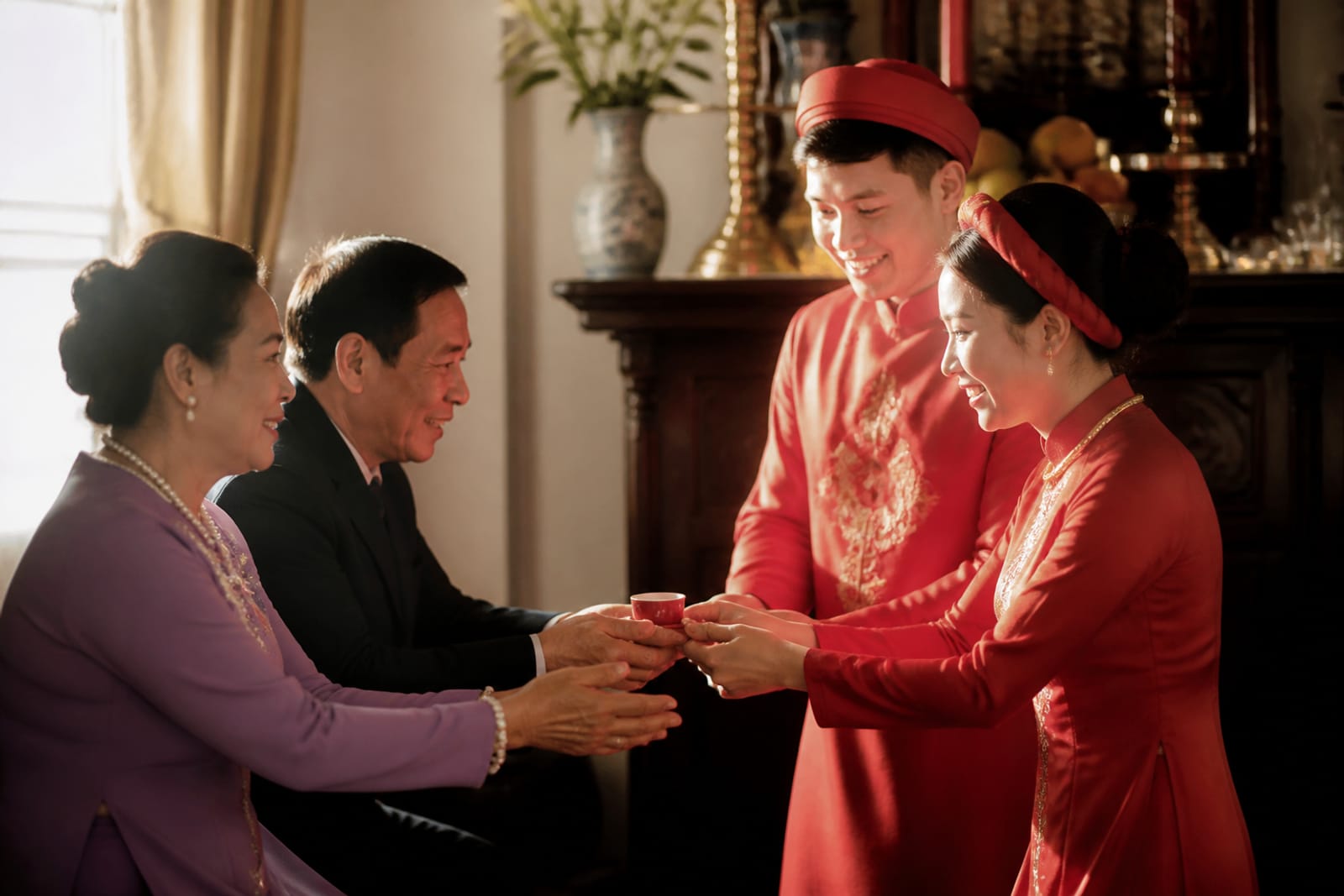
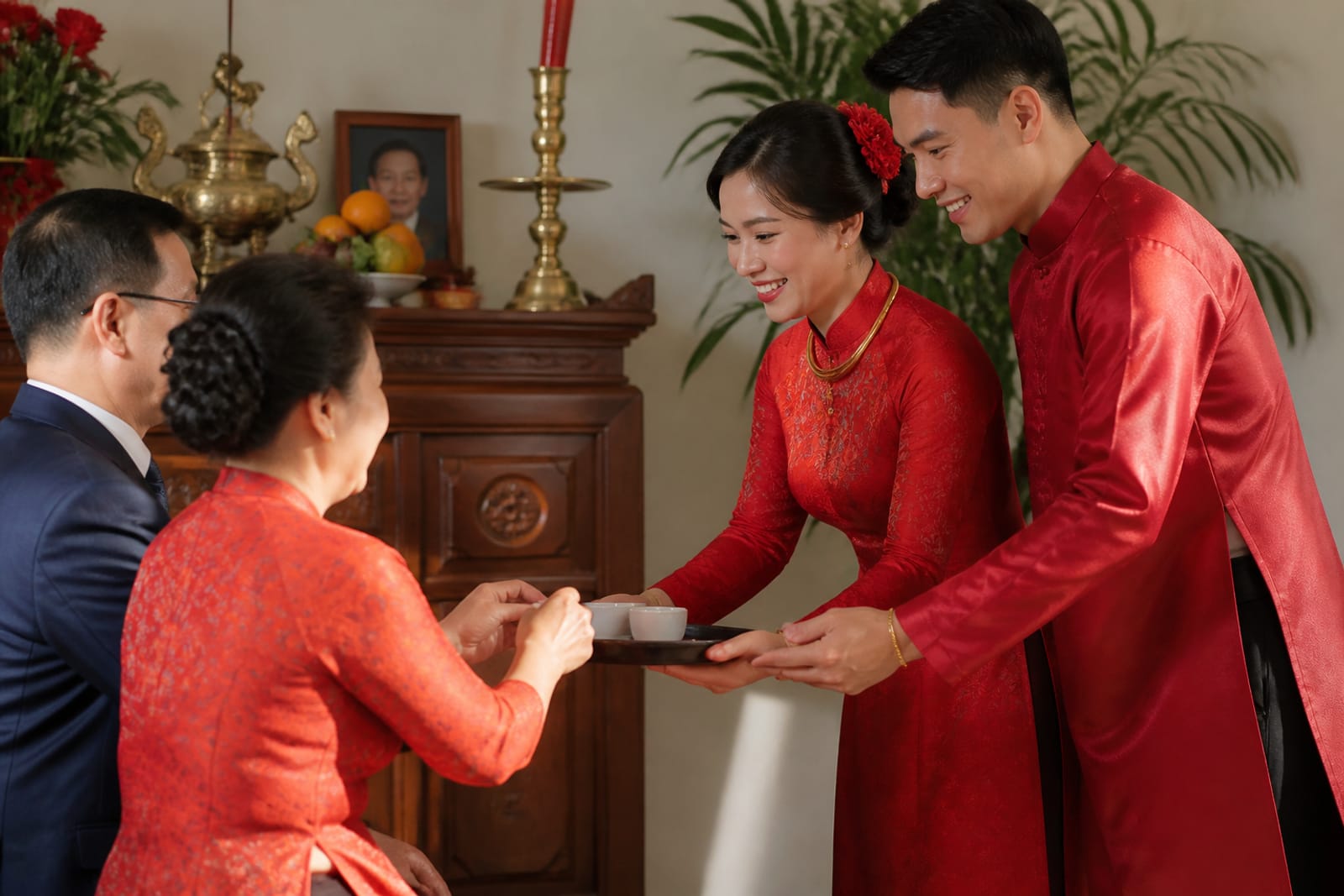
The tea ceremony involves specific objects and gestures that photographers often overlook but families treasure in images. The tea itself—traditionally jasmine, oolong, or green—should be visible in the cup; frame the pouring so the light catches the liquid or steam. The couple's clothing matters: traditional áo dài (usually for the bride, sometimes both) photograph differently than Western wedding dress—the long tunic and silk catch light softly and convey formality. Capture the couple's hands during the pour; interlocked or trembling hands tell a story Western ceremonies don't. The elder's response—a nod, a smile, a squeeze of the cup—is Vietnamese blessing made visible. If the family uses a lacquered tray, an ornate tea set, or red cushions for kneeling, these frame the moment in cultural richness; don't ignore them as background. Finally, ring exchanges or red envelopes (given by elders) are pivotal but quick; have your second angle (or assistant) focused on the elder's hands. A comparison of detail-focused vs. wide-angle framing:
| Framing Choice | Best for capturing | Light needs | Why it matters |
|---|---|---|---|
| Close (tea cup + hands) | Texture, emotion, ritual objects | Side light from window or lamp | Shows reverence, tells story through detail |
| Medium (couple + elder) | Relationship, exchange, context | Ambient overhead + side fill | Balances both people, shows family bond |
| Wide (full room, guests visible) | Crowd reaction, ceremony scale, cultural moment | Even, soft light; avoid harsh shadows | Contextualizes ritual in community, not isolation |
The close framing, shot at f/2.8 with a 85mm lens, isolates emotion; the medium framing, at f/4–f/5.6 with a 50mm, includes both participants and creates narrative; the wide framing, at f/5.6 or f/8 with a 35mm, shows the family's involvement and the ceremony's place in the wedding day.
How does a tea ceremony photo session fit into your full wedding day?
Most couples book a dedicated pre-wedding photoshoot to recreate or practice the tea ceremony ritual beforehand—typically 1–2 hours, in a controlled setting (home, hotel room, or a garden) where light is consistent and the family can walk through the steps without time pressure. This gives you endless angles, multiple setups, and the chance to direct without rushing. On the wedding day itself, the actual ceremony is live and unrepeatable; you shoot it once, and the pressure is absolute. Some couples hire Cáo Studio – Makeup & Photoshoot for makeup and hair at the ceremony location so the bride looks her best under the exact lighting where photos will be taken. Others book a couple photoshoot that includes tea ceremony staging—same ritual, same poses, but on a separate date with perfect light and no family timeline. If the ceremony is part of a larger wedding day photographer package, allocate 30 minutes to the tea ritual alone; don't squeeze it into a 2-hour coverage window. The ritual deserves its own intentional time. For families traveling to Vietnam specifically for a wedding ceremony abroad, Cáo Studio offers photoshoots in Hoi An and across Hanoi and Saigon locations, customized to your ceremony's date and cultural needs.
---
What to check before you book a photographer for a tea ceremony
- Ask whether they've shot a Vietnamese tea ceremony before. Generic wedding photographers may not understand the ritual's pace, emotional depth, or the requirement for ambient-light silence.
- Confirm equipment: fast prime lenses (f/2.8 or wider), high ISO capability, and NO flash policy for the ceremony itself.
- Request a location scout beforehand. Lighting conditions vary wildly between a home living room, a hotel banquet suite, and a restaurant private room. A good photographer visits 24–48 hours early to test camera settings and plan angles.
- Clarify coverage: is the ceremony included in your wedding day package, or is it a separate add-on? (Cáo Studio confirms all details on WhatsApp; see the pricing page and FAQ for specifics.)
- Ask for a pre-ceremony consultation with the family. A photographer who calls the bride's mother to ask about the tea type, the number of family groups, and the sequence shows respect and ensures zero surprises.
- Request sample photos from a recent tea ceremony—not a studio recreation, but a real wedding. Posed tea ceremony images often look staged; a photographer's real-wedding portfolio shows how they handle dim light, crowd chaos, and live emotion.
- Plan outfit rentals early if you want áo dài in ceremony photos. Cáo Studio offers áo dài rental alongside photography, ensuring the garment fits perfectly on the day.
---
FAQ
How long does a typical tea ceremony last, and how many photos should I expect?
A tea ceremony runs 5–30 minutes depending on how many family groups the couple serves. Expect 150–400 frames shot by your photographer(s) during the ritual; 10–20 will be keepers (in-focus, emotionally resonant). Pre-wedding ceremony staging allows 200–600 frames in a 1-2 hour session, with higher keeper rates because lighting and timing are controlled.
Can we do a full tea ceremony photoshoot before the wedding day, separate from the ceremony itself?
Yes. Many couples book a pre-wedding photoshoot that recreates the tea ceremony ritual in optimal light and without time pressure. Cáo Studio arranges these at your home, a hotel, or a rented space; the family walks through the steps while your photographer captures every moment. This is ideal if your actual wedding-day ceremony timing is tight or if you want a separate keepsake album of the ritual itself.
What's the difference between shooting the real ceremony and a staged tea ceremony for photos?
The real ceremony (on your wedding day) is live, unrepeatable, and rich with genuine emotion—but chaotic lighting and family movement challenge even experienced photographers. A staged pre-wedding ceremony photoshoot is controlled, lit intentionally, and repeatable, so you capture multiple angles and perfect moments without pressure. Most couples do both: intimate real-ceremony coverage on the day, plus a polished staged session weeks before.
Should the photographer be present during the whole wedding, or only for the tea ceremony?
If the tea ceremony is a major cultural moment for your family, book enough photography coverage to include it with breathing room—ideally a 4–6 hour wedding day package that allocates 30–45 minutes to the ceremony alone. Cramming it into a 1–2 hour total coverage window means missing candid family reactions and gift-exchange details. Cáo Studio's wedding photographer packages are customized on WhatsApp; ask about ceremony-focused timing.
Do I need a second photographer to cover the tea ceremony?
Not required, but recommended. One photographer captures the couple and the immediate ritual; a second covers guest reactions, the parents' faces, and crowd context from across the room. If budget allows, a second angle enriches the story significantly—especially for large families or multi-group ceremonies where the couple serves tea to 15+ elders.
Can we use flash during the tea ceremony?
Flash is strongly discouraged. It's loud (startles guests), bright (destroys the ritual's intimacy), and unnecessary if your photographer uses a fast lens and raises ISO. Natural and ambient light preserve the ceremony's reverent tone and produce images that feel authentic. If the room is extremely dim, a reflector or a strategically placed lamp is far better than flash.
How do we ensure the makeup and lighting are perfect on ceremony day?
Book makeup and hair at your hotel on the morning of the ceremony, ideally at the location where the tea ceremony will happen. This lets the makeup artist see the exact lighting and adjust concealer, powder, and color so the bride glows under the real lights you'll photograph in. Alternatively, do a makeup trial during a pre-wedding photoshoot so your photographer tests the look and gives feedback before the wedding day.
FAQ
How long does a typical tea ceremony last, and how many photos should I expect?
A tea ceremony runs 5–30 minutes depending on how many family groups the couple serves. Expect 150–400 frames shot by your photographer(s) during the ritual; 10–20 will be keepers (in-focus, emotionally resonant). Pre-wedding ceremony staging allows 200–600 frames in a 1-2 hour session, with higher keeper rates because lighting and timing are controlled.
Can we do a full tea ceremony photoshoot before the wedding day, separate from the ceremony itself?
Yes. Many couples book a [pre-wedding photoshoot](/pre-wedding-photoshoot) that recreates the tea ceremony ritual in optimal light and without time pressure. Cáo Studio arranges these at your home, a hotel, or a rented space; the family walks through the steps while your photographer captures every moment. This is ideal if your actual wedding-day ceremony timing is tight or if you want a separate keepsake album of the ritual itself.
What's the difference between shooting the real ceremony and a staged tea ceremony for photos?
The real ceremony (on your wedding day) is live, unrepeatable, and rich with genuine emotion—but chaotic lighting and family movement challenge even experienced photographers. A staged pre-wedding ceremony photoshoot is controlled, lit intentionally, and repeatable, so you capture multiple angles and perfect moments without pressure. Most couples do both: intimate real-ceremony coverage on the day, plus a polished staged session weeks before.
Should the photographer be present during the whole wedding, or only for the tea ceremony?
If the tea ceremony is a major cultural moment for your family, book enough photography coverage to include it with breathing room—ideally a 4–6 hour wedding day package that allocates 30–45 minutes to the ceremony alone. Cramming it into a 1–2 hour total coverage window means missing candid family reactions and gift-exchange details. Cáo Studio's [wedding photographer packages](/wedding-photographer) are customized on WhatsApp; ask about ceremony-focused timing.
Do I need a second photographer to cover the tea ceremony?
Not required, but recommended. One photographer captures the couple and the immediate ritual; a second covers guest reactions, the parents' faces, and crowd context from across the room. If budget allows, a second angle enriches the story significantly—especially for large families or multi-group ceremonies where the couple serves tea to 15+ elders.
Can we use flash during the tea ceremony?
Flash is strongly discouraged. It's loud (startles guests), bright (destroys the ritual's intimacy), and unnecessary if your photographer uses a fast lens and raises ISO. Natural and ambient light preserve the ceremony's reverent tone and produce images that feel authentic. If the room is extremely dim, a reflector or a strategically placed lamp is far better than flash.
How do we ensure the makeup and lighting are perfect on ceremony day?
Book [makeup and hair at your hotel](/makeup-and-hair) on the morning of the ceremony, ideally at the location where the tea ceremony will happen. This lets the makeup artist see the exact lighting and adjust concealer, powder, and color so the bride glows under the real lights you'll photograph in. Alternatively, do a [makeup trial during a pre-wedding photoshoot](/pre-wedding-photoshoot) so your photographer tests the look and gives feedback before the wedding day.
Ao dai, makeup, hair and a local photographer in Hanoi or Saigon — one WhatsApp message.