Cáo Studio · Mga gabay sa photoshoot sa Vietnam · Ao Dai Photoshoot Vietnam: Mga Opsyon at Gabay sa Pagbili 2026
Ao dai couple photos at Muong Hoa valley rice terraces
Cáo Studio team · Hanoi · 2026-10-03
Muong Hoa valley (Sapa, northern Vietnam) is a rice-terrace landscape that photographs well in green season (May–Aug) and golden harvest (mid-Sep to early Oct), with soft light at dawn and dusk. An ao dai couple session there takes 2–4 hours on foot across muddy or rocky paths; you'll need closed shoes, a sturdy carry bag for the ao dai fabric, and a photographer experienced with elevation, fast-changing weather and village logistics. The valley sits at ~1,200 m elevation—cool, often misty, with afternoon rain common. Cáo Studio does not operate in Sapa; instead, hire a local Sapa photographer who knows terrain and has weatherproof gear, confirm their backup plan for rain, and budget for a guide if paths are unfamiliar. Compare cost factors (travel time from Sapa town, number of outfit changes, meal/rest stops) before booking.
Why Muong Hoa valley is a harder ao dai shoot than mainstream photo spots
Muong Hoa is not a pavilion, temple or urban park—it's a walking landscape. The valley lies 8–15 km southeast of Sapa town, accessible by a winding single-track road and then on foot down steep stone steps or sloped trails. Photographers who know Hanoi's Huc Bridge or Hoi An's riverside are often surprised: there's no shelter, no changing room, no Wi-Fi, and weather turns in minutes. Rain in the valley doesn't mean a quick dash indoors—it means slippery terrain, wind, and ao dai fabric collecting mud and water. If you're drawn to Muong Hoa because the photos look dreamy online, understand that those images were shot by a photographer who timed the season (green or golden rice, not bare fields), arrived before dawn or at dusk (when crowds are gone and light is soft), and had a guide or local knowledge to find the flattest, least-slippery paths. An ao dai photoshoot there is slower, muddier and more physical than a couple shoot elsewhere.
📸 Book on WhatsApp — ao dai photoshoot | 💄 Makeup & hair at your hotel | 🌸 Ideas & lookbook
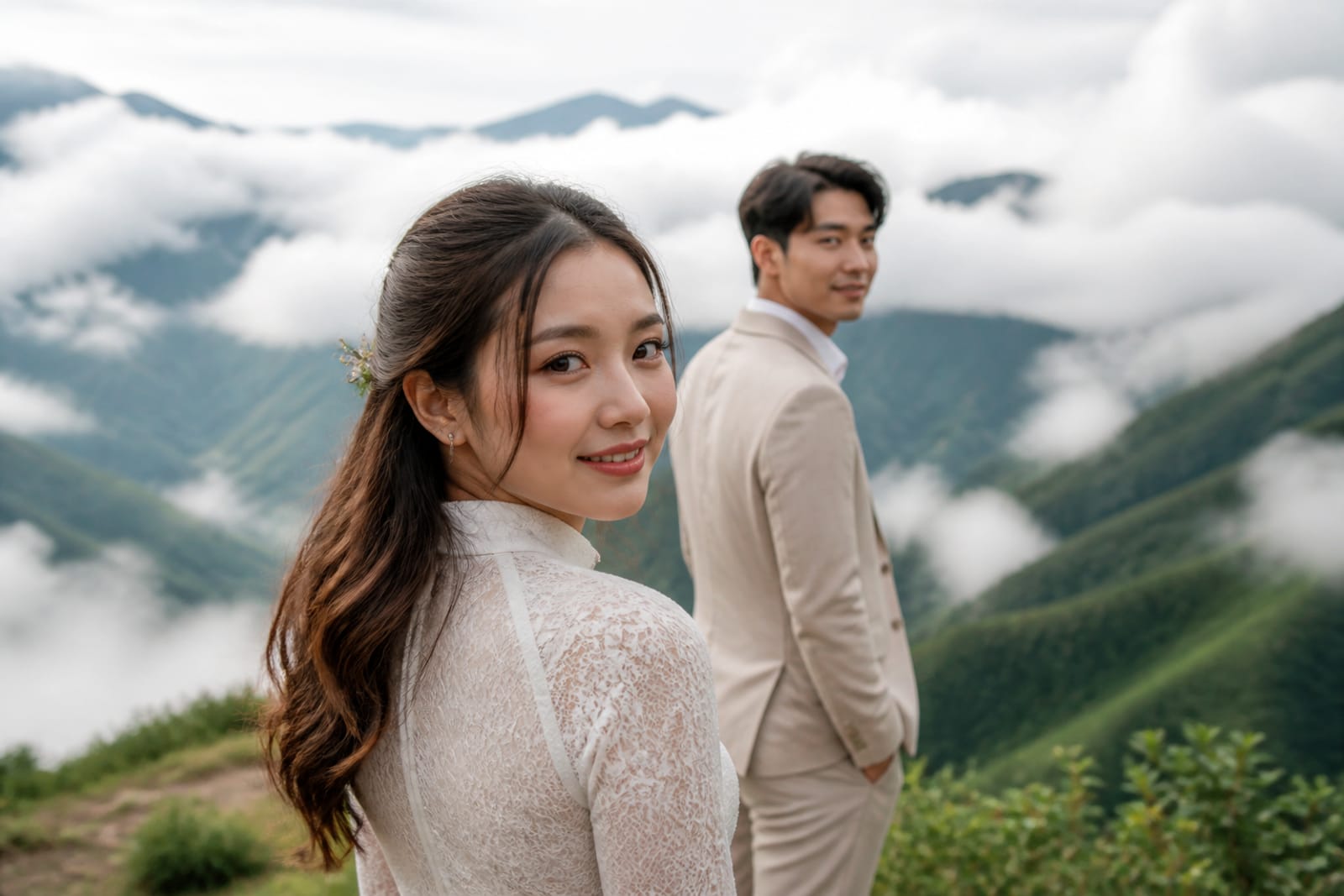
What season and time of day actually works for ao dai couple photos here?
The best ao dai light in Muong Hoa spans two windows: rice-terrace green (May–Aug, daily soft light 6–8 am before mist burns off, or 5–6 pm as mist rolls back in) and harvest gold (mid-Sep to early Oct, same hours, with warmer tones but higher chance of afternoon rain). Winter (Dec–Feb) brings fog that can hide the valley entirely for hours—not ideal unless you want moody, hazy frames. Spring (Mar–May) is inconsistent: some days clear and bright, others overcast. Summer rain is frequent but often brief; midday sun is harsh and unflattering for skin. The 5–6 pm window in Sep–Oct gives amber light across the rice and is often clearest after an afternoon shower, but you must be off the steep paths before dark (sunset ~5:45 pm in early Oct). Avoid midday entirely—light is flat, shadows are harsh, and midday heat makes hiking uncomfortable in formal ao dai. Early morning (6–7 am) is coldest and most misty but has the softest, most even light.
How much walking and what footwear should you plan for?
A typical Muong Hoa session involves descending 300–500 meters of elevation over 1–2 km (steep steps, then uneven stone-and-earth paths), stopping for 2–3 photo setups (each 10–30 minutes), then ascending the same route. Total time on foot is 3–4 hours if you're moving at a relaxed pace with breaks. Wear closed hiking shoes (trail runners or waterproof boots with ankle support)—the paths are slippery in rain and loose stone turns ankles fast. The ao dai itself should be carried in a lightweight dry bag until you're at the first shooting spot; don't wear it downhill. Bring the tunic (áo), trousers (quần) and underdress separately so your photographer can adjust if fabric gets wet. Pack a fleece or rain layer (temperature drops 1 °C per 100 m elevation; at 1,200 m in morning you may be 8–10 °C cooler than Sapa town). A photographer who doesn't warn you about elevation and footwear hasn't shot in the valley before—ask directly: "How many kilometers on foot? What's the elevation gain? What happens if it rains?"
Cáo Studio is not in Sapa—how do you find and vet a local photographer?
Cáo Studio operates in Hanoi, Ho Chi Minh City and Hoi An only. For a Muong Hoa session, you'll need a local Sapa photographer. Ask your hotel or tour operator for recommendations; reputable photographers often have a portfolio on Instagram or Behance and have shot weddings or couple sessions in the valley (not just tourist snapshots). Before booking, ask these five questions:
- Do you own weatherproof camera gear? (Mirrorless or DSLR with weather-sealed body and lenses; phone backup is not enough.)
- Have you shot ao dai in the valley in [your target season]? Ask for 3–4 sample sessions—not just Muong Hoa, but any ao dai work in rain or mist.
- What's your backup plan if it rains hard? (e.g., "We move to a covered tea house nearby and shoot detail frames," not "We reschedule.")
- Do you have a guide or walk the valley regularly? (Someone who knows safe paths and where light is best at that hour.)
- How do you deliver photos? (Timeline, format, editing style—confirm before booking.)
A photographer who hesitates on any of these or says "don't worry, we'll figure it out" is not ready for the valley. Cost should be discussed as a factor of travel time from Sapa town, number of outfit changes (each adds 30–45 minutes and wear on fabric), and whether a guide is included—never as a bare hourly rate.
| Muong Hoa shoot option | Best for | Light & season | Why it works or doesn't |
|---|---|---|---|
| Dawn session (5:30–7:30 am) | Couples who hike early; minimal mist; soft light on skin | May–Oct, 6–8 am golden/blue hour | Coldest, quietest; light is even; paths safest before dew dries and gets slippery; must descend fast—limits outfit changes. |
| Dusk session (4:30–6:30 pm) | Couples with less hiking fitness; warmest; amber light on rice | Sep–Oct only (sunset ~5:45 pm); May–Aug sunset ~6:30 pm, too bright | Hardest light (sun is raking and hot until 5:15 pm), but golden tones on rice are worth it; must exit valley by full dark—no flexibility. |
| Midday (10 am–4 pm) | None—avoid this entirely. | Any season | Harsh overhead sun; shadows under eyes; flat, unflattering light; heatstroke risk in formal ao dai; no narrative to the light. |
| Rainy morning (6–9 am, day after rain) | Couples who love moody, overcast frames; mist lovers | May–Aug, Sep–Oct; best after overnight rain | Soft, even light; no glare; rice terraces feel intimate; risk of slippery paths and wet ao dai fabric; requires photographer confident in low light (ISO 1600+, open aperture). |
📸 Book on WhatsApp — ao dai photoshoot
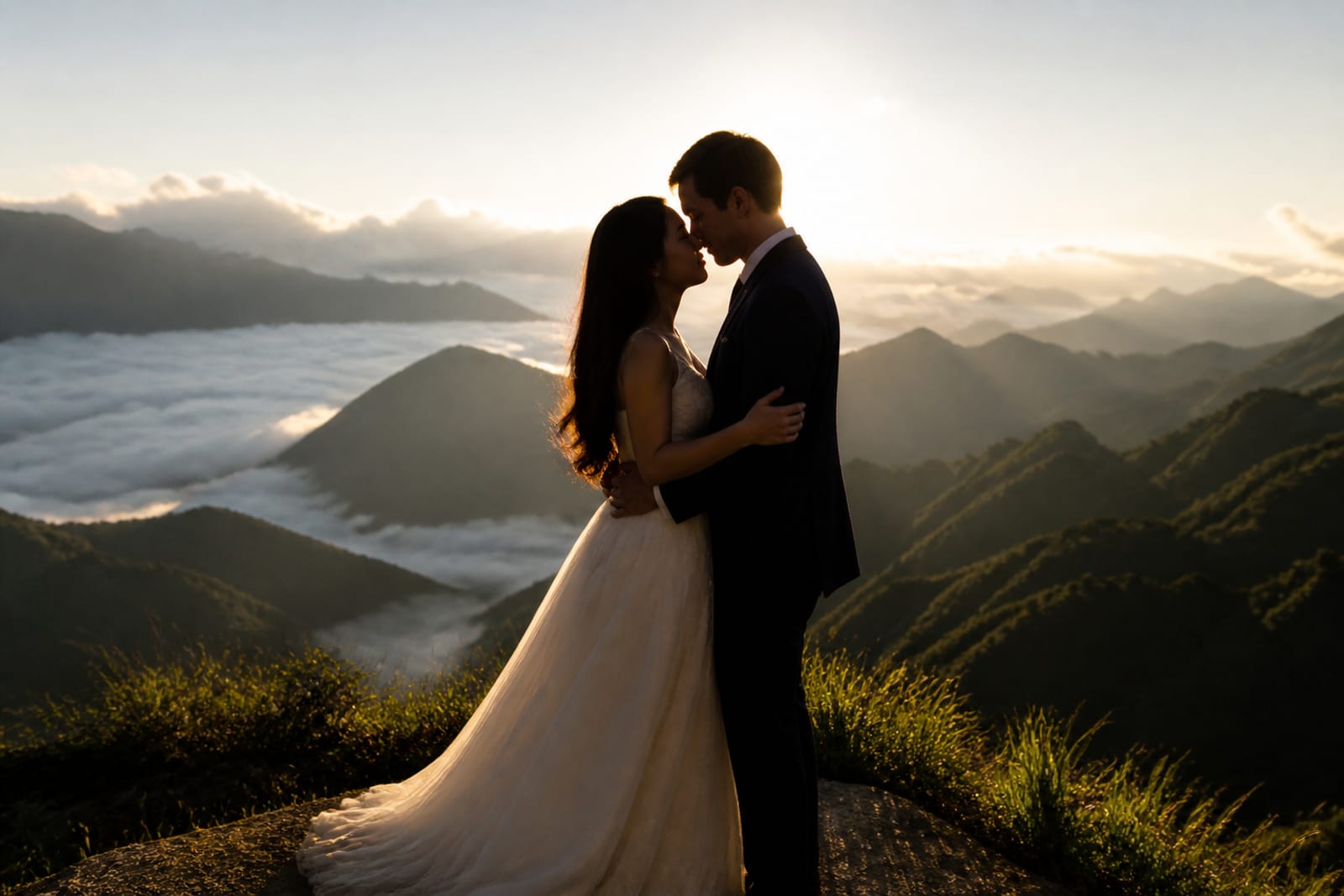
What ao dai fit, color and fabric choice works best in muddy, windy terrain?
The ao dai that photographs beautifully in a studio can be a liability on a mountain trail. Choose a fitted but not tight tunic (breathable silk or cotton blend, not polyester which clings to skin when damp); oversized ao dai catch wind and collect mud. Pale colors (cream, blush, pale pink, white) are classic and photograph well in soft valley light, but they show mud instantly—if the path is wet, consider a deeper cream, sage, or muted blue that reads as elegant but forgives splatter. Avoid heavy brocade or beaded fabric (adds weight, gets caught on branches, takes forever to dry). Your photographer should carry a lint roller and microfiber cloth; ask if they do. Bring a change of underdress (the white cotton slip under the tunic) because it absorbs moisture fast. Trousers should be fitted black or dark silk—loose ones drag on rocks. Wear the ao dai only during photo setups, not the full hike; change in a sheltered spot (a tea house, local home, or photographer's vehicle).
What to check before you book a Muong Hoa ao dai session
Before committing, confirm these logistics:
- Photographer's experience: Ask for 3–5 recent ao dai shoots (any season, any location); look for soft, flattering light and confident posing—not stiff or generic.
- Weather backup: If rain is forecast, what's the plan? Reschedule, move to an indoor location, or shoot anyway? (Each has a different feel.)
- Elevation & fitness: Be honest about fitness; if you're not a regular hiker, a 2–3 hour valley walk is taxing. Ask the photographer if they can shorten the route or focus on one or two spots.
- Fabric care: Who packs, carries and protects the ao dai? If you're renting locally, does the photographer know the rental shop and can they liaise on damage?
- Delivery timeline: When do you get photos? Edited or raw? How many? (This affects your timeline if you're leaving Sapa soon.)
- Cost drivers: Discuss upfront whether the price includes a guide, a vehicle from Sapa town, a change of location if weather is bad, or additional outfit swaps.
If the photographer can't answer these clearly, look elsewhere.
---
Para sa mga couples na nais ng ao dai photos sa ibang lugar
If Muong Hoa's terrain feels too ambitious, consider an ao dai photoshoot in a couple-friendly location with better access. Sapa has less dramatic but more accessible spots (Ma Pí Lèng pass, terraces visible from roadsides, tea plantations). Hoi An offers ao dai shoots by the river or in the ancient town without hiking. Hanoi has parks and lakes that suit ao dai with minimal physical effort. If you're planning a pre-wedding photoshoot or a longer series, mixing a scenic location like Muong Hoa with an easier second day in a different region often works better than committing the whole session to mountain terrain.
For travelers based in Hanoi or visiting for several days, Cáo Studio's Hanoi ao dai photoshoot pairs scenic light (Huc Bridge at dawn, West Lake at dusk) with zero hiking—and the team handles makeup, hair and styling. If you're in Ho Chi Minh City, Saigon's photoshoot options include urban and garden settings. For advice on mixing Muong Hoa with easier backdrops, ask the local Sapa photographer or contact Cáo Studio on WhatsApp for a planning conversation about your full trip.
💄 Makeup & hair at your hotel | 🌸 Ideas & lookbook
FAQ
Is it safe to do an ao dai photoshoot alone as a couple in Muong Hoa valley?
Yes, if the photographer is experienced and you've checked the weather forecast. Stay off the paths if lightning is visible. If you feel unsafe on a steep section, ask to skip it—no photo is worth a fall. Hire a guide if trails are unfamiliar; most local photographers can arrange one. Always tell your hotel where you're going and when you expect to return.
What happens to an ao dai if it gets muddy or wet during the shoot?
Mud dries and brushes off; water marks fade as fabric dries. A photographer should carry microfiber cloths and a lint roller for quick spot-cleaning between shots. If the tunic gets soaked, you'll need to change into a second ao dai or pause and dry it with a hair dryer (ask your accommodation to set one up). Avoid renting an ao dai the same day as a valley shoot—wet fabric takes hours to dry, and you'll forfeit the rental.
Can I shoot Muong Hoa in winter (Dec–Feb)?
Yes, but expect fog, lower light and cold. Rice terraces are bare or partially planted, not the dramatic green or gold. Mornings are often completely fogged (visibility under 30 meters). If you want moody, atmospheric frames and can hike in cool weather, winter is possible; otherwise, choose May–Oct. Ask the photographer: "Have you shot the valley in [your month]? Show me a sample session."
Do I need to rent an ao dai locally or can I bring my own from Hanoi?
Both work. Bringing your own lets you choose the exact fit and color; renting saves luggage weight and money. If renting, book from a Sapa shop a week before and confirm delivery to your hotel. Show the photographer a photo of the ao dai ahead of time so they can plan lighting and posing to flatter it. If you bring your own, pack it flat in a garment bag and keep it dry until the shoot.
How much does a Muong Hoa ao dai photoshoot cost?
Costs vary by photographer, season, guide inclusion and number of outfit changes. Discuss budget upfront as a factor of travel time from Sapa town, terrain difficulty and delivery timeline, not as a fixed rate. Ask three photographers for quotes and compare what's included (guide, transport, editing, timeline) before deciding. If you want a full couple photoshoot with makeup and styling as well, inquire if the photographer offers that or if you'll coordinate separately.
Mga karaniwang tanong
Is it safe to do an ao dai photoshoot alone as a couple in Muong Hoa valley?
Yes, if the photographer is experienced and you've checked the weather forecast. Stay off the paths if lightning is visible. If you feel unsafe on a steep section, ask to skip it—no photo is worth a fall. Hire a guide if trails are unfamiliar; most local photographers can arrange one. Always tell your hotel where you're going and when you expect to return.
What happens to an ao dai if it gets muddy or wet during the shoot?
Mud dries and brushes off; water marks fade as fabric dries. A photographer should carry microfiber cloths and a lint roller for quick spot-cleaning between shots. If the tunic gets soaked, you'll need to change into a second ao dai or pause and dry it with a hair dryer (ask your accommodation to set one up). Avoid renting an ao dai the same day as a valley shoot—wet fabric takes hours to dry, and you'll forfeit the rental.
Can I shoot Muong Hoa in winter (Dec–Feb)?
Yes, but expect fog, lower light and cold. Rice terraces are bare or partially planted, not the dramatic green or gold. Mornings are often completely fogged (visibility under 30 meters). If you want moody, atmospheric frames and can hike in cool weather, winter is possible; otherwise, choose May–Oct. Ask the photographer: "Have you shot the valley in [your month]? Show me a sample session."
Do I need to rent an ao dai locally or can I bring my own from Hanoi?
Both work. Bringing your own lets you choose the exact fit and color; renting saves luggage weight and money. If renting, book from a Sapa shop a week before and confirm delivery to your hotel. Show the photographer a photo of the ao dai ahead of time so they can plan lighting and posing to flatter it. If you bring your own, pack it flat in a garment bag and keep it dry until the shoot.
How much does a Muong Hoa ao dai photoshoot cost?
Costs vary by photographer, season, guide inclusion and number of outfit changes. Discuss budget upfront as a factor of travel time from Sapa town, terrain difficulty and delivery timeline, not as a fixed rate. Ask three photographers for quotes and compare what's included (guide, transport, editing, timeline) before deciding. If you want a full [couple photoshoot](/fil/couple-photoshoot) with makeup and styling as well, inquire if the photographer offers that or if you'll coordinate separately.