Cáo Studio · Przewodniki po sesjach zdjęciowych w Wietnamie · Sesja zdjeciowa w ao dai w Wietnamie – poradnik i rezerwacja
Ao dai couple photos at O Quy Ho: light, season & how to book
Zespół Cáo Studio · Hanoi · 2026-10-03
O Quy Ho Pass, a mountain pass in Ha Giang Province at roughly 1,500 metres elevation, becomes a couple photoshoot destination for its bare-rock ridgeline, thin air light, and isolation—best shot May–September when roads are clear and cloud layers sit below. The pass itself does not permit vehicles to stop for extended shoots; most couples book local Ha Giang photographers or arrange transport via a driver-guide, then walk into nearby sections for 45–90 minute sessions. Cáo Studio does not operate in Ha Giang—this is a location guide for finding and vetting a local photographer. Timing matters intensely: dawn (before 07:00) gives diffuse side light; midday hardens shadows; late afternoon (16:00–17:30) adds gold across fabric. Ao dai in mountain wind requires a fitted, structured style—loose silk catches gusts and reads messy in frames. Expect cloud cover, rapid temperature shifts (bring layers), and roads closed in winter or after heavy rain.
O Quy Ho Pass draws couples for a single reason: the sky. At 1,500 metres, the cloudscape below your feet transforms fabric, skin and landscape into something no valley location offers. But the pass is a transit route, not a village, and the logistics—weather windows, legal parking, finding a photographer who knows the light—demand specific planning. This guide walks you through what works, what to check, and when to shoot.
Why O Quy Ho works for couple ao dai photos—and when it doesn't
O Quy Ho Pass sits in Ha Giang Province (northeast Vietnam), on the route from Ha Giang City toward Meo Vac. The appeal is three-fold: a bare stone ridgeline, air so thin it sharpens detail, and crowds small enough that a couple can walk for five minutes and find empty road. The alpine setting strips away tourist infrastructure, which means it strips away comfort too. No cafés, no shelter, no equipment rental. Weather changes in thirty minutes. Roads close Dec–Feb due to fog and occasional ice; June–September is rainy; the dry window is March–May and October–November, but even then mornings can be grey for hours.
The pass itself is a transit point—vehicles park briefly for photos, then move. Most couples cannot shoot directly on the roadway during daylight; a local driver-guide who knows park rangers and timing is essential. The alternative is to hike into the ridgeline areas nearby, which extends the session but requires fitness and mountain experience.
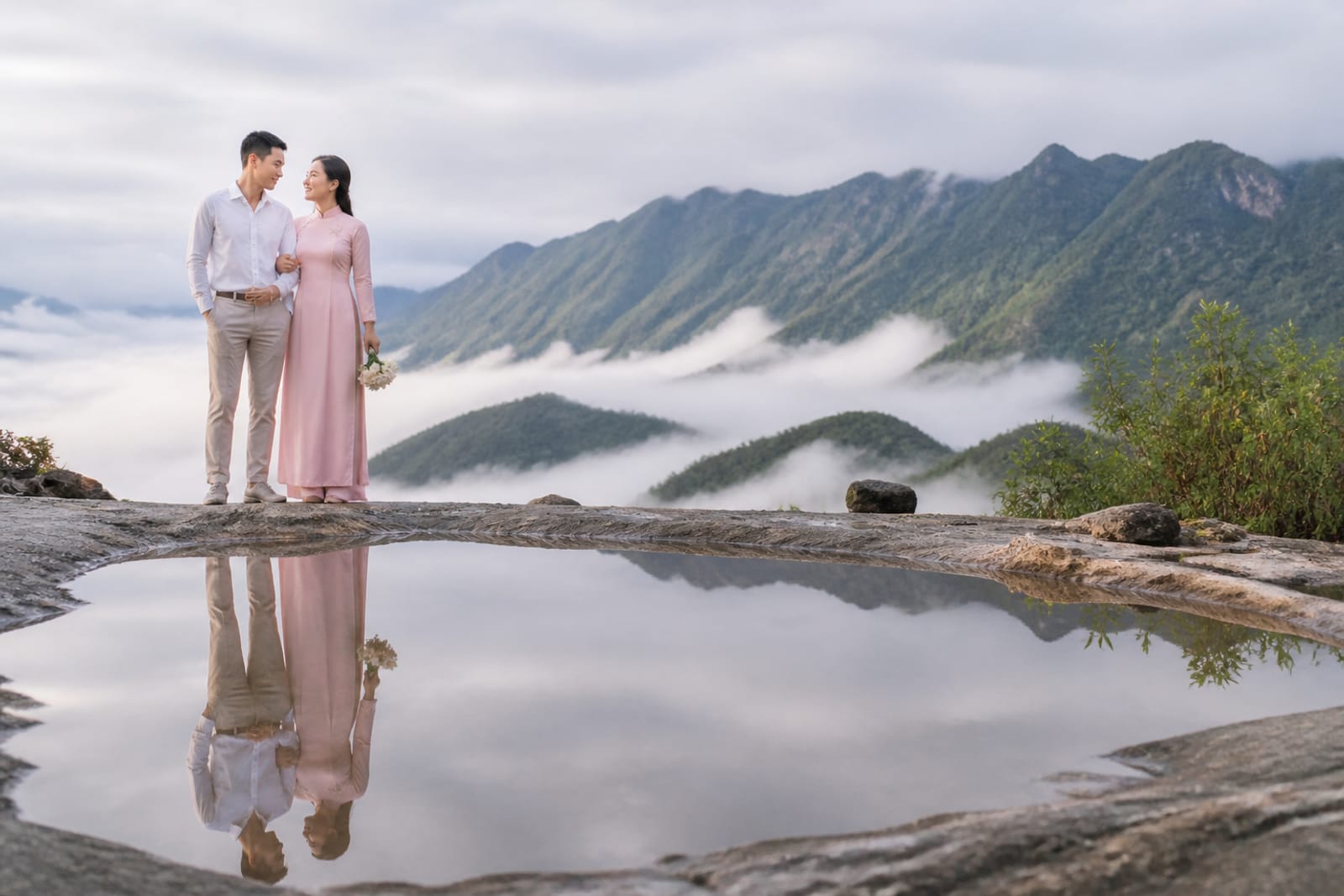
For ao dai, the altitude and wind create real challenges. Heavy, pleated silk reads stiff in stills; lightweight, flowing fabric catches every gust and billows into the frame. Structured ào dài with a fitted bodice and minimal pleat movement handles wind better. Pale colours (cream, white, soft pink) read clean against rock and sky; deep jewel tones can disappear into shadow if the light turns flat.
📸 Book on WhatsApp — ao dai photoshoot | 💄 Makeup & hair at your hotel | 🌸 Ideas & lookbook
Best months and light conditions: how to read the forecast
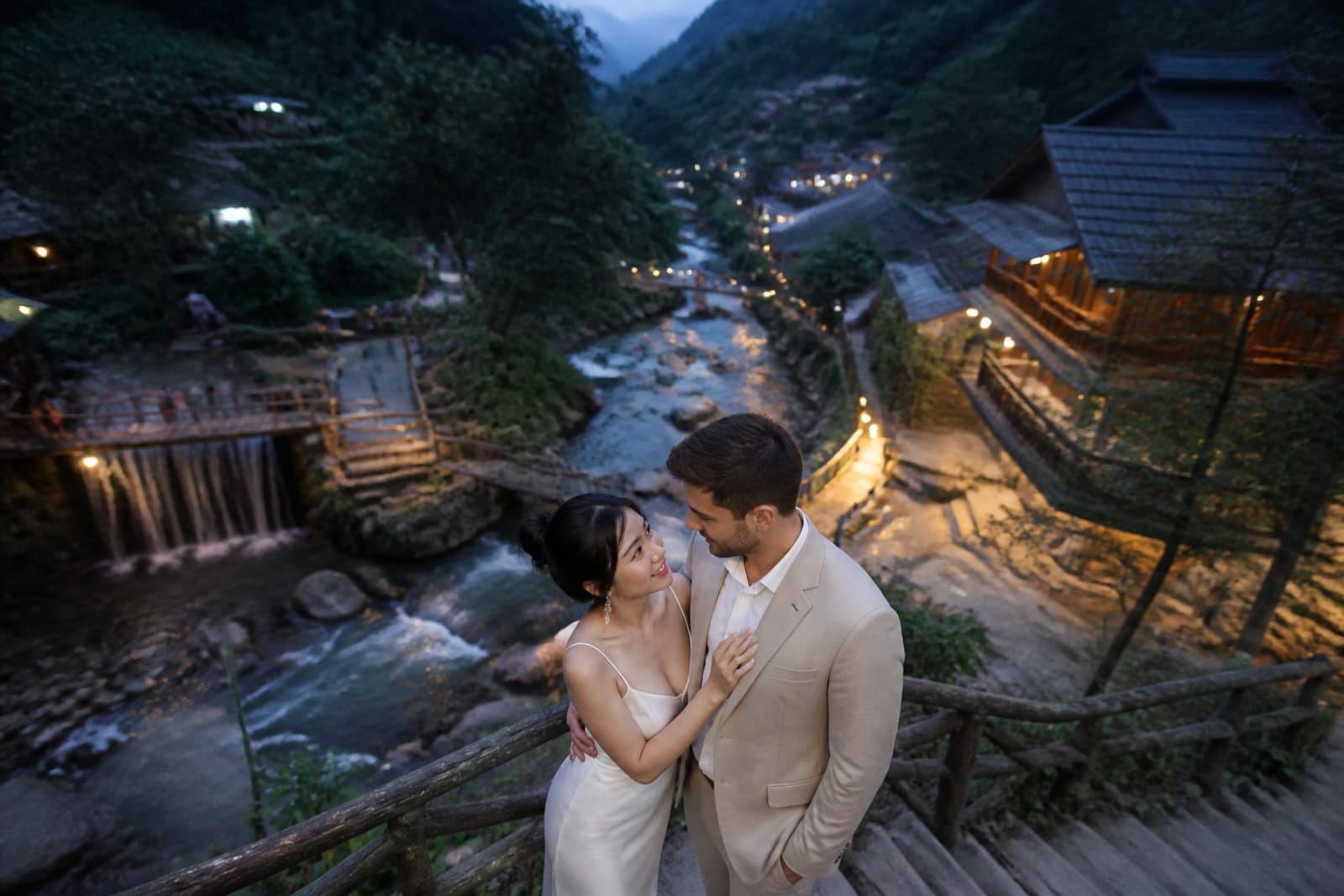
The dry season at O Quy Ho runs March–May and October–November, with October typically the clearest. During these windows, mornings often start grey (00:00–07:00 cloud cover), clear by 08:30–09:00, then cloud over again by 14:00. Mid-morning (09:00–11:30) is the most reliable window for side light; late afternoon (16:00–17:30) works if clouds break, adding warm tone across the dress and skin.
Summer (June–September) brings regular afternoon rain—showers typically start 14:00–16:00, last 30–60 minutes, then clear. Sessions after rain catch dramatic light but wet rock becomes slippery; paths are unsafe. Winter (December–February) is unpredictable: the pass can be clear, socked in grey for days, or icy after overnight frost. January–February also overlaps with Tet (Lunar New Year), when many local guides and drivers go home for several days.
Forecast reading matters more here than any other location. A 24-hour mountain forecast (e.g. Windy.com for altitude-specific data, or check with your driver-guide the evening before) tells you whether 08:00 will be clear or white. If the forecast shows low cloud for three consecutive days, reschedule; the pass is grey, and ao dai fabric becomes a grey smudge in a grey photo.
Sunrise at O Quy Ho is roughly 06:00–07:00 Oct–March and 05:15–05:45 April–September. Couples choosing a dawn session must start the drive by 04:00 from Ha Giang City (30–45 minutes uphill). Early light is softer, but roads are empty and the sky often clear—trade sleep for frames you won't repeat.
How to find and vet a local photographer for O Quy Ho
Cáo Studio does not operate in Ha Giang Province. Your options are:
Local guides with photography skills. Ha Giang tourism offices and guesthouses in Ha Giang City can recommend driver-guides who carry a camera. They know weather patterns, safe stopping points, and how to work with rangers. They are not full-time photographers; image quality varies. Ask to see 10–15 past couple sessions (ao dai specifically) shot at high altitude, in both clear and cloudy light. If they only show mountain landscapes or solo travellers, they may not understand how fabric, skin and fabric move in wind and altitude light.
Regional pre-wedding photographers. Search Instagram for "Ha Giang pre-wedding" or "Ha Giang ao dai shoot" and filter by accounts that post location tags and dates. Message photographers directly; ask if they have O Quy Ho experience and whether they own or rent appropriate lenses for mountain work (wide-angle for landscape context, 50–85mm for detail of dress and expression). Request a sample gallery shot in poor weather (grey cloud, rain-clearing light) as well as clear days—anyone can frame a couple in sunshine, but directing movement and fabric in flat light is the harder skill.
What to ask a photographer before booking:
- Where do you park or anchor for a multi-hour session? (Honest answer: "At a safe pull-off known to local rangers" or "We hike to a ridge 20 minutes uphill.")
- How do you handle wind with ao dai? (Expect: "I bring clips and a dresser to manage folds" or "I position fabric before each shot and coach you on walking into the wind.")
- What happens if cloud cover is solid by 10:00? (Bad answer: "We shoot anyway in grey light." Good answer: "We reschedule or move to a lower-altitude location nearby.")
- How long is a typical session, and how many edited frames do we get? (Confirm; agree in advance. Never agree to undefined deliverables.)
- Do you have liability insurance? (For work on a mountain pass, this matters; confirm.)
| Photographer type | Best for | Light handling | Mountain experience |
|---|---|---|---|
| Driver-guide + camera | Budget, local knowledge, transport included | Variable (depends on photography skill) | High—knows road, weather, rangers |
| Regional pre-wedding pro | Polished frames, artistic direction | Trained to work in any light | Medium—may not know O Quy Ho specifics |
| Cáo Studio (Hanoi or Saigon base) | Only if you also want a Hanoi/HCMC session or styled outfits/makeup | Directional, light-focused, cinema-style | Not applicable—O Quy Ho outside service area |
Outfit choice: ao dai fabric, fit and wind tolerance
The wind at O Quy Ho is relentless, especially 11:00–14:00. A properly chosen ao dai reads elegant and moves with intention; a poorly chosen one tangles around your legs or billows into your face.
Fabric weight. Lightweight silk or cotton-silk blend (typical for spring/summer) catches every breeze and reads chaotic. Medium-weight silk with structure (often used for autumn/winter ao dai) holds shape and moves as one unit. If you rent an ao dai in Ha Giang, ask the rental shop which pieces they recommend for outdoor, windy shoots. Avoid heavily pleated skirts; prefer smooth or minimal-pleat cuts that drape rather than flutter.
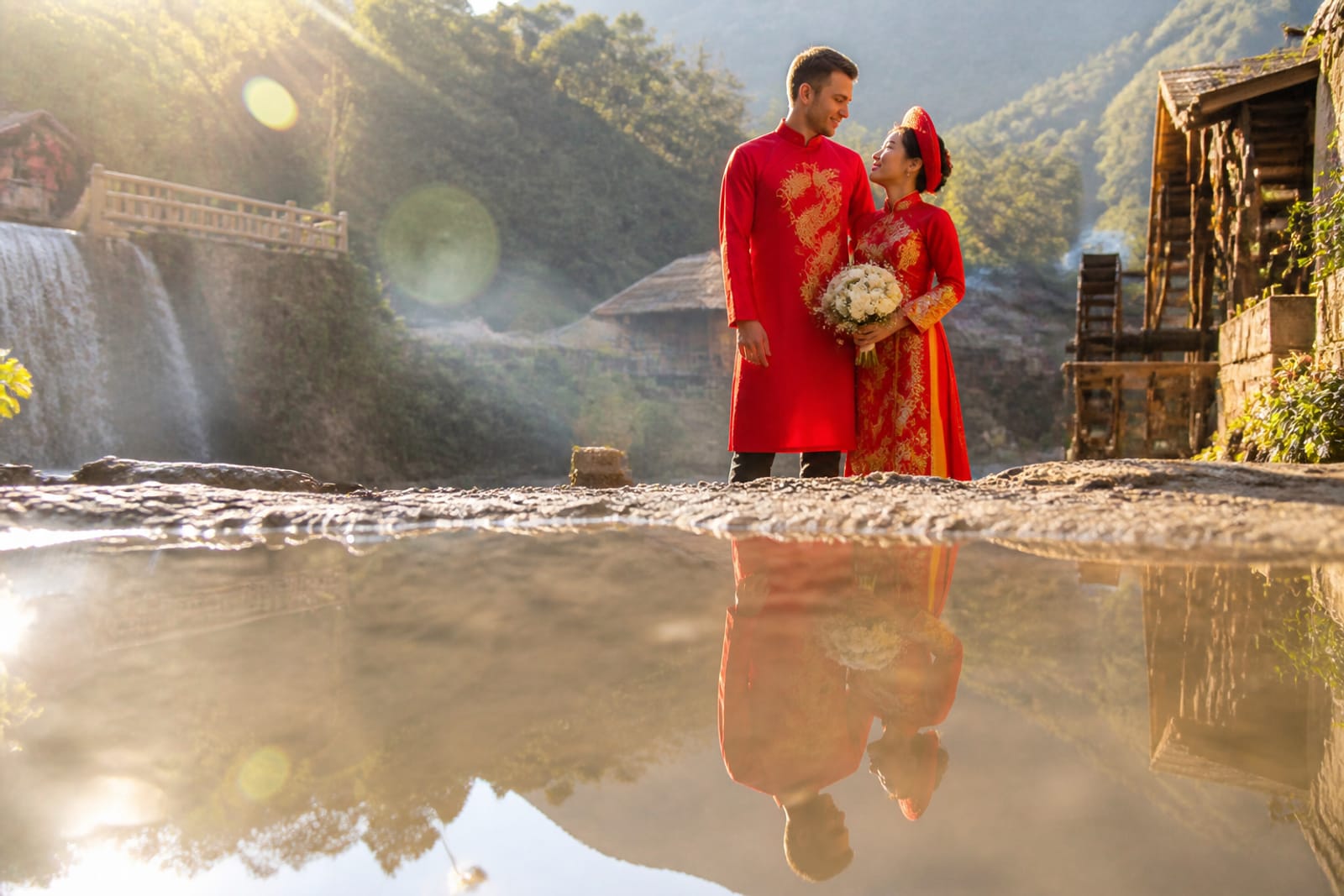
Colour. The rock, sky, and thin air at altitude shift how colours read. Cream, off-white, soft pastels (pale pink, sage green, soft blue) photograph clearly against stone and sky. Deep burgundy, navy or black can merge with rock shadow if the light is overcast. If you love dark tones, pair with a light top or a silk shawl to break the colour mass. Consider how your skin tone reads against your choice; ask your photographer for test frames before you commit to hours in one colour.
Fit and movement. An ao dai that fits snugly at the waist and chest won't twist or gap in wind. Loose-fitting ao dai look relaxed in still air but read unstable on film at altitude. A fitted bodice, smooth front panel, and a skirt with enough room to walk naturally (roughly three fingers of give at the thigh) is the sweet spot.
Layers underneath. Mountain air at 1,500 metres is 8–10 °C cooler than valley floor. Wear a long-sleeved base layer (cotton or thermal) under your ao dai for warmth and to prevent wind chill from reading as goosebumps or tension in your frame. Your photographer will direct you on what shows in the final crop; the base layer stays hidden but keeps you mobile and comfortable enough to walk, turn, and hold a pose for multiple angles.
📸 Book on WhatsApp — ao dai photoshoot | 💄 Makeup & hair at your hotel | 🌸 Ideas & lookbook
Logistics, timing and what to pack: a practical checklist
An O Quy Ho session is not a quick stop. Budget for a full day: 03:30–04:00 pick-up from Ha Giang City, 45–50 minute drive uphill, 90 minutes–2 hours on location, descent and return by 17:00. Start early to catch morning light and finish before afternoon rain or cloud build-up.
What to bring:
- Thick fleece or down jacket (for the pass; remove before shooting, keep it out of frame)
- Sturdy walking shoes or boots (wear to the location, change into ao dai shoes on-site)
- Sunscreen and lip balm with UV (altitude intensifies burn; reapply after each touch-up)
- Lip colour and powder (makeup fades fast in thin air; bring touch-up supplies)
- A large silk scarf or shawl (doubles as a prop, a wind break, and warmth between shots)
- Water (1.5–2 litres per person; altitude can cause mild dehydration)
- Snacks (energy bar, fruit; prevents dizziness and keeps mood stable during a long morning)
- Plastic bags for wet gear (if cloud clears after rain, mud and spray happen)
Timing specifics:
- 03:30–04:00 — Pick-up at your Ha Giang hotel
- 04:45–05:15 — Arrive at pass; photographer scopes light
- 05:30–07:00 — First light frames (if dawn chosen); often grey, then clearing
- 07:00–09:00 — Walk to location, settle into poses, shoot wide angles
- 09:00–11:00 — Main session: medium and detail frames as light improves
- 11:00–12:00 — Optional extended session if light remains clear; often clouds build
- 12:00–13:00 — Break, change of outfit or location (optional)
- 13:00–14:00 — Afternoon session if cloud clears; usually risky (rain or flat light by 14:30)
- 14:00 — Begin descent to avoid afternoon rain and fading light
Cost factors (do not request or expect quoted prices here; ask your photographer): number of outfits (one ao dai vs. two); whether you rent locally or bring your own (rental is simpler; delivery to pass is rare); guide fees (included with driver, separate if you hire a photographer only); transport (shared ride cheaper than private); date (peak Oct–Nov costs more); turnaround time for edited files (faster delivery often costs more).
Avoid these mistakes:
- Booking a dawn session without a local guide who knows access (rangers may stop you before 06:00)
- Wearing loose ao dai or heavy, stiff fabrics (reads messy in wind)
- Shooting in heavy cloud and expecting "moody" frames to look as good as clear-sky shots (they won't)
- Scheduling late afternoon as your main window (cloud and rain almost always arrive by 15:00)
- Forgetting layers (wind chill and sun exposure at altitude are severe; you'll look tense or squinting)
Cáo Studio + O Quy Ho: what's possible and what's not
Cáo Studio (based in Hanoi and Ho Chi Minh City, with team presence in Hoi An by appointment) does not operate in Ha Giang Province. If you are planning a couple photoshoot and want Cáo Studio's team—one director handling outfit, hair, makeup and camera—that shoot must happen in Hanoi, Ho Chi Minh City, or Hoi An.
What you could do instead:
If O Quy Ho is one part of a longer Vietnam trip, split your photoshoot. Book a local photographer for the O Quy Ho session (using the vetting guide above), then book Cáo Studio for a couple photoshoot in Hanoi or Saigon. This way, you get a mountain location with local expertise and a styled, directed session with Cáo Studio's team—two different aesthetics, two keepsake galleries.
If you want a comprehensive pre-wedding or elopement narrative, Cáo Studio's pre-wedding package documents a full day in one location (Hanoi, HCMC, or Hoi An). You could combine that with a separate mountain session booked locally—common for couples who want both intimate city frames and landscape drama.
For makeup and hair preparation before your O Quy Ho session, if you're staying in Hanoi or HCMC, Cáo Studio offers hotel-based makeup and hair services. You arrive ready; your local photographer shoots; Cáo Studio's artists ensure your look photographs cleanly even in altitude and wind.
📸 Book on WhatsApp — ao dai photoshoot | 💄 Makeup & hair at your hotel | 🌸 Ideas & lookbook
---
What to check before you book an O Quy Ho session
1. Weather forecast and flexibility. Confirm with your photographer whether a multi-day forecast (72 hours out) is binding. Mountain weather changes fast; a "we'll reschedule if it's solid grey" clause is standard and honest.
2. Photographer's portfolio. Look for 10–15 images shot on the pass itself, in both clear and overcast conditions. Ask for the dates and times; this tells you they understand seasonal windows.
3. Ao dai rental or ownership. If renting in Ha Giang, ask the shop to deliver to your hotel the evening before; collect shoes and accessories at the same time. If you bring your own ao dai, transport it in a garment bag and try it on the morning of to check fit in mountain air.
4. Transportation and access. Confirm parking location, walk-in distance, and whether your session time overlaps with tour groups. Early morning (before 07:00) is emptier; mid-morning can have crowds.
5. Edited file count and timeline. Agree in advance: how many edited images, in what format, by what date. Written confirmation (WhatsApp message or email) prevents mismatches.
6. Insurance and safety. Ask if your photographer carries liability insurance. Mountain work is inherently riskier; a professional will have coverage.
---
If you're also shooting in Hanoi or HCMC: how to combine sessions
Many couples split their photo story: one session in a city with Cáo Studio, one in the mountains with a local guide. This works because the two aesthetics complement each other—urban, intimate framing from Cáo Studio's director and a landscape-driven, location-focused session at O Quy Ho or similar peaks.
If you want to book a Cáo Studio session alongside your mountain work, explore the ao dai photoshoot options or couple photoshoot page. Cáo Studio also publishes a lookbook showing outfit and light combinations in Hanoi, which can inspire your O Quy Ho outfit choice as well. For a family inclusion or multi-generational shoot, family photoshoot is available in Hanoi or HCMC.
Reach out on WhatsApp for a quote and to confirm your Hanoi or HCMC dates; Cáo Studio will coordinate timing around your mountain session if that's helpful.
FAQ
Is O Quy Ho Pass open year-round for couple photoshoots?
The pass itself is open, but winter (Dec–Feb) brings fog, ice risk, and frequent closures. The best windows are March–May and October–November. Always check a 24-hour weather forecast and confirm access with your local photographer or driver-guide before setting out.
Can I shoot directly on the road at O Quy Ho Pass without permission?
The pass is a transit route managed by local rangers. Brief stops for photos are tolerated; extended sessions require a local guide or driver familiar with ranger protocols. Shooting without a guide risks being moved or fined. Always hire someone who knows the protocol.
What's the difference between hiring a driver-guide with a camera versus a dedicated photographer?
A driver-guide includes transport and knows the location intimately; quality depends on their photography skill. A dedicated photographer has stronger direction and editing but may not know logistics. A hybrid—driver-guide with real photography experience—is often best; ask to see their portfolio first.
How do I know if an ao dai will work in mountain wind?
Medium-weight silk, a fitted bodice, and a smooth skirt (minimal pleats) are safest. Ask the rental shop which pieces handle outdoor, windy shoots. Avoid loose, heavily pleated designs. Pale colours read more clearly than very dark ones against rock and sky.
What's the real turnaround time for edited images from a local Ha Giang photographer?
Turnaround varies. Establish in writing before you book: is it 3 days, 1 week, 2 weeks? Express delivery (48 hours) usually costs more. A typical turnaround is 5–7 business days. Confirm format (digital files, print options, copyright) in advance.
Can Cáo Studio shoot at O Quy Ho Pass?
Cáo Studio does not operate in Ha Giang Province. Use this guide to book a local photographer for O Quy Ho. If you want a Cáo Studio session, book in Hanoi, Ho Chi Minh City, or Hoi An. You can combine a local mountain shoot with a Cáo Studio session in a city—two different locations, two keepsake galleries.
Najczęstsze pytania
Is O Quy Ho Pass open year-round for couple photoshoots?
The pass itself is open, but winter (Dec–Feb) brings fog, ice risk, and frequent closures. The best windows are March–May and October–November. Always check a 24-hour weather forecast and confirm access with your local photographer or driver-guide before setting out.
Can I shoot directly on the road at O Quy Ho Pass without permission?
The pass is a transit route managed by local rangers. Brief stops for photos are tolerated; extended sessions require a local guide or driver familiar with ranger protocols. Shooting without a guide risks being moved or fined. Always hire someone who knows the protocol.
What's the difference between hiring a driver-guide with a camera versus a dedicated photographer?
A driver-guide includes transport and knows the location intimately; quality depends on their photography skill. A dedicated photographer has stronger direction and editing but may not know logistics. A hybrid—driver-guide with real photography experience—is often best; ask to see their portfolio first.
How do I know if an ao dai will work in mountain wind?
Medium-weight silk, a fitted bodice, and a smooth skirt (minimal pleats) are safest. Ask the rental shop which pieces handle outdoor, windy shoots. Avoid loose, heavily pleated designs. Pale colours read more clearly than very dark ones against rock and sky.
What's the real turnaround time for edited images from a local Ha Giang photographer?
Turnaround varies. Establish in writing before you book: is it 3 days, 1 week, 2 weeks? Express delivery (48 hours) usually costs more. A typical turnaround is 5–7 business days. Confirm format (digital files, print options, copyright) in advance.
Can Cáo Studio shoot at O Quy Ho Pass?
Cáo Studio does not operate in Ha Giang Province. Use this guide to book a local photographer for O Quy Ho. If you want a Cáo Studio session, book in Hanoi, Ho Chi Minh City, or Hoi An. You can combine a local mountain shoot with a Cáo Studio session in a city—two different locations, two keepsake galleries.