/pre-wedding-photoshoot
How to Avoid Crowds at Ta Phin Village on Your Wedding Photo Day
Ta Phin village (northwest Vietnam, Sapa district) fills with day-trippers between 9 am and 3 pm; shoot before 7:30 am or after 4:30 pm to find empty terraces. Avoid Tet holidays and weekends if possible—even early light won't guarantee solitude then. A directed pre-wedding photoshoot with a local-based team (like Cáo Studio's partners in the north) means your photographer knows which exact terrace catches first light, which paths tourists skip, and how to compose frames so crowds blur to irrelevance. Plan the session 2–3 weeks ahead; confirm weather windows with your team, since Sapa's climate shifts fast. Wear an ao dai or light outfit suited to the terrain—heavy fabric and heels sink in wet earth. The payoff: frames that feel like you alone discovered the place. 📸 Book on WhatsApp — pre-wedding photoshoot --- #
What time of day actually keeps Ta Phin empty for your shoot?
Daylight at Ta Phin splits into three windows. Before 7:30 am, terraces are empty—mist still clings to the valley, light is soft and directional, and the only sounds are birds and water. Between 8 am and 3 pm, tour buses arrive in waves; even off-season you'll share the path with 20–50 other visitors. After 4:30 pm, buses leave, light turns golden, but you have maybe 90 minutes before dusk falls hard. A pre-wedding photoshoot team worth booking knows this rhythm by heart and will shoot you at the exact hour that balances empty space with shootable light—usually 5:50–6:50 am or 5:15–6:15 pm depending on the season.
Early morning requires a 4:30 am start from your Sapa hotel; late afternoon means a 3:30 pm departure. Factor in the 45-minute drive each way and the 30–45 minutes you need on-site to move between terraces. Your photographer should scout the location on their calendar—not on your shoot day. Ask on WhatsApp whether your chosen team has a preferred time window and whether they've shot Ta Phin in the season you're planning.
Which season and weather window gives you both empty terraces and good light?
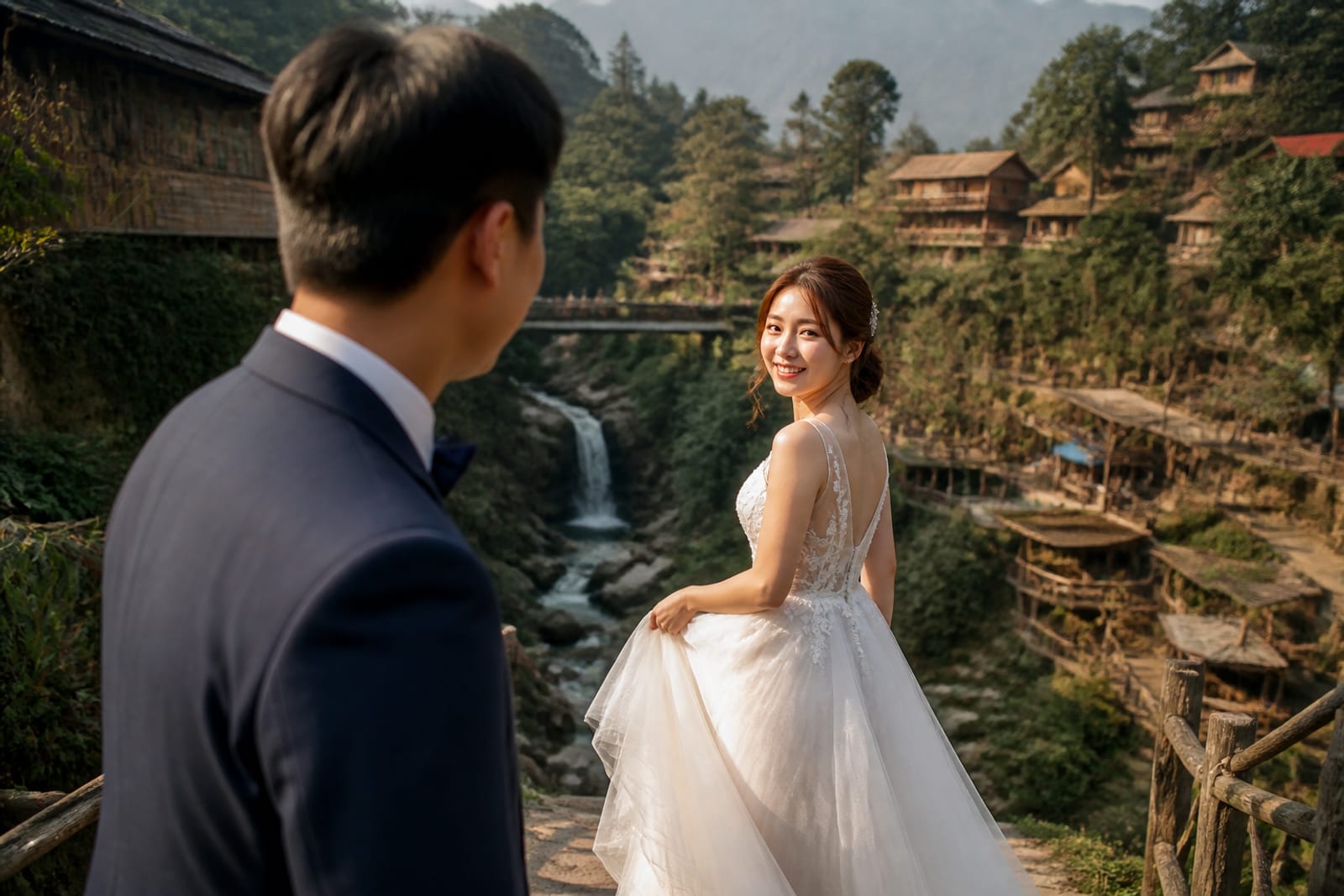
Ta Phin's landscape and crowd density shift dramatically by month. Rice terraces are green and water-filled June–August, golden and ripe mid-September to early October, and brown November–April. The clearest, safest weather runs March–May and September–November; December–February bring fog that can obliterate the view by 8 am, and June–August are hot with afternoon rain.
The crowds peak during these periods: Tet (late January–mid February), Easter school holidays, and June–August domestic tourism. The goldest light and emptiest paths align best in late March–April and late September–mid October—but only if you shoot before 7 am or after 5 pm.
A pre-wedding photoshoot team based in Hanoi or Sapa will know which exact week in your season offers the lowest tourist flow and the most stable weather. When you inquire on WhatsApp, ask them to recommend a 3–5 day window rather than a fixed date—that flexibility lets them chase the light and avoid crowds simultaneously.
How does outfit choice affect your movement through packed terraces?
Your ao dai or wedding dress must fit the terrain. Ta Phin's paths are uneven, often muddy after rain, and narrow enough that passing tourists creates collision points. A traditional ao dai works beautifully if it's tailored to allow stride length—not a ball-gown silhouette. If you're wearing a Western wedding dress, the train will drag in mud; consider renting a shorter dress or a two-piece, or carry the train during walking scenes.
Shoes matter as much as fabric. Heels sink and break; wet earth swallows them. A pre-wedding photoshoot coordinator will advise you to bring two pairs: lightweight hiking shoes or ballet flats for walking between frames, and the shoes you want in final close-up shots. Makeup and hair must be waterproof and sweat-resistant—mist and humidity are relentless at 1,600 m altitude.
Consider renting your ao dai locally if you're traveling light; Sapa has rental shops. Ask your photographer team whether they can coordinate makeup and hair at your hotel in Sapa before the shoot—that way you're ready and don't rush through the session changing clothes.
What's the real difference between shooting Ta Phin on your own versus hiring a directed team?
| Approach | Best for | Light/Terrain Challenge | Why It Works |
|---|---|---|---|
| Self-guided (phone camera, tablet tripod) | Engagement rings, casual snaps, no budget | You chase light; missed the golden hour before 7:30 am. Strangers in frames. | Free, but images feel like tourist snapshots. Crowds ruin depth. |
| Local tourist photographer (walk-in hire in Sapa) | Last-minute sessions, no planning | They have spots but no scouting. Crowd avoidance = luck. | Affordable and quick, but you'll share the terrace with other couples. |
| Pre-wedding photoshoot (Cáo Studio or partner) | Narrative couple frames, editorial light, keepsakes | Photographer scouts beforehand; directs you to walk, look, move—not pose. Light is predicted and timed. | You move alone through the landscape. Frames tell a story, not just show the place. Edited, delivered in 48 hours. |
The gap is directional intent. A walk-in photographer frames what's there; a directed team creates what wasn't yet visible—they tell your photographer partner to look at each other while walking into the light, not at the camera. That's the difference between "we visited Ta Phin" and "we became part of Ta Phin."
A directed pre-wedding photoshoot also means one team handles outfit, hair, makeup and the camera—no coordination headaches with three vendors. Cáo Studio's northern partners operate on this model; ask on WhatsApp whether they cover Sapa or can recommend a trusted local team with the same approach.
Can you really have your frames alone if you're shooting on a weekend or Tet?
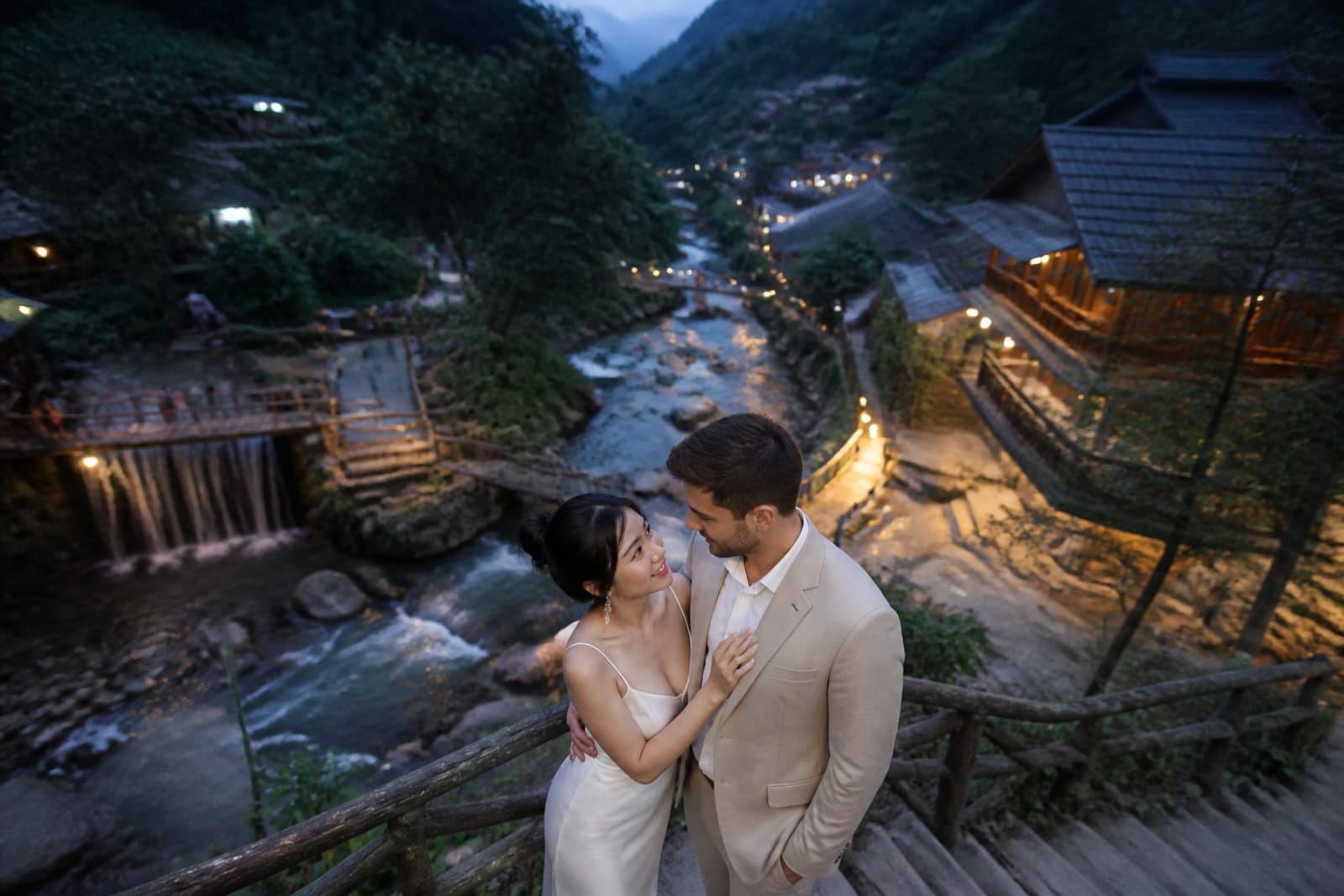
No. Even 5:30 am on a Saturday in September will have 8–12 other visitors if it's a holiday. Tet (late January–mid February) closes many services and triples visitors for 2–3 days. If your dates are fixed around a holiday, accept that strangers will appear in wide shots; ask your photographer to focus on medium and detail frames—close-ups of your hand, the ao dai, your face in the side light—where other people don't intrude.
If you have flexibility, shift your wedding photoshoot away from school holidays and Tet. A pre-wedding photoshoot team will be honest: they'll tell you "we can't guarantee empty terraces on that date—here's a date two weeks later when light and crowds align better." That honesty is worth more than a promise they can't keep.
Wednesday to Friday are quieter than weekends. Early May and late October are goldest and emptiest. Ask your coordinator to flag the best 7-day window in your season; then book that, not a fixed date.
How do you verify your photographer actually knows Ta Phin before shoot day?
Before you commit, ask these questions on WhatsApp:
- Have you shot Ta Phin in [your month]? Can you show 3–5 sample frames?
- What time do you recommend for light and crowds on [your dates]?
- Which terrace do you shoot first, and why?
- If weather turns foggy by 7 am, what's the backup location?
- Do you scout beforehand, or show up on shoot day?
A photographer who hesitates, shows generic Sapa images, or says "we'll figure it out on the day" is not a directed team. Cáo Studio's pre-wedding photoshoot model includes a planning call—you'll discuss light, outfit, mood and exact timing. If you're booking outside Cáo Studio, ask for the same rigor.
Check their lookbook. If all their Ta Phin frames are shot at midday (harsh shadows, crowded paths), they don't have the craft. Real pre-wedding photographers show frames at golden hour, with clear direction—the couple walking, not posing; terraces receding behind them, not framing them like monuments.
---
What to check before you book
- Location scouting: Photographer has shot Ta Phin at least once in your season. Ask for proof (frames, not promises).
- Timing flexibility: Team commits to an optimal light hour (5:30–7:15 am or 5:00–6:30 pm), not a fixed time you choose.
- Weather backup: If fog rolls in, what's the second location? (Many teams pivot to nearby Tac Ba lake or Silver Waterfall.)
- Outfit coordination: They advise on ao dai fit, heel height, and waterproofing—not leave it to you.
- Delivery timeline: How many edited frames do you receive, and when? Cáo Studio delivers within 48 hours; confirm your team's standard.
- Crew size: One photographer and a hair/makeup artist, or a convoy? Smaller teams move faster and stay less intrusive.
---
For a pre-wedding photoshoot beyond Sapa, Cáo Studio covers Hanoi, Ho Chi Minh City, and Hoi An. Ask on WhatsApp about partners in northern Vietnam for Sapa and Ta Phin sessions. If you're planning a full wedding day, explore wedding day photography and wedding video services. For a broader couple photoshoot in Hanoi or Saigon before your ceremony, book a directed session that applies the same light-first, directed-not-posed discipline to urban or coastal backdrops.
---
#
FAQ
What's the earliest I can start shooting at Ta Phin without it being pitch dark?
Between 5:30 and 6:00 am (depending on season), there's enough ambient light to shoot. A directed photographer will have a light meter and know the exact minute when the sun clears the eastern ridge and hits the terrace. Arrive 30 minutes before your planned first frame to position yourself.
If I book a pre-wedding shoot in Hanoi or Saigon, can Cáo Studio shoot Ta Phin for me?
Cáo Studio operates in Hanoi, Ho Chi Minh City, and Hoi An. For Sapa and Ta Phin, ask on WhatsApp—we may recommend a vetted local partner. If you want a full pre-wedding photoshoot package with makeup and hair coordination, our northern team can advise whether they cover Sapa or help you vet a local photographer.
Can I wear a traditional Western wedding dress at Ta Phin, or does it have to be an ao dai?
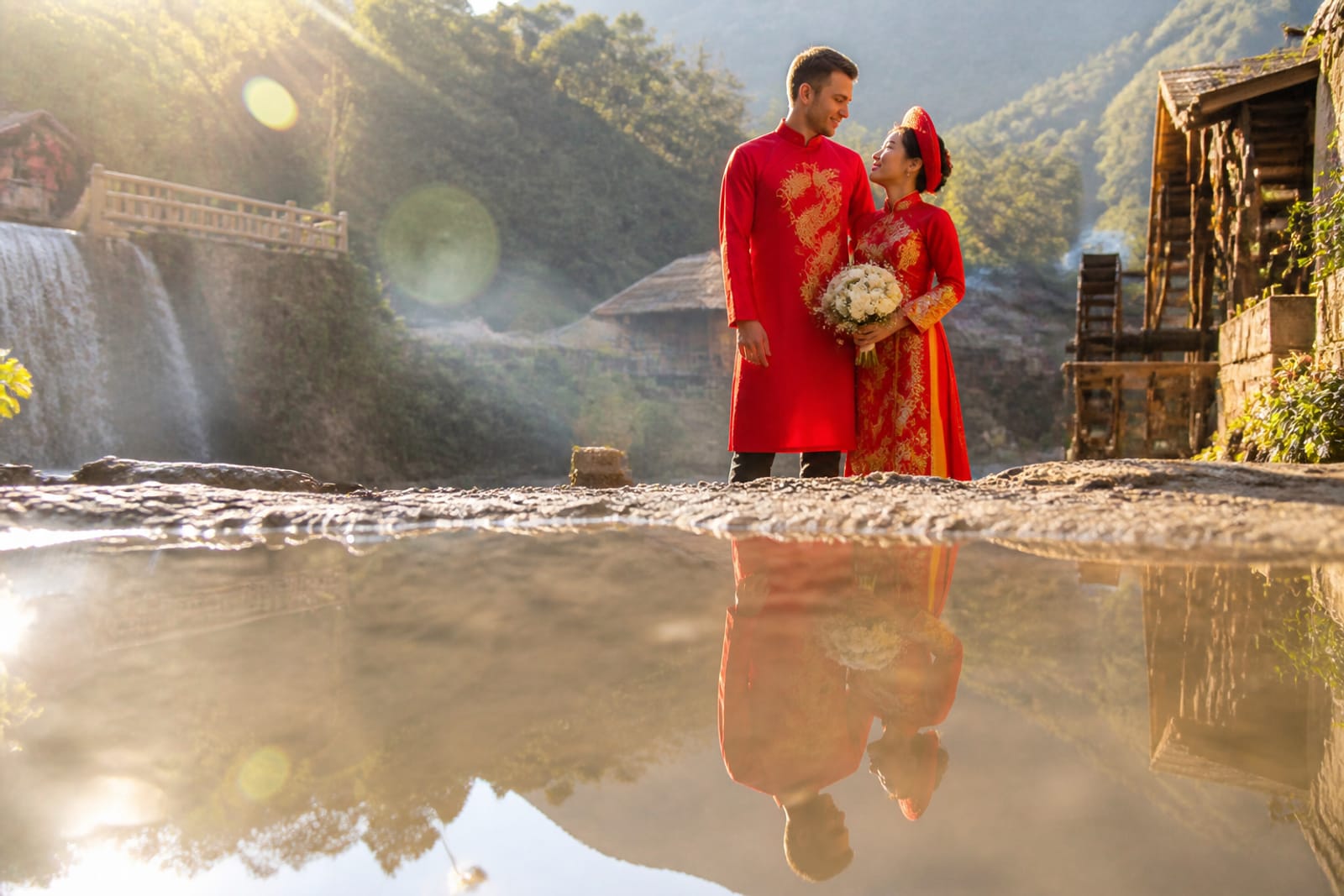
Either works. A full ball-gown train will drag in mud and slow your movement; a dress with a detachable train or a two-piece is practical. Many couples wear an ao dai for Ta Phin—it's lighter, allows stride, and honors the Sapa landscape visually. A pre-wedding photoshoot team will help you choose based on light, terrain and story.
Do I need a permit to shoot at Ta Phin, or is it open for couples?
Ta Phin village itself is open to visitors year-round. Check locally with your hotel or photographer team for any access restrictions or entry practices; regulations can shift. There's no formal permit for couple photos, but be respectful of local people and their homes during your shoot.
How many edited frames do I get from a Ta Phin pre-wedding shoot, and how long does editing take?
That depends on your package and photographer. Cáo Studio delivers edited photos within 48 hours; ask your northern partner or local team for their timeline. Typical pre-wedding photoshoot sessions deliver 40–80 edited frames. Confirm the exact count on WhatsApp before you book. 📸 Book on WhatsApp — couple & family photoshoot
FAQ
What's the earliest I can start shooting at Ta Phin without it being pitch dark?
Between 5:30 and 6:00 am (depending on season), there's enough ambient light to shoot. A directed photographer will have a light meter and know the exact minute when the sun clears the eastern ridge and hits the terrace. Arrive 30 minutes before your planned first frame to position yourself.
If I book a pre-wedding shoot in Hanoi or Saigon, can Cáo Studio shoot Ta Phin for me?
Cáo Studio operates in [Hanoi](/hanoi), [Ho Chi Minh City](/saigon), and [Hoi An](/hoi-an). For Sapa and Ta Phin, ask on WhatsApp—we may recommend a vetted local partner. If you want a full [pre-wedding photoshoot](/pre-wedding-photoshoot) package with makeup and hair coordination, our northern team can advise whether they cover Sapa or help you vet a local photographer.
Can I wear a traditional Western wedding dress at Ta Phin, or does it have to be an ao dai?
Either works. A full ball-gown train will drag in mud and slow your movement; a dress with a detachable train or a two-piece is practical. Many couples wear an ao dai for Ta Phin—it's lighter, allows stride, and honors the Sapa landscape visually. A [pre-wedding photoshoot](/pre-wedding-photoshoot) team will help you choose based on light, terrain and story.
Do I need a permit to shoot at Ta Phin, or is it open for couples?
Ta Phin village itself is open to visitors year-round. Check locally with your hotel or photographer team for any access restrictions or entry practices; regulations can shift. There's no formal permit for couple photos, but be respectful of local people and their homes during your shoot.
How many edited frames do I get from a Ta Phin pre-wedding shoot, and how long does editing take?
That depends on your package and photographer. Cáo Studio delivers edited photos within 48 hours; ask your northern partner or local team for their timeline. Typical [pre-wedding photoshoot](/pre-wedding-photoshoot) sessions deliver 40–80 edited frames. Confirm the exact count on WhatsApp before you book. [📸 Book on WhatsApp — couple & family photoshoot](/couple-photoshoot)
Ao dai, makeup, hair and a local photographer in Hanoi or Saigon — one WhatsApp message.