/pre-wedding-photoshoot
Sapa or Ha Giang for pre-wedding photos: which mountain region fits yo
Sapa suits couples drawn to manicured rice terraces (golden Sep, misty Dec–Feb) and a one-day shoot near Hanoi; Ha Giang works for adventurers wanting raw karst cliffs, buckwheat flowers (Oct–Nov) and a multi-day mountain loop. Both regions demand a team that travels — neither has a studio base. Cáo Studio coordinates pre-wedding shoots in both as part of a planned mountain itinerary: Sapa shoots run 5–6 hours from Hanoi; Ha Giang requires 2–3 days to move between light, elevation and your story. Light differs critically: Sapa's terraces catch side light best at dawn or late afternoon (narrow window); Ha Giang's passes and valleys stay dramatic longer, tolerating overcast conditions. Both close partially in typhoon season (Sep–Nov for the coast, but mountain rain peaks differently). Choose Sapa if you want cultivated beauty and fast turnaround; choose Ha Giang if your narrative is "we came to wander" and you have time to move. 📸 Book on WhatsApp — pre-wedding photoshoot ---
Why Sapa works better for controlled beauty and golden hour frames
Sapa's terraced rice paddies form a visual grid that stops busy compositions from feeling chaotic. The landscape is tended — edges are clear, layers stack visibly, and you can frame a story of descent or journey through fields. Light here works in blocks: early morning brings mist and soft side light (5:30–7:00 am), midday flattens the ridges, and late afternoon (4:30–6:30 pm) throws warm shadows across the steps. The downside: these windows are short, and if clouds roll in, the mood shifts fast. Travel from Hanoi takes 5–6 hours by road; most couples do a single long day. If you want ao dai or a dress that needs stillness and precision framing, Sapa's predictable terrain (wide paths between fields, set viewpoints) supports a tight shot list. The soil is muddy after rain — verify the forecast 48 hours before and wear shoes you can change out of.
Season call: Golden rice (Aug–Sep) draws crowds; misty winter (Dec–Feb) is quieter and moodier; typhoon rains (late Sep–Oct) can close mountain roads.
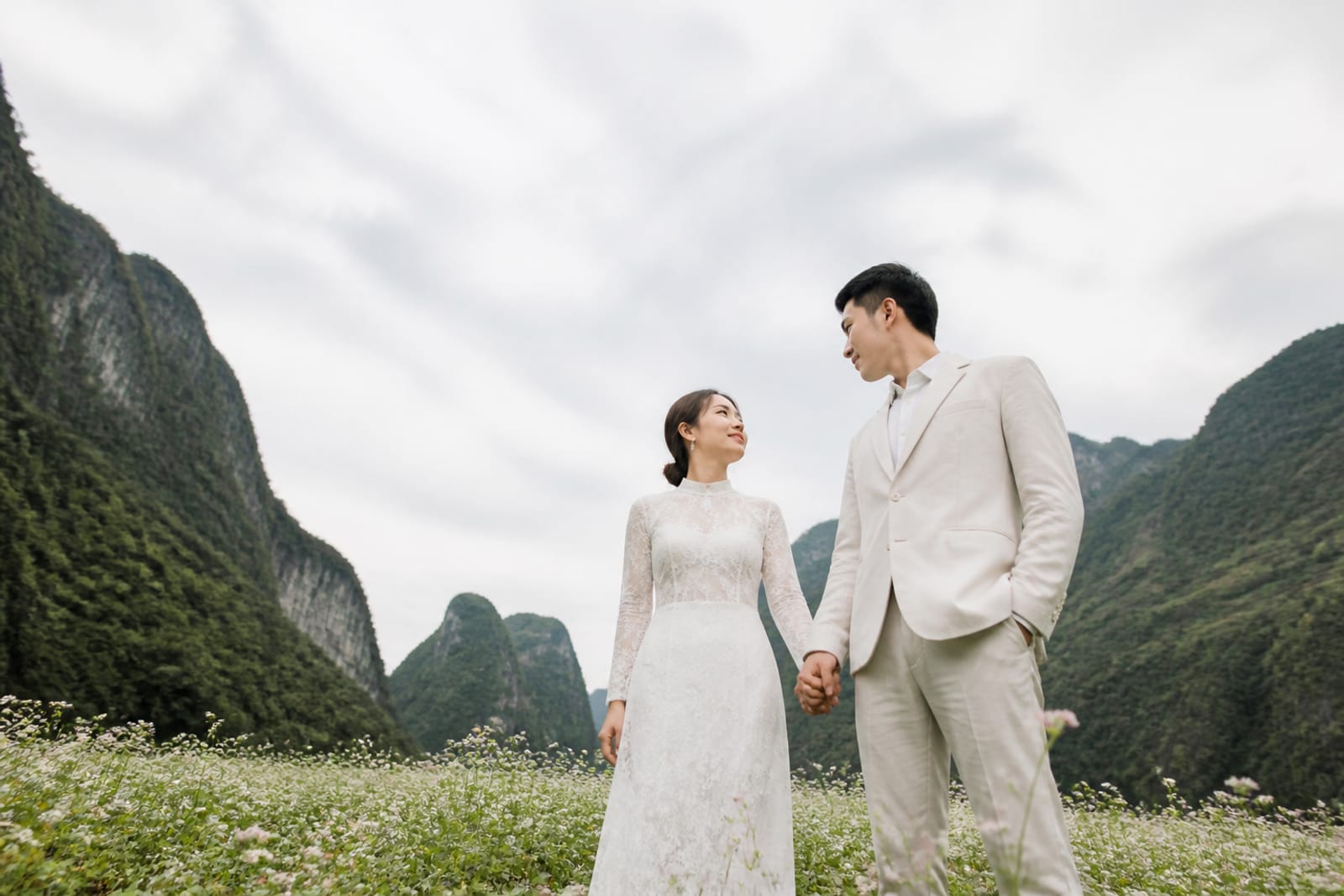
How Ha Giang's raw karst landscape tells a wilder pre-wedding story
Ha Giang Province spreads across 80+ km of limestone passes, river gorges and buckwheat fields — there is no single "Sapa-style" viewpoint. Instead, your shoot weaves through the geography: dawn on one pass, midday in a valley village, late light at a second ridge. This means the session lives in the journey itself. You walk, stop, look back. The frames feel found, not arranged. Buckwheat flowers bloom Oct–Nov (a specific, brief window); rice terraces near Hoang Su Phi go golden around Sep; winter (Dec–Feb) is cold and clear, ideal for dramatic sky. The trade: roads are long, single-lane and winding. A shoot here means a minimum 2–3 day trip, with the team traveling alongside you. Outfits and hair must tolerate road time (wind, dust, temperature swings). If you're doing an ao dai session, prepare to change in a homestay or vehicle; makeup must set for travel.
The payoff: frames that look cinematic precisely because they're not posed in a manicured space.
Season and weather: the deciding factor between the two
| Region | Best for light & mood | Best season | Risk & reality |
|---|---|---|---|
| Sapa | Golden hour reflections, misty mornings | Aug–Sep (rice ripe), Dec–Feb (mist & calm) | Rains & crowds Jun–Jul; Oct–Nov typhoon risk on roads |
| Ha Giang | Dramatic passes, long daylight, clear skies | Oct–Nov (buckwheat), Dec–Feb (crisp), Aug–Sep (green) | Roads close after heavy rain; passes get fog in winter; heat & humidity Jun–Jul |
Conclusion: Sapa's light is more predictable; Ha Giang's beauty is more weatherproof but demands flexibility. Choose Sapa if your timeline is rigid; choose Ha Giang if you can move your dates around flower blooms or road conditions.
How to evaluate travel time, outfit changes and team logistics
Sapa is a day trip — you leave Hanoi at dawn, shoot by late afternoon, return by evening or next morning. This works for one outfit (an ao dai, a dress, a suit) and minimal setup. Cáo Studio brings makeup, hair and a camera; you're mobile on footpaths. Ha Giang, by contrast, eats 2–3 days minimum. Outfit changes happen in vehicles or homestays, not in a dedicated space. Hair and makeup must survive wind and road hours. If you're renting an ao dai or groom suit, the team manages that coordination, but you'll be stepping into corners of small rooms to change. Makeup resets happen once at dawn, then touchups in the vehicle between passes. This is not a retreat-style pampered schedule — it's a creative expedition. Some couples love this rawness; others find it exhausting. Ask yourself: are you shooting in the landscape, or on top of it?
Ha Giang also means logistics with a local guide (many shoots pair with a guide-translator). Cáo Studio handles photo direction; the guide handles road, village access and translation. Confirm this on WhatsApp when booking.
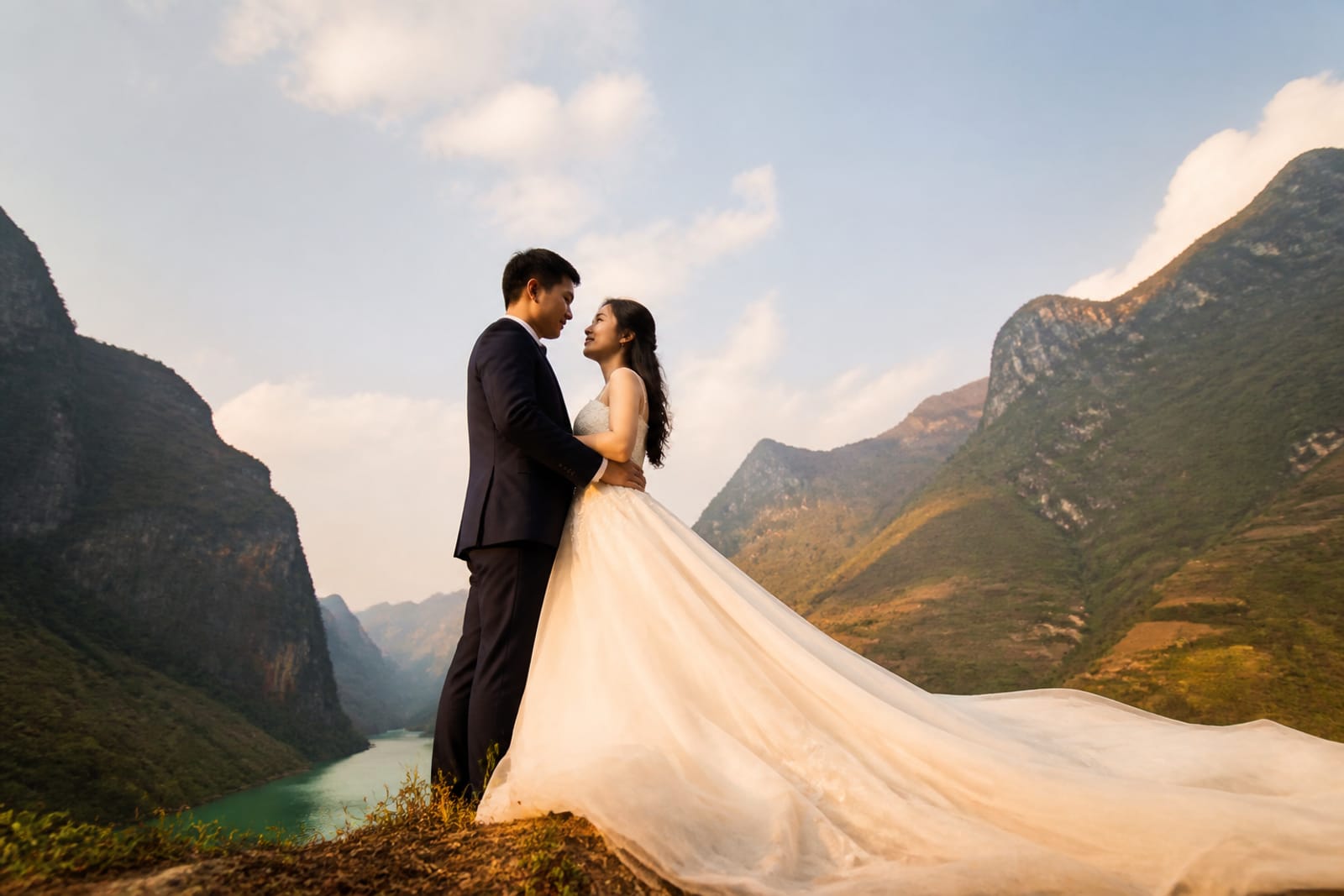
Comparing outfit choices for mountain terrain and climate
Ao dai (the traditional tunic) works in both regions, but differently. Sapa's terraces are narrow, muddy paths — a full ao dai skirt collects dirt fast, but the layers photograph beautifully in morning mist. Ha Giang's passes are rocky; a long skirt snags on thorns and makes climbing harder. Many couples doing Ha Giang wear a cropped ao dai or a modern tunic-and-trouser cut. Western dresses (A-line, wrap styles, lightweight) suit both — Sapa's soft light flatters pale fabrics; Ha Giang's dramatic sky makes darker jewel tones pop. Consider:
- Sapa: bring one full outfit + a backup top (mud splashes). Shoes must change from heels to trekking footwear.
- Ha Giang: pack practical bottoms (trousers, cropped skirt) over a groom suit or tunic. Layers are essential (temperature swings of 10°C between valleys and ridge).
- Hair: both regions have wind. Braids, buns and secured pieces hold; loose waves need spray and pins.
Check with Cáo Studio on WhatsApp about rental options for ao dai or groom suits and how the team manages changes on location.
A practical decision framework: ask yourself these questions first
- When can you travel? If your dates are fixed, check the season table above. If you have a 2–week window, Ha Giang's flowers (Oct–Nov) might align; Sapa works year-round.
- What's your fitness level? Sapa's paths are gentle descents; Ha Giang involves climbing, winding roads and altitude shifts (up to 1,500 m). Be honest about energy after a 6-hour drive.
- Do you want one mood or multiple? Sapa = one landscape, one golden hour. Ha Giang = sunrise in the north, lunch in a village, sunset on a different ridge. Which tells your story better?
- How much time for the shoot? Sapa = half a day. Ha Giang = 2–3 days integrated into your trip. Is the extra travel worth it?
- Outfit & makeup complexity? Single outfit + light makeup = Sapa's pace. Multiple changes & heavy makeup = risky in Ha Giang's heat and vehicle time.
Once you know your answers, WhatsApp Cáo Studio with your dates, location preference and story. The team will confirm feasibility, season specifics and coordination needs.
---
What to check before you commit to a mountain pre-wedding shoot
- Road conditions: Cáo Studio will ask about your dates. If there's been heavy rain, some Ha Giang passes may be impassable. This is checked 1 week before, not months ahead.
- Altitude & fitness: Ha Giang has elevations above 1,000 m. Ask yourself honestly if you'll enjoy hiking in makeup and an outfit on day 2.
- Backup dates: Mountain weather changes fast. Book with flexibility — if light fails or a road closes, the team pivots to a nearby location (a village, a different pass, a homestay garden).
- Local permits & etiquette: Sapa and Ha Giang involve minority villages. Respectful shooting (asking before entering homes, not posing on sacred sites) is built into Cáo Studio's direction. Confirm this is what you want.
- Edited turnaround: Mountain shoots mean driving back to Hanoi to edit. Expect photos ready in 48 hours after you return to the city, not the day after the shoot.
---
Explore more for your pre-wedding story
If mountains feel right, see how Cáo Studio directs other pre-wedding photoshoots in urban and coastal settings. For couples wanting ao dai, the ao dai photoshoot page shows how the team pairs outfit rentals with location. And if you're planning a wedding day itself after the pre-wedding session, read about wedding day photography and wedding video coordination. Cáo Studio's bases are in Hanoi and Saigon; mountain shoots depart from Hanoi.
📸 Book on WhatsApp — pre-wedding photoshoot | 💄 Makeup & hair at your hotel | 🌸 See the lookbook
---
FAQ
Do I need to rent an ao dai for Sapa or Ha Giang, or can I wear my own wedding dress?
Either works. Many couples rent an ao dai for the mountain day (it's practical, photograph-able and tied to place), then wear a dress for ceremonies or a second session. Cáo Studio handles rentals via ao dai rental or can coordinate suit options via suit rental. Ask on WhatsApp which works best for your dates and outfit vision.
How long does a mountain shoot take, and when do I get edited photos?
Sapa takes 5–6 hours on-location; Ha Giang spreads across 2–3 days (half-days of shooting, rest for travel and mood-setting). After you return to Hanoi, editing takes 48 hours. Exact inclusions (number of photos, edited files, video clips) are confirmed on WhatsApp when you book.
What if the weather is bad on my shoot day?
Cáo Studio reschedules if rain closes roads (Ha Giang) or visibility drops below usable levels. For Sapa, light drizzle can be moody; heavy rain shifts the shoot to the next safe day. Backup dates are discussed when you book. Mountain weather is unpredictable — flexibility is built into the service.
Can I do both Sapa and Ha Giang in one pre-wedding trip?
Geographically, they're 5+ hours apart. Possible but exhausting: Sapa one day, then a 6-hour drive north to Ha Giang for 2 days, then back to Hanoi. Most couples choose one. If you want variety, Cáo Studio can frame Sapa's terraces at different hours, or mix Ha Giang's passes with a village homestay garden for two distinct moods.
How does makeup and hair hold up during a long Ha Giang drive and outfit changes in small spaces?
Cáo Studio applies makeup at your hotel or homestay in the morning, using long-wear and waterproof products. Hair is styled for wind (braids, buns, pins). Between locations, a makeup artist touches up with powder, spray and lip tint (kept in the vehicle). Outfit changes happen in homestay rooms or vehicle privacy — the team coordinates timing so you're ready fast. It's not a salon experience, but it's organized.
Do I need a separate guide or translator for Ha Giang, or does Cáo Studio handle that?
Cáo Studio directs the shoot; many Ha Giang sessions pair with a local guide for road navigation, village access and translation. This is confirmed and coordinated on WhatsApp. The guide is separate from the photo team — they work in parallel so you move smoothly through the landscape while the photographer frames the story.
FAQ
Do I need to rent an ao dai for Sapa or Ha Giang, or can I wear my own wedding dress?
Either works. Many couples rent an ao dai for the mountain day (it's practical, photograph-able and tied to place), then wear a dress for ceremonies or a second session. Cáo Studio handles rentals via [ao dai rental](/ao-dai-rental) or can coordinate suit options via [suit rental](/suit-rental). Ask on WhatsApp which works best for your dates and outfit vision.
How long does a mountain shoot take, and when do I get edited photos?
Sapa takes 5–6 hours on-location; Ha Giang spreads across 2–3 days (half-days of shooting, rest for travel and mood-setting). After you return to Hanoi, editing takes 48 hours. Exact inclusions (number of photos, edited files, video clips) are confirmed on WhatsApp when you book.
What if the weather is bad on my shoot day?
Cáo Studio reschedules if rain closes roads (Ha Giang) or visibility drops below usable levels. For Sapa, light drizzle can be moody; heavy rain shifts the shoot to the next safe day. Backup dates are discussed when you book. Mountain weather is unpredictable — flexibility is built into the service.
Can I do both Sapa and Ha Giang in one pre-wedding trip?
Geographically, they're 5+ hours apart. Possible but exhausting: Sapa one day, then a 6-hour drive north to Ha Giang for 2 days, then back to Hanoi. Most couples choose one. If you want variety, Cáo Studio can frame Sapa's terraces at different hours, or mix Ha Giang's passes with a village homestay garden for two distinct moods.
How does makeup and hair hold up during a long Ha Giang drive and outfit changes in small spaces?
Cáo Studio applies makeup at your hotel or homestay in the morning, using long-wear and waterproof products. Hair is styled for wind (braids, buns, pins). Between locations, a makeup artist touches up with powder, spray and lip tint (kept in the vehicle). Outfit changes happen in homestay rooms or vehicle privacy — the team coordinates timing so you're ready fast. It's not a salon experience, but it's organized.
Do I need a separate guide or translator for Ha Giang, or does Cáo Studio handle that?
Cáo Studio directs the shoot; many Ha Giang sessions pair with a local guide for road navigation, village access and translation. This is confirmed and coordinated on WhatsApp. The guide is separate from the photo team — they work in parallel so you move smoothly through the landscape while the photographer frames the story.
Ao dai, makeup, hair and a local photographer in Hanoi or Saigon — one WhatsApp message.