/pre-wedding-photoshoot
What to wear for a pre-wedding photoshoot in Mui Ne
Pre-wedding shoots in Mui Ne succeed when you dress for the light and terrain, not just the look. The dunes are best at sunrise before the sand heats up; strong winds November to March call for fabrics that move but don't tangle. Lightweight, flowing linen or cotton dresses and loose trousers photograph better than heavy silk in heat; avoid white and pale tones on white sand (they blow out in photos). Cáo Studio operates in Hanoi and Ho Chi Minh City, not Mui Ne — but we guide Hanoi couples toward a local Mui Ne photographer through our WhatsApp consultants, who advise on light timing, outfit rentals and what to pack. Book a session by contacting us; we'll help you plan.
Pre-wedding shoots in Mui Ne attract couples drawn to the dunes' soft light and isolation. The challenge is dressing for sand, wind and sun without looking stiff or uncomfortable. We break this into outfit choice, season and logistics so you arrive ready.
Why lightweight fabrics beat heavier silks on Mui Ne sand
Heavy fabrics absorb heat, cling to sweat and catch wind gusts awkwardly — all captured in photos. Linen, cotton-linen blends and loose viscose move with you and photograph as texture, not weight. Silk pulls tight against the body and reflects glare near the sand's edge, creating blown highlights in the camera's frame. A flowing linen shirt over raw cotton trousers works better than a tailored silk dress for a full-day shoot starting at 6 a.m.
The rule: if you're sweating under the fabric by 7 a.m., it won't survive until the detail shots at 9 a.m. Test your outfit in your home's warmest room before packing. Lightweight layers (a linen overshirt you can remove) beat one heavy piece.
📸 Book on WhatsApp — pre-wedding photoshoot
Should you wear white and pale tones, or go darker?
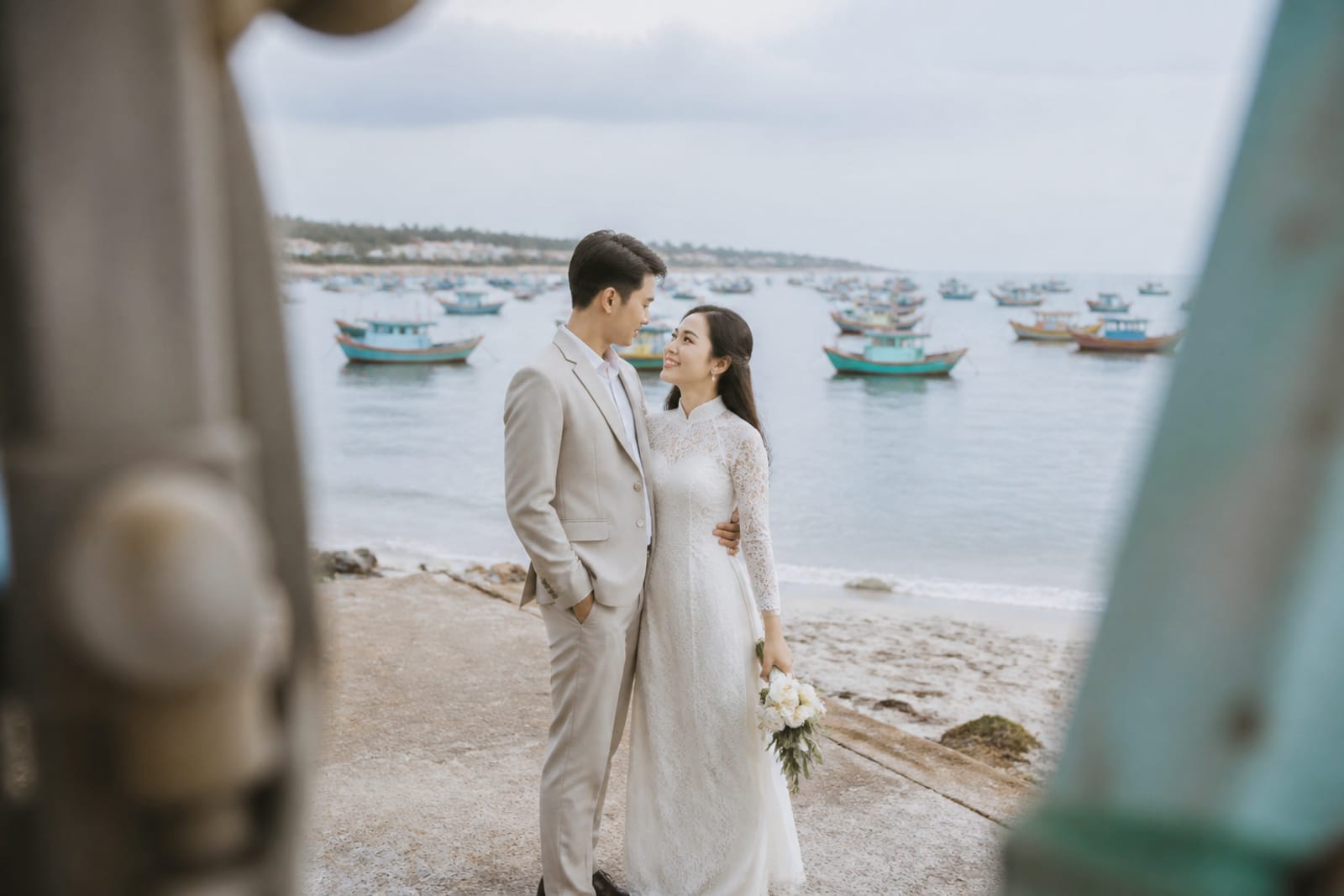
White and off-white dresses blow out against white sand when lit directly from the front. The camera loses fabric detail, seams and texture — your dress merges with the background. Soft pastels (blush, warm grey, pale ochre) work if the shoot times early morning (before 6:30 a.m.) when the light is warm and directional, coming from the side.
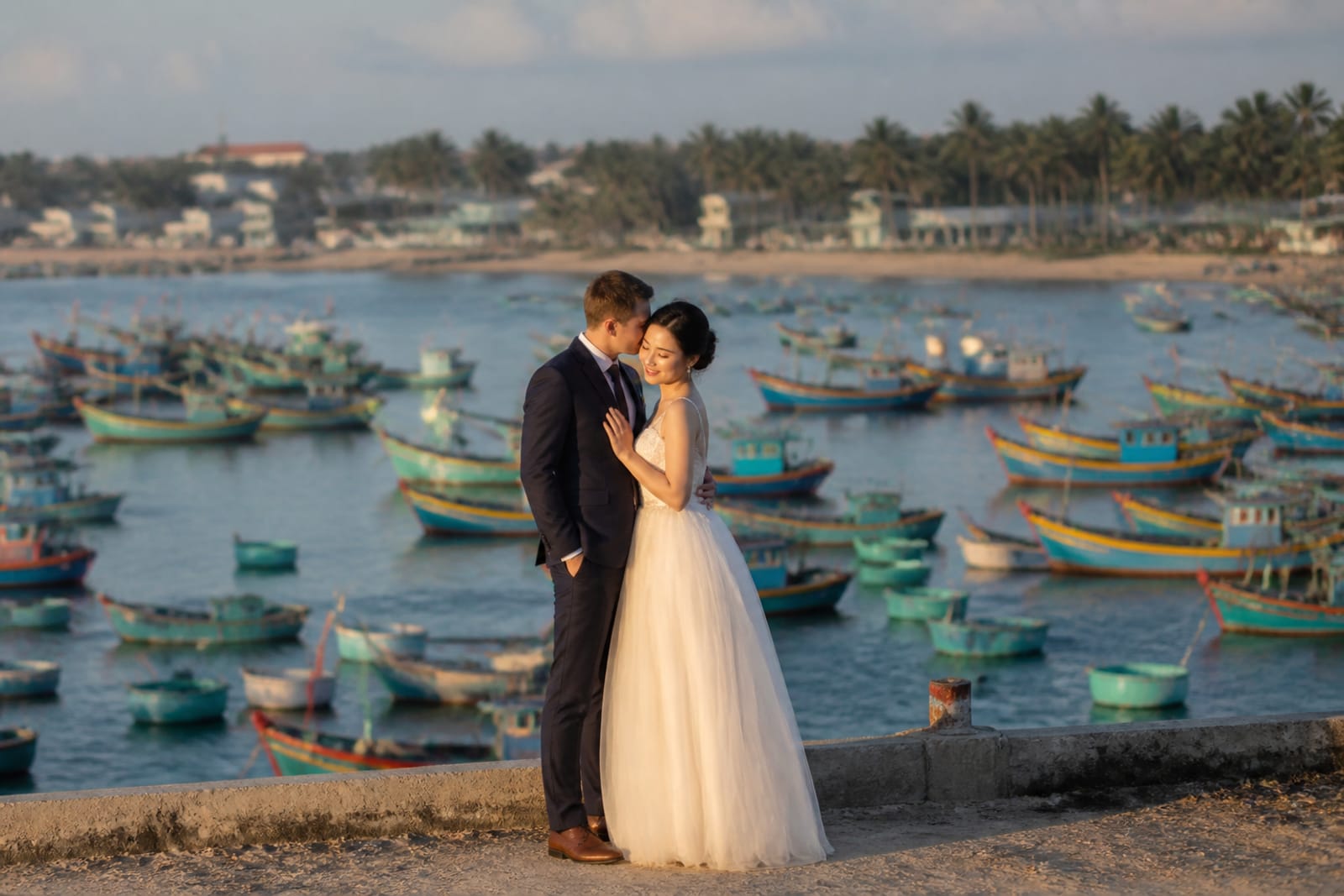
Deeper tones (charcoal, navy, rust, deep sage) separate from the sand and let the photographer use the dunes as a clean backdrop. Jewel tones (emerald, sapphire) photograph richly in Mui Ne's clear air. If you're set on white or cream, plan the shoot for golden hour (late afternoon, after 5 p.m.) when the sun is low and warm, creating shadow and dimension instead of flat glare.
Test this: take a phone photo of your dress on white paper in full sun at midday, then at 6 a.m. — you'll see the difference immediately.
What do you wear under an ao dai if you choose that route?
An ao dai is a beautiful pre-wedding choice in Mui Ne, but sand and heat create specific problems. Wear breathable silk or cotton slip pants underneath (not polyester — it doesn't breathe and clings wet). The slip should reach your ankle; loose, flowing slip pants photograph better than fitted ones beneath the ao dai's slit.
A silk or cotton camisole under the áo dài top keeps you cool and prevents chafing where the fabric moves with wind. Avoid underwear that shows through the silk in sunlight — the photographer will catch it in silhouette shots against the dunes. The ao dai's long sleeves protect your arms from the sun but hold heat; choose a summer-weight ao dai (single-layer silk or cotton blend, not double silk) if you're shooting between 6 a.m. and 8 a.m. or after 5 p.m.
How does season change what you should pack (November to April)?
| Season | Wind strength | Sand behavior | Best outfit type | Why it works |
|---|---|---|---|---|
| November–January | Strong (gusts 20+ km/h) | Dry, blows easily | Anchored layers, long loose trousers | Wind moves fabric, not tangles it |
| February–March | Moderate-to-strong | Dry, settled | Linen dresses, flowing shirts | Warm sun, less chaotic wind |
| April | Weak (warm thermals) | Dry, fine | Minimal layers, light cotton | Heat rises; breeze is warm |
November and December see the strongest winds. Pack a light shawl or overshirt you can anchor under your trousers or with a belt — it photographs as intentional style, not accident. February and March are ideal for pre-wedding shoots: the wind softens and morning temperatures drop below 20°C. April heats quickly after 8 a.m., so early-morning shoots work best; skip heavy fabrics entirely.
Never shoot mid-day (10 a.m.–4 p.m.) in any month — the sun is harsh and directly overhead, creating shadows under eyes and cheekbones that flatten the face.
What's the step-by-step outfit plan before booking a Mui Ne shoot?
- Choose your shoot time: sunrise (5:30–7 a.m.) or golden hour (5–7 p.m.). Sunrise is cooler but requires an early drive; golden hour is warmer and has richer light but shorter.
- Pick a primary outfit: one piece (a linen dress or ao dai) that moves and breathes. Avoid white unless the shoot is golden hour.
- Test the outfit in heat and wind: wear it outside on a warm day, walk in it, turn sideways to a window. Does it cling? Does it catch air awkwardly? If yes, revise.
- Add one layering piece: a loose linen shirt, a gauze shawl or a vintage jacket you can add or remove mid-shoot. This shows in photos as visual interest and protects arms and shoulders.
- Choose footwear you can walk in on sand: flat sandals, minimal sneakers or bare feet (if comfortable). Heels sink and create awkward photos; avoid them.
- Brief your photographer on light timing: tell them you want side light, not front light (for definition), and confirm they've scouted the dunes before your session. Ask them to shoot wide first (you in the landscape), then medium (half-body), then detail (hands, faces, fabric).
- Pack a small bag with water, a light scarf for wind, and phone charger. Avoid carrying a large backpack in frame.
Should you rent a local outfit or bring your own?
Rental is smart if you're flying to Vietnam. Local Mui Ne photographers often know rental contacts (ao dai rental shops, vintage dress hire) and can advise on what works. Rentals are usually breathable summer fabrics chosen for the climate — better than packing a heavy travel dress.
If you bring your own, pack one breathable primary outfit and one simple layer. Laundry in Mui Ne town is available; if your shoot is two days apart, you have time to wash and dry linen overnight.
Cáo Studio's team in Hanoi and Ho Chi Minh City handles pre-wedding shoots with makeup, styling and photography — we advise Hanoi couples on Mui Ne options over WhatsApp, or we can shoot your engagement session in the city before you travel to the coast. For a full pre-wedding package with direction and editing, book a session in Hanoi or Saigon and carry the portfolio into Mui Ne.
What to check before you book a Mui Ne pre-wedding photographer
Ask these questions:
- Have they shot the dunes at sunrise? Request a gallery of morning shoots. Sunrise light looks different from golden hour — you want to see it works for their style.
- Do they know how to light sand without blown highlights? Ask how they meter (expose) for white sand and skin tone together. A good answer: "I expose for skin and let the sand blow slightly bright" or "I use a reflector to fill shadows."
- Will they scout the location before your shoot? Wind direction, tide (if shooting near water), other tourists — these change day to day. A professional checks 24 hours before.
- How do they handle wind and sand on equipment? Ask if they carry lens protectors, how they clean the sensor between outfits, and whether they've had sand issues. Honest answer: "Yes, I take precautions and check the sensor regularly."
- Do they offer edited photos and delivery timeline? Ask for the exact number of edited images and when you'll receive them (usually 2–4 weeks). Cáo Studio delivers edited photos in 48 hours for shoots in Hanoi and Saigon; Mui Ne work is managed through local referral.
- What's their backup plan if wind or weather worsens? Ask if they reschedule or shorten the session. Winds over 30 km/h can make photography unsafe; you want a photographer who'll make that call.
For international couples, hiring a photographer who speaks English and has worked with foreign couples reduces miscommunication. Mui Ne has a growing tourism base; search for photographers with Instagram galleries and testimonials from English-speaking clients.
How Cáo Studio helps even if we don't shoot in Mui Ne
We're based in Hanoi and Ho Chi Minh City, so we don't operate in Mui Ne. But many clients ask us: "We want an engagement shoot in Hanoi, then a pre-wedding in Mui Ne — how do we plan both?"
Over WhatsApp, our team advises on outfit choices, light timing and how to find a vetted local photographer for the coast. We often shoot a pre-wedding session in Hanoi with styling, makeup and hair, and wedding-day photography, then guide you toward a local Mui Ne contact for the beach portion. Some couples split it: engagement in the city with us, pre-wedding day in Mui Ne with a local photographer, then a wedding video in Hanoi before the ceremony.
Contact us on WhatsApp — we'll walk you through the plan.
---
FAQ
Does wind ruin pre-wedding shoots in Mui Ne?
Wind doesn't ruin shoots if the photographer and outfit are prepared. Strong November–March winds move lightweight fabrics beautifully in photos. The trick: wear layers you can anchor (tuck a shawl, wear a belt) and shoot when you're relaxed, not fighting the fabric. Avoid stiff fabrics that tangle or heavy pieces that flip awkwardly.
Can I wear a heavy wedding dress in Mui Ne?
Not comfortably. Heavy satin, tulle and multiple layers absorb heat, trap sweat and photograph as wrinkled by 7 a.m. If you want a formal dress, choose a lightweight silk or cotton blend and plan a late-afternoon shoot (after 5 p.m.) when it's cooler. Layer it over breathable undergarments only.
What shoes work best on sand?
Flat sandals, minimal canvas sneakers or bare feet. Heels sink, throw off balance and create unnatural posture in photos. If barefoot feels odd, bring minimal flat sandals you can slip on and off between shots. Many photographers recommend removing shoes entirely for movement shots.
Should I book sunrise or golden hour for better light?
Both work, but differently. Sunrise (5:30–7 a.m.) is cooler, softer and less crowded — ideal if heat is a concern. Golden hour (5–7 p.m.) is warmer and richer in color but requires afternoon energy. Choose sunrise if you're sensitive to heat; choose golden hour if you prefer warmer tones and a relaxed evening pace. Confirm the photographer has worked that time.
How do I protect my outfit from sand stains during the shoot?
Sand doesn't usually stain light fabrics if brushed immediately — have the photographer's assistant (or bring a friend) gently brush your hem and train between outfit changes. Avoid sitting directly on sand; stand or use a lightweight fabric as a ground sheet. Bring a small brush or lint roller in your bag.
Is it better to hire a local Mui Ne photographer or book Cáo Studio for a shoot elsewhere?
Hire local for Mui Ne — they know the dunes, tides and weather patterns. Cáo Studio shoots in Hanoi and Ho Chi Minh City; if you want a full pre-wedding package with styling, makeup and photography, book with us in the city or ask us to refer you to a vetted local for Mui Ne. Many couples do both: engagement with us, beach shoot with a local contact.
FAQ
Does wind ruin pre-wedding shoots in Mui Ne?
Wind doesn't ruin shoots if the photographer and outfit are prepared. Strong November–March winds move lightweight fabrics beautifully in photos. The trick: wear layers you can anchor (tuck a shawl, wear a belt) and shoot when you're relaxed, not fighting the fabric. Avoid stiff fabrics that tangle or heavy pieces that flip awkwardly.
Can I wear a heavy wedding dress in Mui Ne?
Not comfortably. Heavy satin, tulle and multiple layers absorb heat, trap sweat and photograph as wrinkled by 7 a.m. If you want a formal dress, choose a lightweight silk or cotton blend and plan a late-afternoon shoot (after 5 p.m.) when it's cooler. Layer it over breathable undergarments only.
What shoes work best on sand?
Flat sandals, minimal canvas sneakers or bare feet. Heels sink, throw off balance and create unnatural posture in photos. If barefoot feels odd, bring minimal flat sandals you can slip on and off between shots. Many photographers recommend removing shoes entirely for movement shots.
Should I book sunrise or golden hour for better light?
Both work, but differently. Sunrise (5:30–7 a.m.) is cooler, softer and less crowded — ideal if heat is a concern. Golden hour (5–7 p.m.) is warmer and richer in color but requires afternoon energy. Choose sunrise if you're sensitive to heat; choose golden hour if you prefer warmer tones and a relaxed evening pace. Confirm the photographer has worked that time.
How do I protect my outfit from sand stains during the shoot?
Sand doesn't usually stain light fabrics if brushed immediately — have the photographer's assistant (or bring a friend) gently brush your hem and train between outfit changes. Avoid sitting directly on sand; stand or use a lightweight fabric as a ground sheet. Bring a small brush or lint roller in your bag.
Is it better to hire a local Mui Ne photographer or book Cáo Studio for a shoot elsewhere?
Hire local for Mui Ne — they know the dunes, tides and weather patterns. Cáo Studio shoots in Hanoi and Ho Chi Minh City; if you want a full [pre-wedding package with styling, makeup and photography](/pre-wedding-photoshoot), book with us in the city or ask us to refer you to a vetted local for Mui Ne. Many couples do both: engagement with us, beach shoot with a local contact.
Ao dai, makeup, hair and a local photographer in Hanoi or Saigon — one WhatsApp message.