Cáo Studio · Mga gabay sa photoshoot sa Vietnam · Pre-Wedding Photoshoot Vietnam: Hanoi, Saigon & Hoi An Guide
Best Time of Day for Couple Photos at Muong Hoa Valley Rice Terraces
Cáo Studio team · Hanoi · 2026-10-03
Muong Hoa valley rice terraces in Sapa shoot best at sunrise (5:30–6:30 am) when soft side light catches terrace edges and mist sits low; golden hour (5–6 pm) works equally well but draws more trekkers. Midday (10 am–2 pm) offers sharp detail but flattens color and forces harsh shadows — skip it unless you want that look. Weather depends on season: March–May and September–November are clearest; June–August brings afternoon rain and fog; December–February is cold and foggy. Cáo Studio does not operate in Sapa — the studio shoots in Hanoi, Ho Chi Minh City, and Hoi An. To shoot Muong Hoa, hire a local Sapa photographer who knows the terrain, light windows, and permit requirements; book them 2–4 weeks ahead and confirm they'll shoot in the season you're visiting. 📸 Book on WhatsApp — ao dai photoshoot | 💄 Makeup & hair at your hotel | 🌸 Ideas & lookbook
Why Sunrise Gives You the Sharpest Frames at Muong Hoa
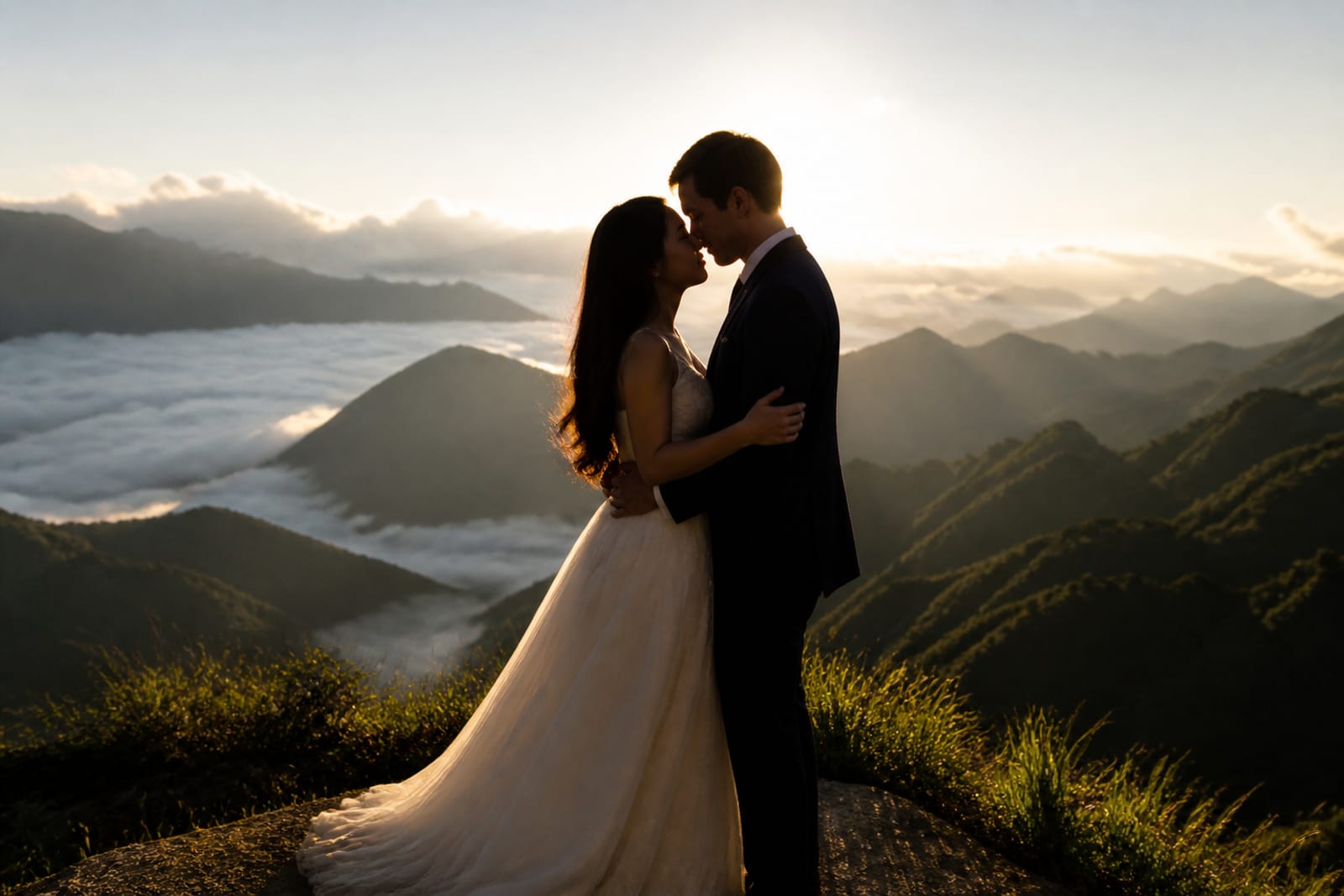
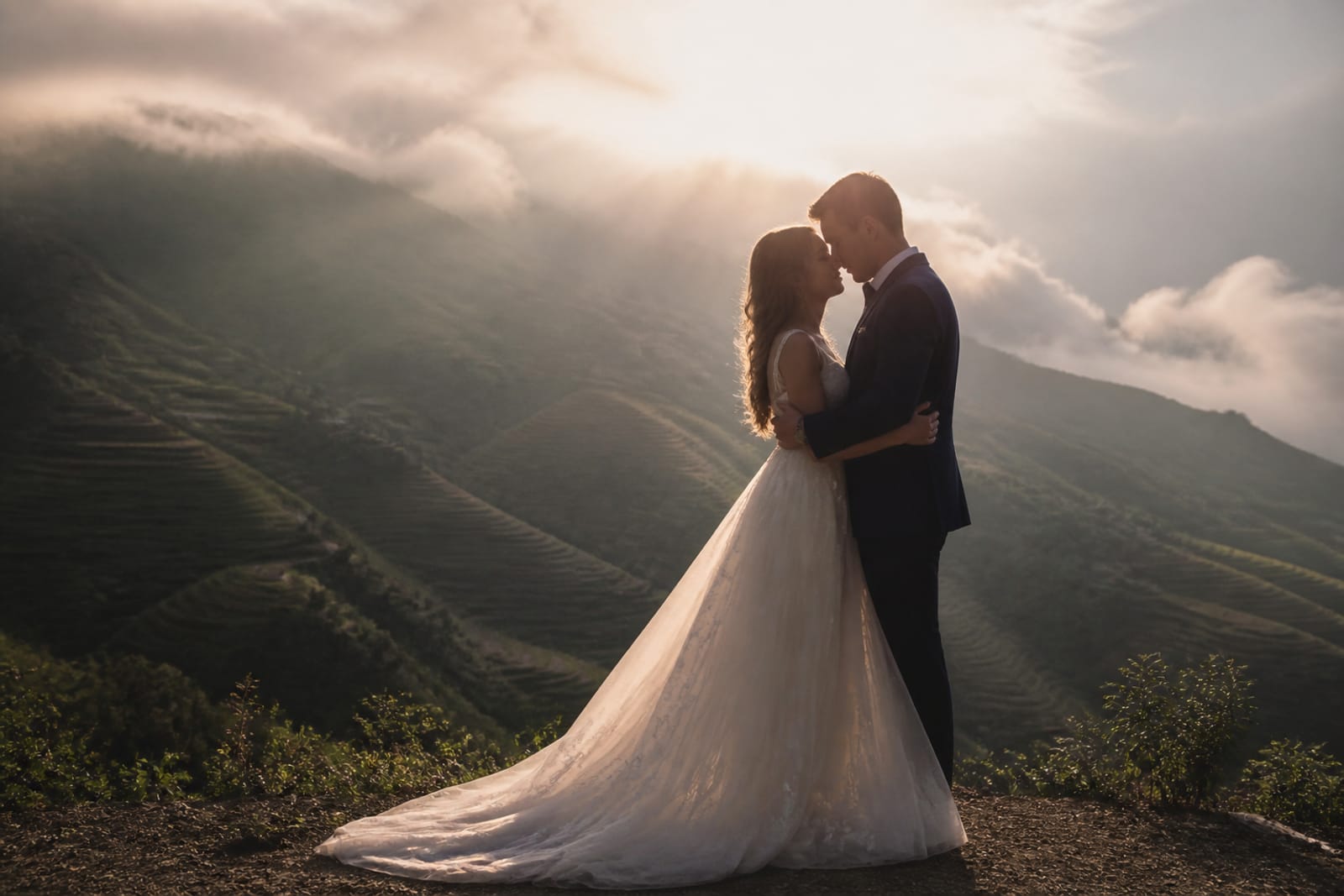
Sunrise at Muong Hoa (roughly 5:30–6:30 am depending on season) is when light hits terrace edges at a low angle and mist still clings to the water-filled paddies. That side light creates depth: terrace lines cast shadows, water reflects pale sky, and your silhouettes sit crisp against soft green. The crowd is minimal — mostly solo trekkers and one or two local guide groups. You'll have space to walk, pause, and let the photographer compose wide shots without strangers in frame. The challenge: you must start hiking at 4:30–5 am, so your team needs to be on location the night before (stay in Sapa town). Coordinate with your local guide the evening before; confirm the exact trail, the meeting point, and whether they can hold position for a 30–45 minute shoot without moving the whole group on.
The light window closes fast — by 7 am, the sun is higher, side light flattens, and mist burns off. If you're not on the terrace by 5:45 am, you've missed the best hour.
Golden Hour (5–6 pm): The Trade-off Between Light and Crowds
Evening light at Muong Hoa is warm and directional — it bathes terraces in amber and makes water glow. Many couples prefer it because the color is forgiving and romantic. The downside: this is the hour when day-trippers and guided groups finish their hikes and descend, so trails are busiest between 4:30–6 pm. You'll share space with 10–30 other people, and a skilled photographer can frame around them, but it takes longer and requires quick composing.
Shoot golden hour only if your local team knows the least-trafficked edges of the valley and can move you between vantage points (upper terrace, mid-slope, near the water stream) every 8–10 minutes. Ask your guide which micro-trails are quieter; don't assume the main path is your only option. Light is gone by 6:15 pm, so plan your descent before dusk — trails become unlit and harder to navigate after sunset.
Why Midday (10 am–2 pm) Fails Most Couples
Direct overhead sun flattens terrace depth, turns water into glare, and casts dark shadows under your chin and eyes. Colors desaturate: green looks grey-green, skin tone shifts cool. Midday is also peak tourist hour — the valley fills with groups, and finding an empty corner takes 20+ minutes of hiking. Professional photographers avoid it because post-processing can't recover the lost dimension and contrast.
Shoot midday only if you want a specific look — sharp, almost documentary aesthetic — or if your schedule forces it. Even then, position yourselves where shadows from your own bodies or terrace walls can soften light on your face, and ask your photographer to underexpose slightly to push color saturation in post-production.
Season Matters More Than You Think: Light, Mist, and Terraces Filled with Water
| Season | Light Quality | Mist & Clarity | Terrace Fill | Best Time of Day | Challenge |
|---|---|---|---|---|---|
| Mar–May | Crisp, warm, minimal haze | Clear mornings, occasional mid-day haze | Water receding (less reflection); some paddies drained | Sunrise or golden hour | Heat builds by afternoon; trails dry and dusty |
| Jun–Aug | Soft but humid; afternoon rain common | Heavy morning mist; afternoon fog | Full of water (best for reflection) | Very early sunrise (5:15 am) before mist burns | Afternoon thunderstorms; risk of shoot cancelled |
| Sep–Nov | Clearest overall; golden hour longest | Minimal mist; crisp dawn | Full (harvest mid-Sep to Oct) or draining | Sunrise or golden hour | Cooler; crowds peak Oct–Nov (peak season) |
| Dec–Feb | Cold, often grey; occasional frost | Heavy fog most mornings; clears slowly | Drained or minimal water | Golden hour (when sun breaks) | Fog may not lift until 9 am; temperature near 0–10°C |
Spring and autumn are optimal: March–May and September–November offer clear light, filled terraces, and manageable crowds. Summer sunrise is your only safe hour because afternoon rain is near-certain and clouds block evening light. Winter is risky — fog often doesn't clear, leaving you with flat, grey tones no matter the time of day.
How to Choose Between a Local Guide-Led Shoot and a Solo Photoshoot Booking
When you search for "couple photoshoot Muong Hoa," you'll find three options.
Option 1: Trek with a local guide + phone camera or bring your own photographer. Cost drivers: guide fee, photographer travel. You control the pace and light window. The risk: guides prioritize trekking; they'll rush you if other groups are waiting. A hired photographer unfamiliar with the trails may arrive late or miss light while navigating. Best for: couples who want flexibility and don't need professional editing.
Option 2: Book a Sapa-based photography service in advance. A local photographer knows the terrain, landing spots, and permit ins and outs. They'll meet you at your hotel in Sapa and lead the hike with you. Cost is higher, but you get a dedicated team, edited photos, and no logistics stress. The catch: the photographer's schedule is fixed — if weather turns poor, you may not get a second date. Best for: couples who want polished frames and are comfortable with one assigned date.
Option 3: Hire Cáo Studio for a base in Hanoi, then shoot a different location. Cáo Studio operates in Hanoi, Ho Chi Minh City, and Hoi An. If you're in Sapa for a multi-day trip, consider shooting a couple or family photoshoot in Hanoi — the studio controls all variables (light, timing, outfit, hair and makeup) and delivers edited frames in 48 hours. Hanoi has iconic morning mist scenes (Huc Bridge at dawn, Red River, French Quarter light) without the hike. Best for: couples who want certainty, full-service coordination, and don't want to gamble on mountain weather.
Comparison table: What Each Route Gives You
| Route | Pros | Cons | Best For |
|---|---|---|---|
| Local guide + your camera | Low cost; flexible timing | No professional edit; quality varies; guide rushes you | Budget-conscious; casual aesthetic |
| Sapa photographer service | Terrain knowledge; dedicated team; edited files | Fixed date; higher cost; weather risk | Couples wanting polished pre-wedding frames |
| Cáo Studio in Hanoi/Hoi An | Full control (light, outfit, hair, makeup, edit); 48-hour turnaround; no mountain risk | Not in Sapa; requires travel to a city; different aesthetic | Couples who want certainty and all-in-one service |
What to Check Before You Book a Muong Hoa Couple Photoshoot
1. Confirm the photographer's experience in this specific valley. Ask them to show you 3–5 recent shoots at Muong Hoa (not just Sapa town, not other terraces). Different valleys have different light angles and trail logistics.
2. Verify the exact starting time and meeting point. If they say "sunrise," push back: does that mean 5 am start, or do they meet you at 6 am? Sapa town is 8 km from Muong Hoa trailhead; add 20 minutes for the drive. If meeting time is 5:30 am, you're arriving at the terrace by 6:15 am — you've already lost the best light.
3. Ask whether they'll scout the weather the day before. Fog and rain are unpredictable in monsoon season. A good photographer will text or call the evening before and say, "Forecast shows clear dawn tomorrow, so we'll stick with sunrise" or "Heavy fog is predicted — do you want to move to golden hour?" Inflexible "we're starting at dawn no matter what" photographers often deliver grey, flat frames.
4. Clarify the output: how many edited photos, and what format? Some local services deliver 20 edited files; others give 50+ with minimal curation. Ask whether they'll provide prints, digital files, an album, or raw files for you to edit. Confirm the delivery timeline (same day, 1 week, 2 weeks).
5. Discuss outfit changes and makeup. Terraces are muddy and wet. If your outfit is delicate (wedding dress, silk ao dai), discuss how to protect it. Ask if they can recommend a spot to change or if you should arrive in hiking clothes and change on-site. Cáo Studio's makeup and hair service travels to your hotel — if you're based in Sapa, you could prep there before heading to the trailhead, but a local Sapa photographer won't coordinate that. Plan separately or ask if they work with a makeup artist.
6. Check permit and access rules. Muong Hoa valley is part of Sapa district (public trails), but some micro-areas or homestays require entry fees. Ask your photographer whether permits are needed and if they're included in their fee. Confirm with Sapa's tourism office a few days before your shoot.
7. Have a weather backup plan in writing. If dawn arrives with fog so thick you can't see 20 meters, what happens? Do you reshoot the next day, or accept the grey frames? Get this in the booking confirmation.
Booking Cáo Studio Instead: A Practical Shortcut
If you're overwhelmed by logistics or the weather forecast for Sapa looks uncertain, consider booking Cáo Studio for a couple photoshoot in Hanoi or Hoi An instead. The studio handles light, timing, outfit, hair and makeup, and delivers edited photos and a short film in 48 hours. No trekking, no weather gamble, one team controlling every variable. Sessions run year-round and are booked via WhatsApp. Ask the team about ao dai rental if you want that look.
📸 Book on WhatsApp — couple & family photoshoot | 💄 Makeup & hair at your hotel | 🌸 Ideas & lookbook
---
What a Real Shoot at Muong Hoa Looks Like: Hour by Hour
4:30 am: Your guide picks you up from Sapa town. You're in hiking clothes; outfit and makeup are done (if using a makeup artist, this was at 3:30 am at your hotel — tight but possible). You're carrying your dress or ao dai in a garment bag.
5:00 am: Arrive at the trailhead. Light is still dark. The photographer tests camera settings. You and your partner begin the 15–20 minute hike to the first terrace vantage point.
5:25 am: You reach the upper terrace. Mist is still thick; light is pale grey-blue. The photographer shoots wide frames of you walking toward the camera, your silhouettes against the terraces. These are the "landscape" shots. No posing — you're walking, looking at each other, pausing to take in the view.
5:50 am: Sun breaks the horizon line. Side light hits the right side of your face and your outfit. The photographer moves you to a terrace edge and shoots medium frames — waist-up, profile, back-to-camera walking. This is the "golden 10 minutes."
6:10 am: Sun is higher now. Light is still directional but less dramatic. The photographer moves you down-slope to shoot with water and the full terrace stack in the background. Detail shots: your hands, your face close-up, the texture of the terraces.
6:30 am: Light is now more general (less side angle). Trekkers begin arriving. The photographer wraps and you change back into hiking clothes and begin your descent. Total shoot time: about 1 hour; the team is off the mountain by 7:15 am.
Turnaround: A Sapa photographer typically delivers edited files within 3–7 days. Cáo Studio (if you had booked in Hanoi) would send frames and a short film within 48 hours.
---
📸 Book on WhatsApp — pre-wedding & elopement | 💄 Makeup & hair at your hotel | 🌸 Ideas & lookbook
FAQ
Is sunrise or golden hour better for rice terrace couple photos?
Sunrise (5:30–6:30 am) gives softer light and fewer crowds; golden hour (5–6 pm) is warmer but busy. Both work. Sunrise requires an early wake and overnight stay near the trailhead; golden hour is logistically easier but less private. Choose based on your energy and crowd tolerance.
What month is best for Muong Hoa valley couple shoots?
September to November offers clear light, filled terraces (especially during harvest in mid-September to October), and minimal fog. March to May is also good. June to August have afternoon rain and heavy morning mist. December to February are cold and often grey from fog that won't lift.
Can we shoot Muong Hoa if we're not into hiking?
Muong Hoa is a trekking destination — there's no way around walking 15–45 minutes to reach the best photo spots. If you're not fit for hiking or uncomfortable on muddy trails, book a couple photoshoot in Hanoi or Hoi An with Cáo Studio instead. Urban and cultural landscapes need no climbing and deliver polished frames in 48 hours.
How much does a couple photoshoot at Muong Hoa cost?
Local Sapa photographers charge differently based on hike difficulty, edit turnaround, and file count. Ask photographers for quotes directly — costs depend on season, number of edited photos, and whether makeup is included. For a no-stress all-in-one service with guaranteed turnaround, ask Cáo Studio for a quote on WhatsApp; the studio shoots in Hanoi, Ho Chi Minh City, and Hoi An.
What do we wear for a Muong Hoa rice terrace shoot?
Wear hiking-appropriate base layers and shoes to the trailhead (muddy, wet paths). Change into your couple outfit (wedding dress, ao dai, suit, or dress shirt) once you reach a flat spot on the terrace or a nearby homestay. Bring the outfit in a garment bag to keep it dry. A local guide or your photographer can hold your hiking clothes while you shoot. Avoid heavy fabrics that absorb water and mud.
Can we reshoot if weather is bad?
It depends on your photographer's policy. Ask before booking whether bad weather (heavy fog, rain) qualifies for a free reshoot or a full refund. Some offer one free date change; others do not. Get this in your booking confirmation. Weather is unpredictable in Sapa June–August and December–February — book in spring or autumn if weather certainty matters.
Should we hire Cáo Studio or a local Sapa photographer?
If you want to shoot Sapa, hire a local photographer — they know the terrain and light windows. Cáo Studio does not operate in Sapa but shoots couple and family photoshoots in Hanoi, Ho Chi Minh City, and Hoi An. If you're in northern Vietnam and can travel to Hanoi, Cáo Studio offers full coordination (light, outfit, hair, makeup, editing) with 48-hour turnaround and zero weather risk.
Mga karaniwang tanong
Is sunrise or golden hour better for rice terrace couple photos?
Sunrise (5:30–6:30 am) gives softer light and fewer crowds; golden hour (5–6 pm) is warmer but busy. Both work. Sunrise requires an early wake and overnight stay near the trailhead; golden hour is logistically easier but less private. Choose based on your energy and crowd tolerance.
What month is best for Muong Hoa valley couple shoots?
September to November offers clear light, filled terraces (especially during harvest in mid-September to October), and minimal fog. March to May is also good. June to August have afternoon rain and heavy morning mist. December to February are cold and often grey from fog that won't lift.
Can we shoot Muong Hoa if we're not into hiking?
Muong Hoa is a trekking destination — there's no way around walking 15–45 minutes to reach the best photo spots. If you're not fit for hiking or uncomfortable on muddy trails, book a [couple photoshoot](/fil/couple-photoshoot) in [Hanoi](/fil/hanoi) or [Hoi An](/fil/hoi-an) with [Cáo Studio](/fil/pre-wedding-photoshoot) instead. Urban and cultural landscapes need no climbing and deliver polished frames in 48 hours.
How much does a couple photoshoot at Muong Hoa cost?
Local Sapa photographers charge differently based on hike difficulty, edit turnaround, and file count. Ask photographers for quotes directly — costs depend on season, number of edited photos, and whether makeup is included. For a no-stress all-in-one service with guaranteed turnaround, ask Cáo Studio for a quote on WhatsApp; the studio shoots in Hanoi, Ho Chi Minh City, and Hoi An.
What do we wear for a Muong Hoa rice terrace shoot?
Wear hiking-appropriate base layers and shoes to the trailhead (muddy, wet paths). Change into your couple outfit (wedding dress, ao dai, suit, or dress shirt) once you reach a flat spot on the terrace or a nearby homestay. Bring the outfit in a garment bag to keep it dry. A local guide or your photographer can hold your hiking clothes while you shoot. Avoid heavy fabrics that absorb water and mud.
Can we reshoot if weather is bad?
It depends on your photographer's policy. Ask before booking whether bad weather (heavy fog, rain) qualifies for a free reshoot or a full refund. Some offer one free date change; others do not. Get this in your booking confirmation. Weather is unpredictable in Sapa June–August and December–February — book in spring or autumn if weather certainty matters.
Should we hire Cáo Studio or a local Sapa photographer?
If you want to shoot Sapa, hire a local photographer — they know the terrain and light windows. Cáo Studio does not operate in Sapa but shoots [couple and family photoshoots](/fil/couple-photoshoot) in [Hanoi](/fil/hanoi), Ho Chi Minh City, and [Hoi An](/fil/hoi-an). If you're in northern Vietnam and can travel to Hanoi, [Cáo Studio](/fil/pre-wedding-photoshoot) offers full coordination (light, outfit, hair, makeup, editing) with 48-hour turnaround and zero weather risk.