Cáo Studio · Mga gabay sa photoshoot sa Vietnam · Pre-Wedding Photoshoot Vietnam: Hanoi, Saigon & Hoi An Guide
Muong Hoa thRice Terraces Wedding Photos: Outfit & Timing Guide
Cáo Studio team · Hanoi · 2026-10-03
Muong Hoa valley (Sapa, northern Vietnam) requires outfits chosen for three constraints: steep terrain, morning soft light, and cold mountain air. Ao dai—a fitted silk tunic over loose trousers—moves naturally across rice paddy steps and photographs with flow in wind; heavy Western wedding gowns cling and demand petticoat support on wet earth. Choose your outfit based on season (Mar–May and Sep–Nov offer dry, bright mornings; Dec–Feb is fog-heavy and near freezing; Jun–Aug is rainy), walking endurance (narrow, muddy paths, no carriages), and your shot list (close-ups, walking shots, or documentary pairs-in-landscape). If booking Cáo Studio, the team travels from Hanoi with makeup, hair and camera as one unit—outfit rentals are arranged separately. Local Sapa photographers exist but require vetting: ask for portfolio samples of real couples in similar light, confirm they understand rice paddy logistics, and verify backup weather plans before signing.
Muong Hoa thvalley rice terraces are Southeast Asia's most photographed pre-wedding backdrop—but choosing what to wear there is not a straightforward "gown or dress" question. The landscape is a working paddy field: muddy in places, slippery when wet, and climbed on foot over narrow raised paths. The light shifts hourly. The cold hits hard in winter. And the outfit you choose determines whether you walk freely, stay dry and warm, and look like yourself—or feel pinched and out of place against the valley's scale.
This guide walks through the decision: which outfit type suits which season and shot style, what weather and terrain actually feel like on the ground, how to work with Muong Hoa's light, and whether to book a Sapa-local photographer or bring a full team from Hanoi. We'll include a comparison table to match outfit choices to your priorities, and honest timings for getting ready and shooting.
Ao Dai or Western Gown—Which Moves Better on Rice Paddy Paths?
An ao dai is two pieces: a fitted silk or cotton tunic that falls to the ankles, worn over high-waisted straight trousers. On rice paddies, it moves. Wind carries the tunic hem, creating frames photographers call "flow"—no posing required. The trousers keep legs dry and warm. Mud and water splash only to the ankle, not the hem. And climbing over paddy embankments, a tunic doesn't snag or tangle. A Western wedding gown—ball gown or mermaid—is designed for ballrooms, not fields. The weight concentrates at the hem, mud clings to fabric yards long, and walking uphill on muddy slopes with a 20-pound skirt is exhausting. Full-length veils catch wind and dirt. Trains drag. A-line gowns with a crisp petticoat hold shape but are heavy; mermaid skirts lock the legs and make stepping over paddy walls a two-handed event.
Verdict: Ao dai is built for working landscapes. Western gowns work if you're stationary (posed portraits, formals near the entry, seated shots on a clear patch), but limit freedom and comfort. If you choose a gown, plan fewer walking shots, more seated or close-up frames, and budget mental energy for managing fabric.
📸 Browse ao dai rentals and pre-wedding packages
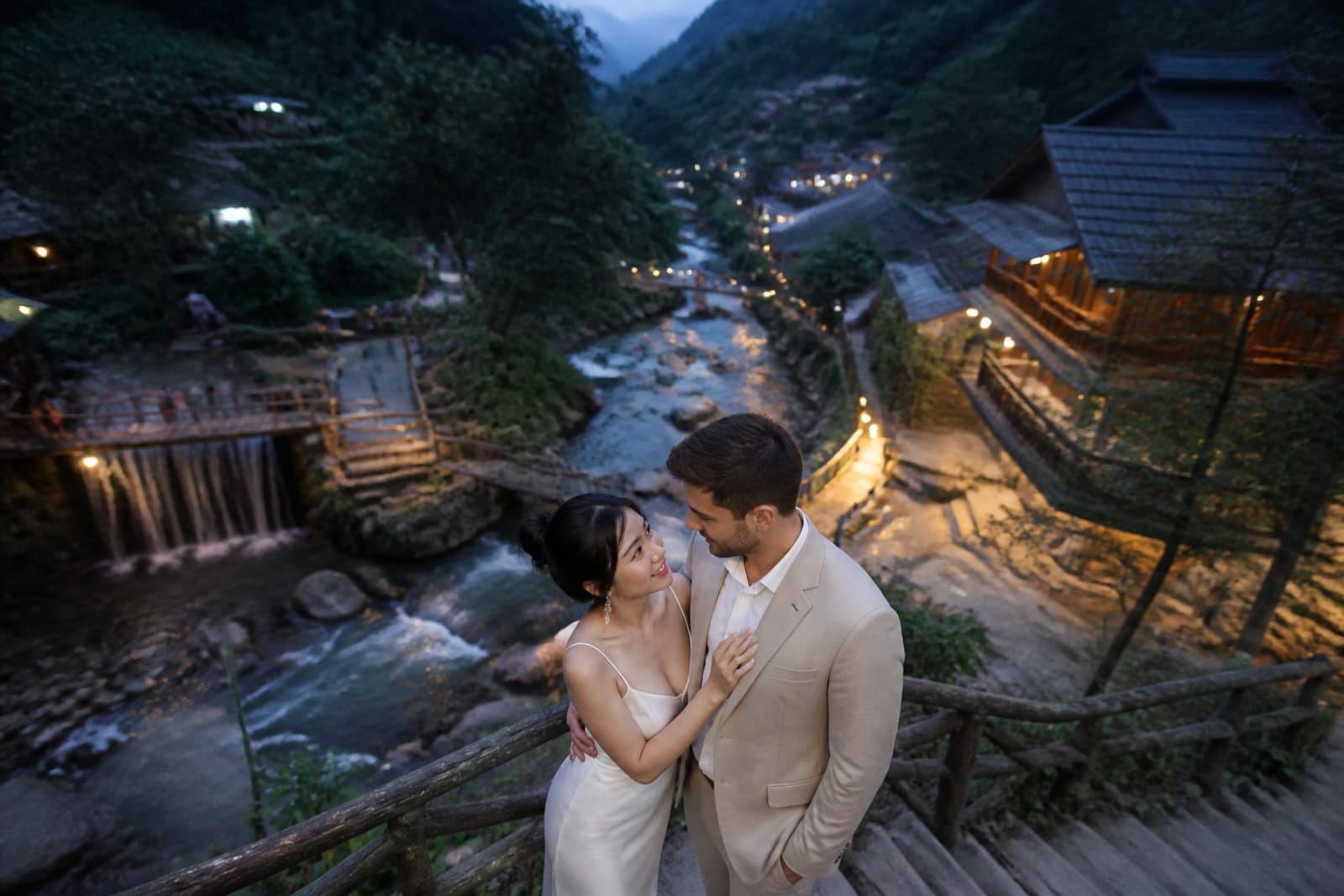
How Season Shapes Your Outfit Layers and Light Angles
Muong Hoa's season determines temperature, fog, ground condition, and light quality—three months feel completely different.
| Season | Temperature / Fog | Ground | Light | Ao Dai Layers | Gown Layers | Best For |
|---|---|---|---|---|---|---|
| Dec–Feb (winter) | 5–10°C, dense fog until 8–9 am | damp, can frost | soft, long shadows (if sun breaks) | cardigan, silk lining, wool undershirt | gown + long robe, gloves risky for handheld shots | documentary couples who don't mind muted colour |
| Mar–May (spring) | 12–18°C, clearing fog by 7 am | drying, firm | crisp, direct by 7:30 am | lightweight silk, no layers | gown + thin shawl or veil | most travellers; bright, walkable |
| Jun–Aug (summer) | 18–25°C, humid, afternoon rain | waterlogged, soft | hazy, afternoon downpours by 2 pm | cotton only, no sleeves (risky in open valley) | gown + no layer, but rain risk | short-window morning shoots only (before 9 am) |
| Sep–Nov (autumn) | 12–20°C, clearing mid-morning | muddy, puddled | golden before 8 am, then haze | silk with light jacket | gown + cardigan or shawl | harvest colours; high risk of 24-hour rain Oct–Nov |
Key insight: If you're wearing ao dai, layers work within the design (a lined tunic, or a thin cardigan over it). If you're in a gown, adding warmth means robes or cloaks that photograph as separate items, or shivering for the frame. Cold hands (Feb, Jan, Dec) also make it hard to hold a bouquet steadily for handheld shots.
Season also drives the kind of light. Winter mornings (Dec–Feb) are shrouded; if the sun emerges, the angle is low and golden but only for 20 minutes. Spring and autumn (Mar–May, Sep–Nov) clear by 7–7:30 am and offer 2–3 hours of walkable, directional light. Summer is bright but humid and faces afternoon downpours, so shoots must finish by 9 am. This timing pressure affects outfit choice: in summer, wear something you can move in fast; in winter, wear something that looks good in soft, diffused light even if the shot list gets cut short by fog.
💄 Pre-wedding prep: makeup & hair at your hotel
Walking Muong Hoa: What "Steep Terrain" Really Means for Footwear and Endurance
Muong Hoa valley's paths are not paved. They are dirt and stone embankments raised between paddies, roughly a foot above water or mud. Some sections are steps; most are walking trails. A full shoot—entering the valley, walking to 3 scenic spots, posing, walking back—takes 90 minutes to 2 hours. Your feet are on earth the entire time.
Mud is the wildcard. After rain (May–Nov), paths hold water and are slippery. After a dry spell (Feb–April), paths harden but stones are uneven. In winter (Dec–Feb), rare frost makes earth crispy; one misstep and you slide. Shoes matter: open-toe sandals are a no; stilettos will sink. Many couples wear flat shoes (leather flats, ballet pointes, or simple sandals that wrap the foot) during the walk, then change into heeled or formal footwear for posed shots on a dry spot—ask your photographer if they can work with outfit changes.
An ao dai's trousers and flat shoes handle this easily. A Western gown with a train? The train drags through mud within 50 meters. Heels sink. Your stylist or a second person needs to hold the hem the entire time. It's doable if you're stationary, but for a walking session, it's exhausting and photo time is spent managing fabric, not connecting with your partner.
Practical check: Walk 100 meters on a slope while holding weight at your feet and waist. If you feel pinched or unbalanced, your outfit is too heavy or restrictive for the valley.
Cáo Studio Hanoi or a Local Sapa Photographer—What Changes
Muong Hoa valley sits in Sapa town. Cáo Studio does not operate there; the studio is based in Hanoi and Ho Chi Minh City. For a shoot in Sapa, you have two paths:
Path 1: Hire a local Sapa photographer. A local knows the best light windows, has permissions to guide you into the paddies, and understands morning fog patterns. But logistics are split: you arrange makeup separately (usually a hotel or local salon the morning-of), bring an outfit or rent from a local ao dai shop, and get photos in 3–5 days after editing. You are coordinating three vendors. If the photographer doesn't respond to your tone or style, you have limited recourse.
Path 2: Book a full team travel from Hanoi. Some studios (like Cáo Studio's model) can travel to Sapa if hired in advance. One team handles makeup, hair, outfit rental (or rental coordination), and photography. The team understands your vision because it's the same people from first conversation to final frame. But costs rise because of travel, and the team's dates are tied to their Hanoi and Ho Chi Minh City bookings—you lose flexibility. The upside is one message, one accountability, and no miscommunication between vendors.
How to vet a local Sapa photographer:
- Ask for portfolios of 5+ real couples shot in Muong Hoa, same season as your shoot.
- Check if they provide unedited samples (proof they're not over-processing to hide blur or bad light).
- Confirm their backup plan if it rains or fog doesn't clear (most will offer a reshoot or refund, but confirm in writing).
- Ask how long they've shot in the valley and if they know current access rules (Muong Hoa is managed; some sections require local guides).
If you want a full-team experience with makeup and hair included, ask Cáo Studio on WhatsApp about Sapa travel availability—the team coordinates everything, but you'll need to book early and confirm dates.
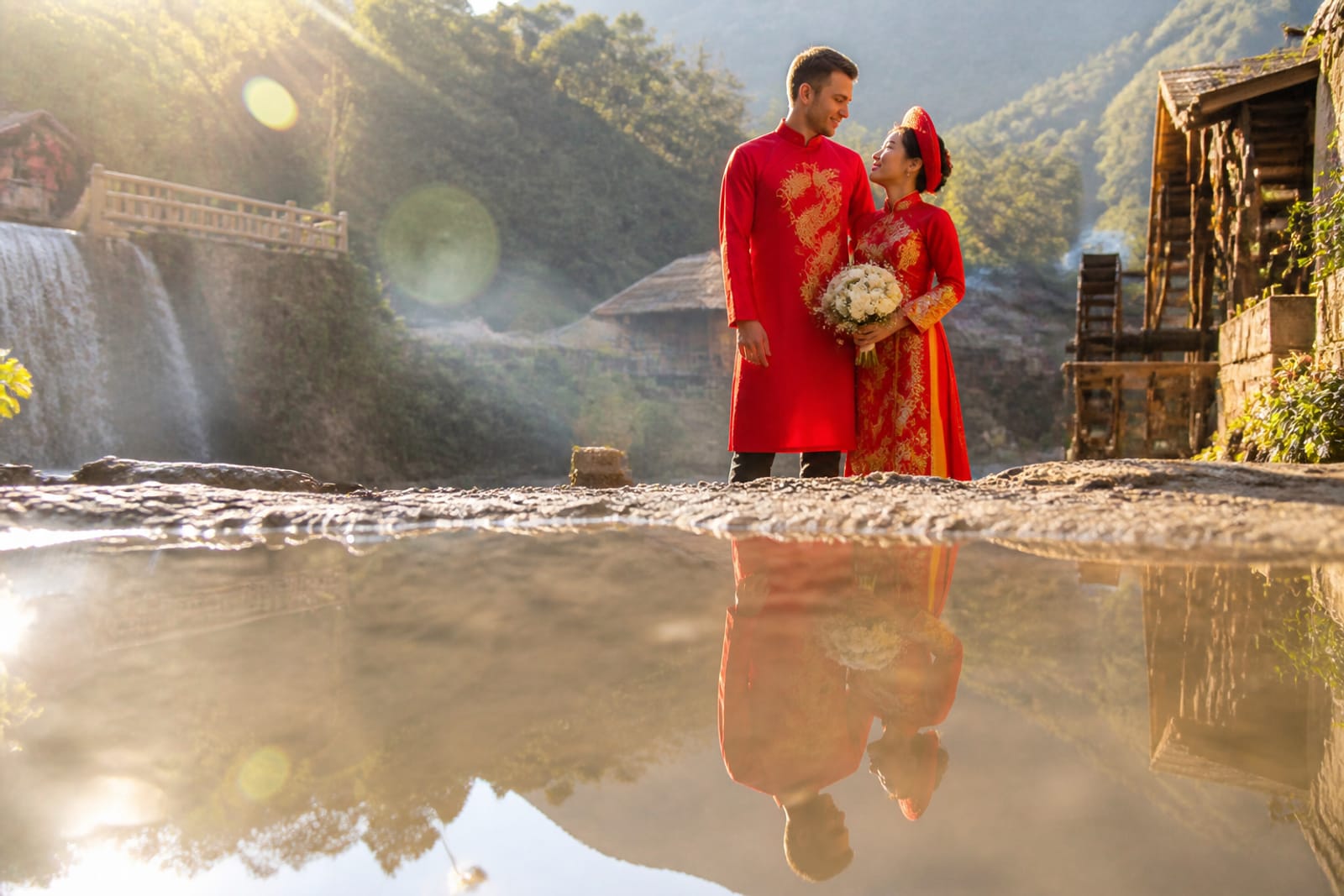
Outfit Rental vs. Your Own Dress—Timeline and Fit Factors
Many couples flying to Vietnam rent an ao dai or gown locally rather than pack and risk luggage loss. Rental shops in Hanoi and Sapa offer sizes S to XL, with fittings 3–5 days before the shoot. If you rent:
- Ao dai: Rent 5 days ahead, try it on, confirm sleeves and tunic length. Rental shops in Sapa and Hanoi have stock.
- Western gown: Harder to rent in Sapa; most rentals are in Hanoi or Ho Chi Minh City. If you need a gown, rent in Hanoi, fly to Sapa with it, and iron or steam it the evening before.
If you bring your own dress:
- Pack a garment bag and carry-on your dress (suitcase dresses arrive wrinkled).
- Plan 2–3 hours the morning before the shoot for ironing and fitting checks.
- Confirm with your photographer that your dress fits your movement and their shot list (walking vs. posed).
For a gown: Rent or buy from bridal shops in Hanoi or Ho Chi Minh City, have it steamed the day before, and brief your team on any trains, veils or delicate layers. Cáo Studio coordinates rentals for partners; ask on WhatsApp for Sapa-specific options.
Timeline before your Muong Hoa shoot:
- 2–3 weeks before: Confirm outfit (rent or bring), shoot date, and weather forecast.
- 1 week before: Confirm makeup and hair logistics (bring a stylist or hire a local artist).
- 3 days before: Pick up or receive your outfit, try it on, and plan footwear + backup layers.
- Evening before: Press outfit, confirm start time with your photographer, and set your alarm for sunrise.
Light Angles and Frame Types That Change What You Wear
Photographers frame Muong Hoa in three ways: wide shots (you small in the landscape), medium shots (torso to head, walking or standing), and detail shots (hands, faces, rings on a paddy stone). Each frame type rewards different outfit choices.
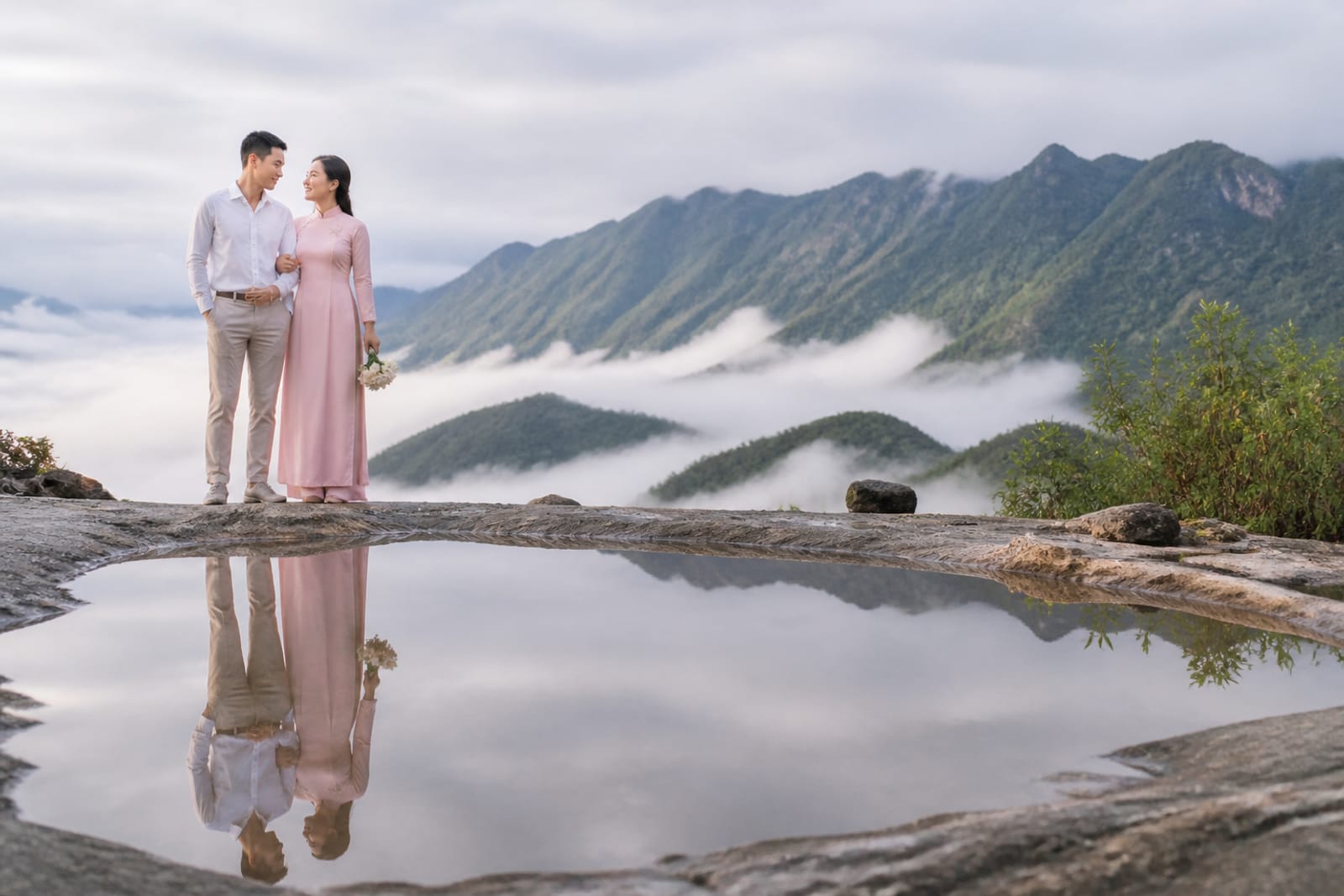
Wide shots (the iconic valley backdrop): You appear small against the terraced hills. Details of your outfit matter less; flow and silhouette matter most. An ao dai's tunic catches wind and reads as elegant movement even from 30 meters away. A gown's bulk reads as static weight. If your shot list is 70% wide, wear an ao dai or a simple, tailored gown (A-line, no train). Baggy fabric or oversized tulle will blob into the landscape.
Medium shots (walking, interaction): The photographer frames you from the thighs up. Outfit texture, colour and how you move become the story. An ao dai's fitted tunic and the way it moves with your legs creates kinetic frames—the photographer catches you mid-stride, and the tunic ripples naturally. A gown demands a slower walk; tulle and beading read as formal even when moving casually. If your shot list is 70% medium, wear something that photographs well at chest-and-face level and doesn't restrict your gait.
Detail shots (rings, flowers, faces, earth underfoot): Extreme close-ups of hands, rings, your partner's shoulders, or your feet on a paddy stone. Outfit colour and texture fill the frame. Jewel tones (deep green, burgundy, navy) in an ao dai are striking in close detail. Blush or champagne-coloured gowns can fade into the sky. Mud splashes on a hem photograph as authentic, not sloppy, in a documentary frame. If your shot list is 70% detail, wear something with colour and texture that looks intentional, not accidental, in a 12-inch-tall crop.
Ask your photographer early: "What's the ratio—60% wide, 20% medium, 20% detail?" or similar. This drives your outfit choice.
🌸 See real couples and shot styles in our lookbook
What to Check Before You Book a Muong Hoa Photoshoot
Before signing a contract or paying a deposit, confirm these logistics in writing (or on WhatsApp if your photographer prefers):
- Outfit inclusion: Does the quote include ao dai rental, makeup, hair, and footwear? Or are you renting separately? (Cáo Studio coordinates these; ask on WhatsApp for exact inclusions.)
- Seasons and light: Confirm your shoot date and ask the photographer for a honest forecast—is fog normal that week? What time do they recommend starting? What's the backup weather plan?
- Walking vs. stationary: Ask if the shoot involves walking the full valley or staying in one scenic zone. This changes outfit choice and shoe needs.
- Photo count and edits: How many edited photos do you receive? When? (Cáo Studio delivers in 48 hours; local Sapa photographers may take 3–7 days.)
- Reschedule or refund: If weather cancels the shoot, can you reschedule free, or do you lose the deposit?
- Permissions and access: Does the photographer have access to shoot inside the paddies, or are you shooting from a roadside viewpoint? (Some sections of Muong Hoa require local guides or have restricted hours.)
---
Booking a Muong Hoa shoot? Start here:
📸 Book on WhatsApp — pre-wedding & elopement
For a shoot in Muong Hoa valley with a full team (makeup, hair, outfit coordination, photography), explore Cáo Studio's pre-wedding packages and reach out on WhatsApp to confirm Sapa travel dates and pricing factors.
For a local Sapa photographer, gather portfolios from 3–5 options, ask the vetting questions above, and confirm in writing before paying a deposit. If fog or rain cancels your shot, a local photographer with a strong backup plan will be your safest bet.
---
FAQ
Is an ao dai better than a wedding gown for Muong Hoa valley?
Ao dai moves freely on muddy paddy paths and handles cold mountain air with natural layering. A gown works for stationary or close-up shots but is heavy, mud-prone, and uncomfortable for walking. Choose ao dai if your shot list includes 50%+ walking frames; choose a gown if you want formality and will pose in one or two dry spots.
When is the best season to shoot at Muong Hoa valley?
March–May and September–November offer the clearest mornings and driest paths. Dec–Feb is cold and fog-heavy; Jun–Aug risks afternoon rain and humidity. Mar–May and Sep–Nov (especially Sep–early Oct for harvest colour) are ideal, but book at least 4 weeks ahead as these are peak seasons.
Can I wear a train or veil at Muong Hoa?
Veils catch wind and mud easily; trains drag and require a second person to manage. If you want either, plan stationary shots only (near the paddy entry) and confirm your photographer can position you safely without the fabric sliding downhill. Most couples choose to skip both for valley walks.
Should I hire a local Sapa photographer or bring a team from Hanoi?
A local Sapa photographer knows the light and paddies intimately and costs less; vet their portfolio carefully for your style. Bringing a full team (makeup, hair, photography) means one message and no vendor coordination, but requires early booking and travel time. Ask local photographers for references and unedited samples to compare.
What shoes should I wear, and when do I change into formal footwear?
Wear flat shoes (leather flats, ballet pointes, or grippy sandals) for walking muddy paths. For posed or detail shots on a dry, level spot, change into heeled or formal shoes (the photographer will pause while you change). Bring both pairs in a small bag; some couples even go barefoot for close-ups on paddy stones.
How long does a Muong Hoa photoshoot take, and how should I prepare the morning-of?
A full shoot (entry, walk, 3 scenic spots, return) takes 2–3 hours. Plan to wake 2 hours before start time for makeup, hair, and outfit fitting. Eat a light breakfast to steady your energy for walking. Bring water, a small towel, and bug spray. Confirm your start time the evening before, and set your alarm for sunrise light (typically 6–6:30 am in Mar–May, 5:30–6 am in Sep–Oct). ===INTERNAL LINKS CHECKLIST=== ✓ ao dai rentals and pre-wedding packages ✓ makeup & hair at your hotel ✓ Cáo Studio's pre-wedding packages ✓ wedding dress rental ✓ See real couples and shot styles in our lookbook ✓ ask Cáo Studio on WhatsApp about Sapa travel availability ===CTA BUTTONS (verbatim)=== 📸 Book on WhatsApp — ao dai photoshoot 💄 Makeup & hair at your hotel 🌸 Ideas & lookbook 📸 Book on WhatsApp — pre-wedding & elopement
Mga karaniwang tanong
Is an ao dai better than a wedding gown for Muong Hoa valley?
Ao dai moves freely on muddy paddy paths and handles cold mountain air with natural layering. A gown works for stationary or close-up shots but is heavy, mud-prone, and uncomfortable for walking. Choose ao dai if your shot list includes 50%+ walking frames; choose a gown if you want formality and will pose in one or two dry spots.
When is the best season to shoot at Muong Hoa valley?
March–May and September–November offer the clearest mornings and driest paths. Dec–Feb is cold and fog-heavy; Jun–Aug risks afternoon rain and humidity. Mar–May and Sep–Nov (especially Sep–early Oct for harvest colour) are ideal, but book at least 4 weeks ahead as these are peak seasons.
Can I wear a train or veil at Muong Hoa?
Veils catch wind and mud easily; trains drag and require a second person to manage. If you want either, plan stationary shots only (near the paddy entry) and confirm your photographer can position you safely without the fabric sliding downhill. Most couples choose to skip both for valley walks.
Should I hire a local Sapa photographer or bring a team from Hanoi?
A local Sapa photographer knows the light and paddies intimately and costs less; vet their portfolio carefully for your style. Bringing a full team (makeup, hair, photography) means one message and no vendor coordination, but requires early booking and travel time. Ask local photographers for references and unedited samples to compare.
What shoes should I wear, and when do I change into formal footwear?
Wear flat shoes (leather flats, ballet pointes, or grippy sandals) for walking muddy paths. For posed or detail shots on a dry, level spot, change into heeled or formal shoes (the photographer will pause while you change). Bring both pairs in a small bag; some couples even go barefoot for close-ups on paddy stones.
How long does a Muong Hoa photoshoot take, and how should I prepare the morning-of?
A full shoot (entry, walk, 3 scenic spots, return) takes 2–3 hours. Plan to wake 2 hours before start time for makeup, hair, and outfit fitting. Eat a light breakfast to steady your energy for walking. Bring water, a small towel, and bug spray. Confirm your start time the evening before, and set your alarm for sunrise light (typically 6–6:30 am in Mar–May, 5:30–6 am in Sep–Oct). ===INTERNAL LINKS CHECKLIST=== ✓ [ao dai rentals and pre-wedding packages](/fil/ao-dai-rental) ✓ [makeup & hair at your hotel](/fil/makeup-and-hair) ✓ [Cáo Studio's pre-wedding packages](/fil/pre-wedding-photoshoot) ✓ [wedding dress rental](/fil/wedding-dress-rental) ✓ [See real couples and shot styles in our lookbook](/fil/lookbook) ✓ [ask Cáo Studio on WhatsApp about Sapa travel availability](/fil/pre-wedding-photoshoot) ===CTA BUTTONS (verbatim)=== [📸 Book on WhatsApp — ao dai photoshoot](https://wa.me/84338762340) [💄 Makeup & hair at your hotel](/fil/makeup-and-hair) [🌸 Ideas & lookbook](/fil/lookbook) [📸 Book on WhatsApp — pre-wedding & elopement](https://wa.me/84338762340)